CUPERTINO — In a move that signals a potential seismic shift in the semiconductor landscape and a departure from its decade-long trajectory of vertical integration, Apple Inc. is reportedly evaluating the integration of processors from long-time rivals Intel Corp. and Samsung Electronics Co. into its future hardware lineup. According to sources familiar with the matter speaking to Bloomberg Tech, the Silicon Valley giant is in the preliminary stages of exploring a hybrid silicon strategy that would see its proprietary M-series and A-series chips working alongside components manufactured by outside firms. This pivot comes at a time when the global demand for specialized artificial intelligence processing and advanced node manufacturing has placed unprecedented strain on even the world’s most sophisticated supply chains.
For years, Apple’s transition away from Intel to its own "Apple Silicon" was hailed as a masterstroke of engineering and corporate independence, providing the company with total control over its product roadmaps and industry-leading performance-per-watt metrics. However, the current technological climate is evolving at a pace that is testing the limits of single-vendor dependency. As Apple prepares to launch more ambitious generative AI features across its ecosystem, the raw computational requirements are skyrocketing. Analysts suggest that while Apple’s internal designs remain top-tier, the sheer volume of high-end silicon required for its global fleet of devices, combined with the complexities of moving to 2-nanometer and 1.4-nanometer processes, may be forcing a strategic diversification.
The consideration of Intel represents a particularly ironic twist in the tech industry’s ongoing narrative. Since losing Apple as a client in 2020, Intel has undergone a massive structural overhaul under CEO Pat Gelsinger, pouring billions into its "IDM 2.0" strategy to become a premier foundry for other designers. By opening its doors to external clients through Intel Foundry Services, Intel has aimed to recapture the crown in transistor density and packaging technology. If Apple were to return to the Intel fold—not necessarily for the primary CPU, but perhaps for specialized accelerators or high-performance server chips for its data centers—it would serve as the ultimate validation of Intel’s turnaround efforts and provide a massive boost to the American semiconductor manufacturing base.
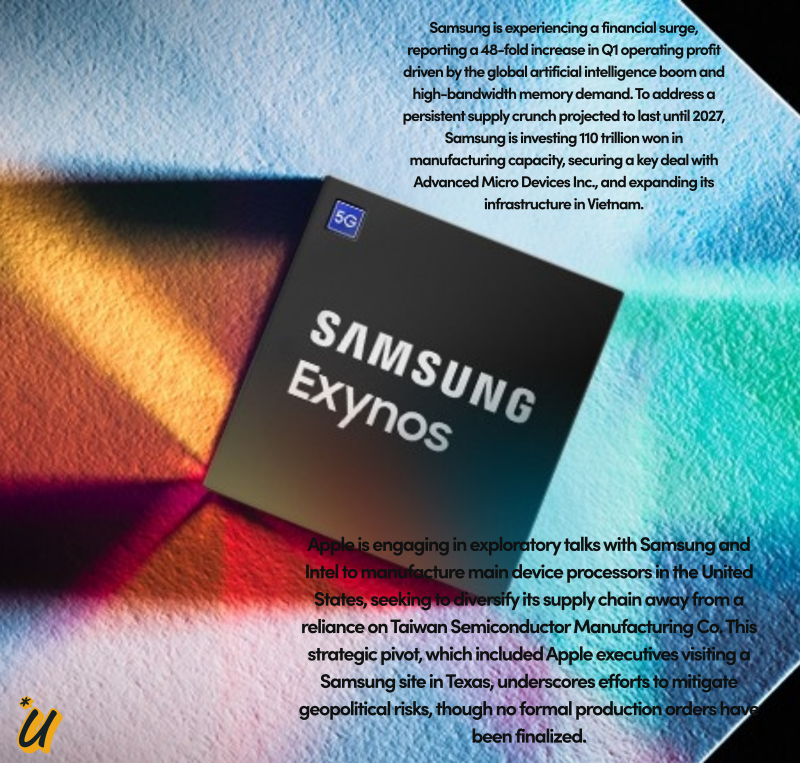
Simultaneously, the exploration of Samsung’s processor capabilities highlights the complex "frenemy" relationship between the two mobile titans. While Apple and Samsung compete fiercely in the smartphone and tablet markets, they remain deeply intertwined through display and memory supply chains. Samsung’s recent breakthroughs in Gate-All-Around (GAA) transistor architecture have reportedly caught the eye of Apple’s hardware engineering team. As the physical limits of traditional FinFET transistors are reached, Samsung’s early adoption of GAA technology offers potential efficiency gains that Apple may find too significant to ignore, especially as it seeks to maintain its lead in the high-stakes arms race of mobile processing power.
Industry experts believe this move is less an admission of failure in Apple's internal chip division and more a pragmatic evolution of its procurement strategy. By utilizing a multi-vendor approach, Apple gains significant leverage in price negotiations and insulates itself against geopolitical risks or manufacturing delays at any single foundry, such as TSMC. Furthermore, as the industry moves toward "chiplet" designs—where multiple smaller chips are packaged together rather than one massive monolithic die—it becomes technically feasible for Apple to house its own proprietary neural engines alongside an Intel-made connectivity module or a Samsung-fabricated graphics component.
The financial implications of such a shift are profound. Apple’s R&D spending has ballooned as it chases the leading edge of silicon design, and sharing some of that burden with partners like Intel and Samsung could allow the company to reallocate resources toward software and services. For Intel and Samsung, securing even a fraction of Apple’s silicon business would mean billions in guaranteed revenue and a shared roadmap with the world's most influential consumer electronics brand. As of Tuesday, shares in both Intel and Samsung saw a notable uptick on the news, while Apple remained steady, reflecting investor confidence in a more flexible, resilient supply chain.
While no final contracts have been signed and the timeline for such products remains fluid, the fact that Apple is even entertaining these discussions marks the end of an era of absolute silicon isolationism. As the world enters a new age of computing defined by pervasive AI and increasingly difficult physics, even a titan like Apple appears to be realizing that the next decade of innovation may require a more collaborative approach. For consumers, this could mean a future where the sleek glass and aluminum of an iPhone or Mac houses a global coalition of the world’s most advanced processing technologies, all optimized under the singular vision of Cupertino’s designers.