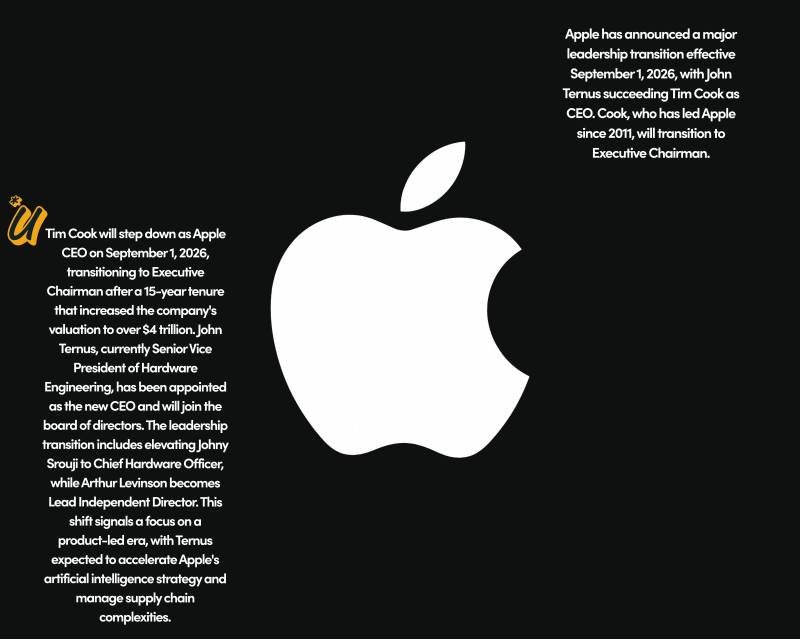
CUPERTINO - The following report details the landmark leadership transition at Apple Inc., synthesizing the strategic implications of the appointment of John Ternus and the shift in Tim Cook’s responsibilities within the global tech landscape. This move that marks the end of an era and the beginning of a meticulously choreographed new chapter, Apple Inc. announced today that Tim Cook will formally step down as Chief Executive Officer on September 1, 2026. The transition, while long the subject of speculation among Silicon Valley insiders and Wall Street analysts, signals a profound shift in the governance of the world’s most influential technology company. Cook will not be leaving the Cupertino campus entirely; instead, he will transition into the role of Executive Chairman, a position designed to leverage his unprecedented diplomatic cachet. Succeeding him in the CEO seat is John Ternus, the company’s current Senior Vice President of Hardware Engineering and a 25-year veteran of the firm.
The selection of Ternus is a definitive statement of intent by Apple’s Board of Directors. By elevating a "hardware guy" to the highest office, the company is doubling down on its identity as a premier engineering powerhouse. Ternus, who has overseen the development of every generation of iPhone, iPad, and the transition to Apple Silicon, represents a commitment to strategic continuity. His deep roots in the company’s product development cycles suggest that Apple has no intention of pivoting away from the tight integration of hardware and software that defined the Cook and Jobs eras. Analysts believe that Ternus is the personification of Apple’s core product ecosystem, offering a steady hand to maintain the engineering excellence that consumers have come to expect.
However, the transition also recognizes that the modern CEO of a trillion-dollar company must be more than just a product visionary or an operations expert; they must be a diplomat. This is where Tim Cook’s new role as Executive Chairman becomes critical. In recent years, Cook has become Apple’s primary envoy to the world’s most powerful political figures. As he moves away from the day-to-day minutiae of corporate management, Cook is expected to focus almost exclusively on navigating the increasingly treacherous waters of global policy. His primary mission will be managing the vital and often volatile relationship between the United States and China. Given Apple’s heavy reliance on Chinese manufacturing and its significant consumer base in the region, Cook’s ability to maintain a stable geopolitical environment is seen as essential to the company’s long-term survival.
Despite the logic behind the succession plan, the financial markets greeted the news with a palpable sense of reservation. While the transition was not entirely a surprise to those who follow Apple closely, the reality of a post-Cook era led to immediate market caution. Apple’s stock underperformed in the hours following the announcement as investors began the process of digesting what the change would mean for the company's fiscal discipline. Tim Cook’s tenure was defined by a massive expansion of services and a masterclass in supply chain efficiency that yielded record-breaking profits and stock buybacks. The "Cook Premium" that investors have enjoyed for over a decade is now being re-evaluated under the lens of a Ternus leadership.
The challenges facing Ternus are as significant as the legacy he inherits. The next decade of consumer technology is expected to be defined by the seamless integration of Artificial Intelligence and the birth of new product categories that can move the needle for a company of Apple’s scale. Ternus will be tasked with driving this next wave of innovation, with industry experts pointing toward the long-rumored development of foldable devices and the deeper embedding of generative AI across the Apple ecosystem as his first major tests. He must prove that Apple can still surprise and delight a market that has grown accustomed to incremental updates.
Fortunately for the incoming CEO, he takes the helm of a company that remains in an enviable position of strength. Apple’s supply chain management, refined by Cook into the most sophisticated logistics machine in history, provides a formidable moat against competitors. Furthermore, the brand's consumer loyalty remains at historic highs, providing a reliable buffer as Ternus implements his vision. While the market may be hesitant in the short term, the internal consensus at Cupertino appears to be one of confidence. By keeping Cook in a strategic diplomatic role and placing a seasoned engineer at the top of the executive masthead, Apple is attempting to balance the need for fresh innovation with the requirement for absolute operational stability. As September 1 approaches, the tech world will be watching closely to see if this transition can preserve the unique alchemy that has made Apple a global titan.