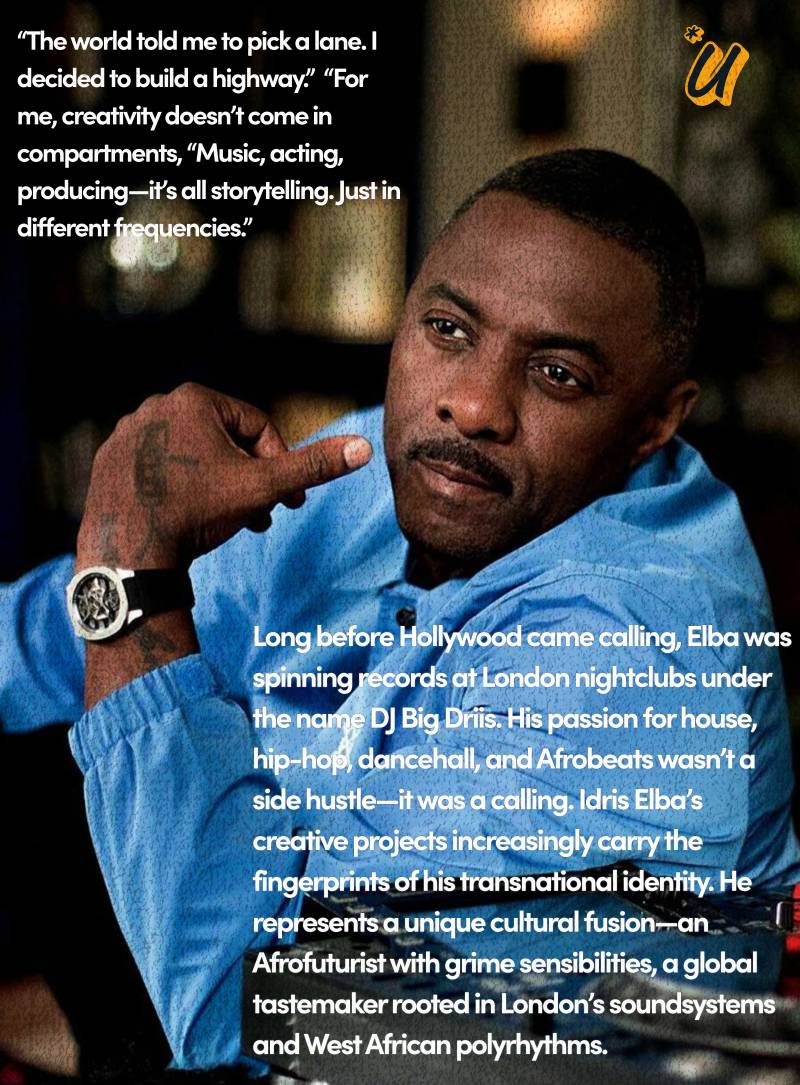
Some people enter a room, and the air shifts. Not because they’re loud or demanding, but because they carry something the rest of us spend lifetimes trying to find, an ease, a rhythm, a steeze. Idris Elba has that. Effortlessly. It’s not just the voice, the stature, or the catalogue of characters he's embodied on screen. It's the fact that no matter what space he enters, whether a DJ booth in Ibiza or a gritty London film set, he doesn’t become part of the atmosphere. He is the atmosphere.
In the latest episode of Steeze Factory, Elba sits with Toddla T, not to perform, but to explore. And that’s where the gold lies. They talk music, film, culture, but what unravels in between is a deeper story. A story of a man who has mastered the art of moving through spaces that were never built with him in mind, and making them his own.
Elba doesn’t wear his Britishness like a badge; it’s stitched into him. The London twang, the East End grit, the Caribbean heritage, the global presence. He’s a son of Hackney, yet somehow belongs everywhere. And this has always been his gift. He made Stringer Bell, a Baltimore drug lord in The Wire, so convincing that Americans were shocked to learn the accent was borrowed. Then he turned around and became Nelson Mandela, channeling gravitas through restraint. From Luther to Beasts of No Nation, to spinning house tracks in Ibiza under the name DJ Big Driis, Idris Elba has become a master of duality.

Steeze Factory – Idris Elba
Related article - Uphorial Podcast

But there’s a moment in the Steeze Factory episode, almost easy to miss, when he speaks about rhythm and identity. He talks about how music grounds him, how sound is a way to return to himself when the world demands a version that isn’t always whole. You can hear it in the bass of his words, the pauses between thoughts. It’s not just about entertainment. It’s about staying rooted in a world that often pulls you in too many directions.
Elba isn’t just a celebrity. He’s become a cultural translator. A bridge between generations, between genres, between continents. Young Black boys in London see in him what wasn’t always visible growing up: possibility. A seat at the table. Or, better yet, the option to build your own. And while many wear fame like a costume, Elba moves with something closer to purpose. Whether it’s launching campaigns for diversity in film, producing African stories, or DJing with unfiltered joy, he carries culture like a second skin. It’s not performative. It’s lived.
There’s something timeless about Elba, but not in the way we typically think of “timeless.” He isn’t trying to resist age or trends. Instead, he evolves with intention. The man who once fought aliens in Pacific Rim is now championing African creators through his production company, Green Door Pictures. The boy from East London who once had to “act more Black” to get roles is now the one defining what Blackness looks like in global media.
So when he walks into the Steeze Factory, it’s not about showing off style or swagger. It’s about telling a story. Not of success, but of staying true. And that, more than anything, is the lesson. Steeze isn’t in the clothes, or the roles, or the beats. It’s in the authenticity. In a world desperate for the next big thing, Idris Elba reminds us that longevity is the real flex. That versatility isn’t about doing everything, but doing what matters. That culture is not a trend, it’s a lifeline. And as the music fades and the episode ends, one truth lingers: You can’t fake steeze. And Idris Elba doesn’t need to. He is the steeze.