The landscape of immigration enforcement in the United States has undergone a radical transformation, characterized by a massive surge in arrests and detention capacity, according to Vittoria Elliot in a detailed analysis for the WIRED series "On the Grid". Since January, Immigration and Customs Enforcement (ICE) has executed over 100,000 arrests, a figure that is double the number compared to the previous year, leaving more than 60,000 migrants currently in detention. This intensive focus has made immigration enforcement the centerpiece of the Trump administration.
The data tracked by WIRED reveals the magnitude of the increase: from January to June 2024, under former President Joe Biden, ICE conducted about 49,000 arrests; in the same time frame in 2025, under President Trump, the number of arrests surged by approximately 122%. The White House has set an internal quota of 3,000 arrests per day, and ICE's budget has ballooned to $170 billion, with plans underway to nearly double its enforcement force to about 20,000 personnel.
Geographically, the enforcement effort is highly concentrated. Texas leads the nation, accounting for about 23.2% of all arrests nationwide, followed by Florida (11%), California (7%), Georgia (4%), and Arizona (3%).
A defining moment in this escalation occurred the day the current president took office, when a policy protecting sensitive locations—including schools, hospitals, churches, and courthouses—was scrapped. ICE can now operate in virtually any public space, making everywhere "fair game". This new operational freedom has led to frequent incidents of ICE agents operating at courthouses, such as 26 Federal Plaza in New York City, waiting to arrest migrants as they exit hearings. This creates a "catch 22" situation: attending a hearing risks arrest, while skipping it risks deportation.

Related article - Uphorial Radio
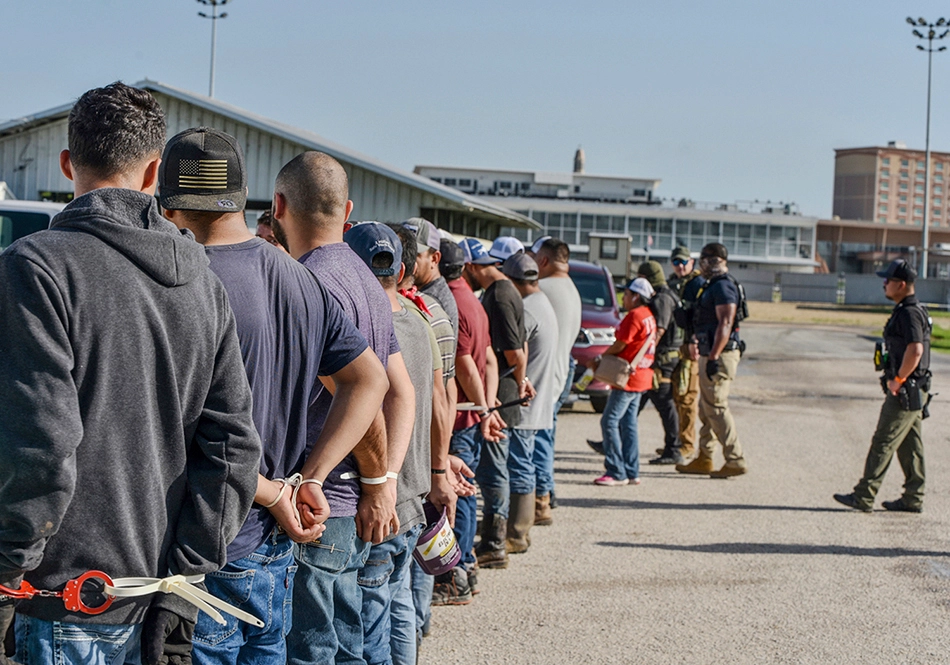
Worksite raids are also at an "all-time high," including a significant operation at a Hyundai plant in Elabel, Georgia, where many South Korean individuals were arrested, causing a diplomatic crisis, particularly because most of the detained workers were not in the country illegally. The industry hardest hit by the chilling effect of these raids is construction, followed by food services, waste management, manufacturing, agriculture, healthcare, transportation, warehousing, and educational services.
The economic consequences of this aggressive enforcement are already being felt. For example, in Mobile, Alabama, fears of an imminent raid at a construction site reportedly caused roughly half the workforce to stay home, delaying the completion of an 84,000 square foot recreation center. The agriculture industry, especially in California—which grows about a third of America's vegetables and three-quarters of its fruits and relies on undocumented labor for roughly half its farm workers—is heavily impacted. A recent study estimated that reducing the agricultural workforce by 20% to 40% would result in an estimated $3 billion to $7 billion in lost crops and drive produce prices up by 5% to 12%.
Post-arrest, migrants are processed before being detained. ICE is aggressively doubling its detention capacity, aiming for more than 107,000 detainees across 125 facilities. The bulk of this expansion is concentrated in Texas, California, Georgia, and Louisiana. The vast majority of people held in ICE detention are housed in facilities owned or operated by private prison companies like GEO Group or Core Civic, indicating that "business is booming". Texas currently holds the most detainees—over 13,000 as of August 18th—followed by Louisiana, which contains the Gulf Coast area nicknamed "Detention Alley," home to 14 of the nation's 20 largest immigration detention centers. Facilities like the Moshannon Valley Processing Center in Pennsylvania have faced calls to end contracts following the death of a Chinese detainee. Even the US military prison at Guantanamo Bay Naval Base in Cuba is holding 72 immigrant detainees. Alarmingly, as of August 24th, 2025, nearly 70.3% of the more than 60,000 people in ICE detention had no criminal conviction.
The surge in deportations is equally dramatic, putting the current administration on track for the highest level of formal deportations in a decade. ICE has deported nearly 200,000 people since the administration returned to office, augmented by almost 150,000 more deportations from US Customs and Border Protection. Between January 20th and August 31st, 2025, the administration carried out at least 7,454 deportation flights, with many directed to Central America’s Northern Triangle (El Salvador, Guatemala, and Honduras). This includes controversial "third country deportations" to places like El Salvador’s notorious mega prison, Scott, following a multi-million-dollar deal. The deployment of massive money and manpower into ICE and DHS is radically changing enforcement, a change Vittoria Elliot warns will not only be felt by immigrant populations but will "reshape this country for all of us" through increased surveillance, restrictions on government services, and the weaponization of public figures' immigration status.