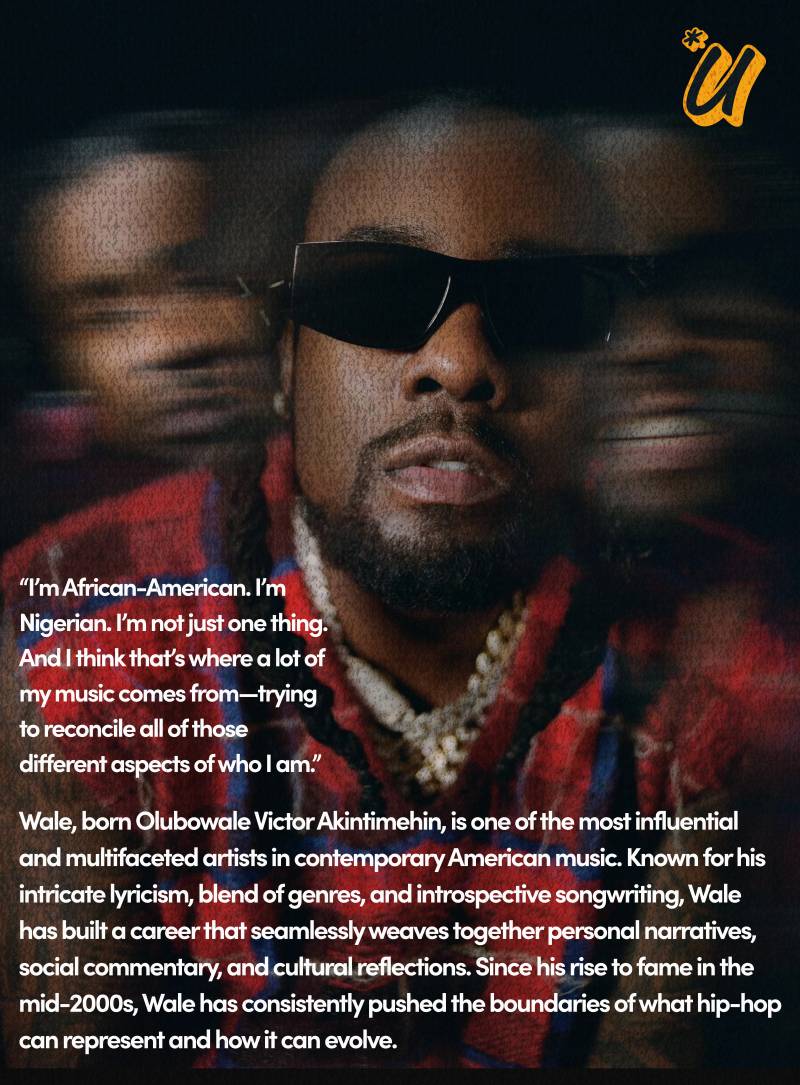
Some artists carry the burden of brilliance like a badge; others drag it like chains. Olubowale Victor Akintimehin, better known as Wale, lives in that complicated middle. An enigma in sneakers and poetry, Wale has always been the artist you couldn’t quite define—a rapper’s rapper with the soul of a poet, a Nigerian-American carrying both cultural pride and industry scars.
In his recent interview with Complex, Wale pulled back the curtain on a truth he rarely shares: he has felt overlooked, even discarded, by an industry he helped shift. The conversation wasn’t another routine press tour—it was a raw, unfiltered stream of consciousness from a man who has spent the past decade building a career most would envy, while privately wrestling with validation, vulnerability, and the pressure of being seen only through a commercial lens.
But before the accolades and frustrations, there was the hunger. Born to Nigerian immigrant parents in Washington, D.C., Wale didn’t come from privilege, but he came with pressure—the kind every first-generation child knows intimately. He played football, transferred colleges, and eventually dropped out to chase music. But his first real breakthrough came not from radio or industry cosigns—it came from the internet.
Related article - Uphorial Podcast

Wale was one of the earliest adopters of the blog era grind. While major artists clung to radio spins, Wale was flooding DatPiff, IllRoots, and 2DopeBoyz with mixtapes like The Mixtape About Nothing—a Seinfeld-inspired project that fused comedy, introspection, and biting cultural commentary. It was witty, unpredictable, and genre-defying. And it worked. The industry couldn’t ignore him anymore. By the time Attention Deficit dropped in 2009, Wale had the respect of Jay-Z, Lady Gaga on a hook, and a cult following that believed they had found hip-hop’s next intellectual heavyweight. But mainstream success didn’t match the momentum. Sales lagged. Critics were lukewarm. And Wale felt the sting of being almost—almost there, almost accepted, almost enough.
Then came MMG. Rick Ross signed Wale in 2011, and everything changed. Ambition arrived like a storm—“Lotus Flower Bomb” went platinum, and suddenly, Wale was charting. The MMG era gave Wale the street weight and swagger he needed to break through. But with that came tension. Wale had to constantly balance lyrical depth with club bangers, vulnerability with bravado. For a man who once wrote spoken-word pieces about self-worth and social injustice, it was a tightrope walk.
And now, over a decade later, Wale is back. Not with a single, but with something to say. The Complex interview wasn’t just reflective—it was a warning. He’s done with the chase. "I was the most hated. I was the most underrated. I was the most complicated," he said. And it’s true. Wale has often been caught in the limbo of being too mainstream for the backpackers and too lyrical for the mainstream. He spoke of battling depression, of being ignored when others were celebrated for sounds he pioneered. He hinted at an industry that praises you when you’re trending and forgets you when you’re feeling. Wale’s story isn’t just one of music—it’s one of mental health, of resilience, of a man who never stopped believing in his worth even when everyone else did.
But make no mistake—Wale is not asking for your sympathy. He’s reclaiming his narrative. The Complex interview is just a preview of the Wale that’s about to reemerge: seasoned, self-aware, and unwilling to let the industry shrink his legacy. In 2025, with a new project on the horizon and his head clear, Wale isn’t just back—he’s better. Not because he reinvented himself, but because he finally accepted the parts of himself that the world tried to suppress. The sensitivity. The stubbornness. The seclusion. The genius. And maybe that’s the story after all—not of a comeback, but of a man who never left. A poet in a rapper’s game. A soul who raps not for fame, but to feel seen.