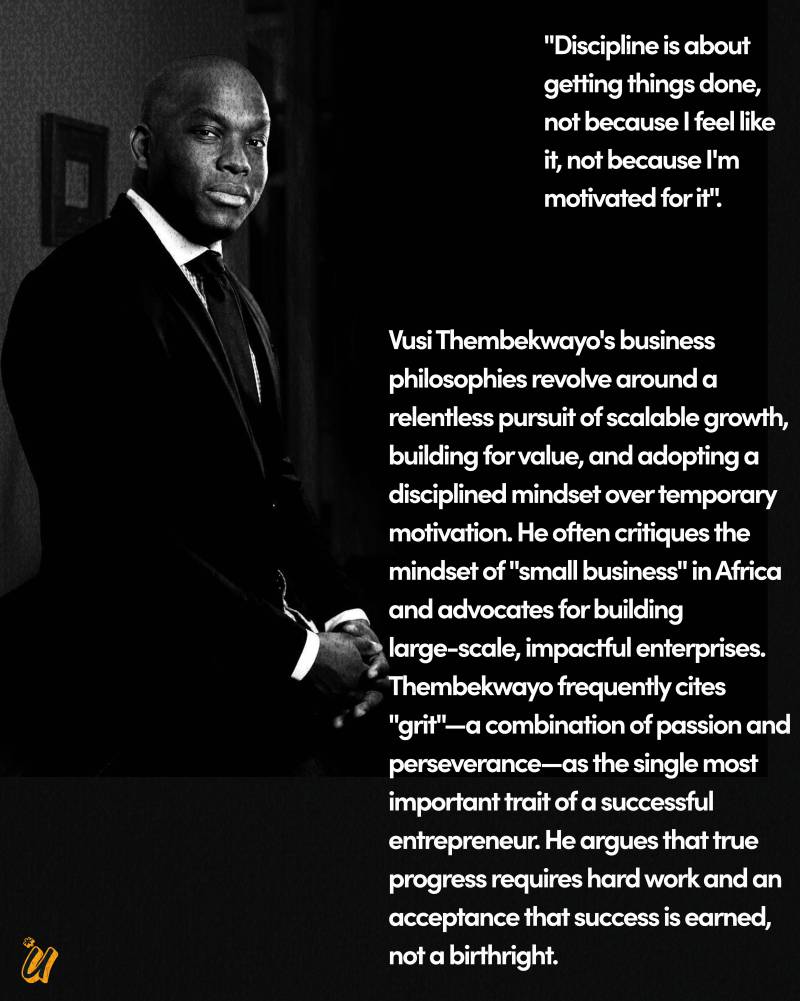
World-renowned entrepreneur and speaker Vusi Thembekwayo sat down with the Afropolitan show to deliver a profound and unfiltered discussion on the costs of audacious African entrepreneurship, the trauma inflicted by poverty, and the complex geopolitical dynamics shaping the continent’s future. Born in 1985, Thembekwayo is a first-generation Black South African who grew up during apartheid, an experience that informs his relentless drive today.
During the Afropolitan show, Thembekwayo reassured African entrepreneurs that building a business on the continent is "the easiest now it has ever been," despite common challenges such as shallow debt capital markets, foreign exchange issues, and policymakers who don't understand their work. He asserted that these are mere "exceptions" that do not disprove the rule of increased opportunity. He highlighted that the online sector is currently skyrocketing, in part because Africans in different parts of the world can make a difference in the online space without having to leave their lives behind. Thembekwayo himself has long found a home online, preferring a space where he can self-express without needing permission from the "gatekeepers" of traditional media.
Thembekwayo shared a deeply personal cost of his path: the strain on his relationship with his mother, who perceived his decision to start a business as "throwing away everything". His mother's entire working life was structured by apartheid, which bred Black people to become "labor foder in the factories". For his parents' generation, the goal of sacrifice was for their children to get the best education, secure high corporate positions, and build generational wealth through guaranteed salary and pension contributions, not to face the higher risk-reward metric of starting a business. It took about 10 years to attempt to rebuild their relationship, a process that required him to see his mother as an "independent human being" first, and his mother second.

Related article - Uphorial Shopify
Vusi Thembekwayo: The Truth About Money, His Traumas, and Building

He also revealed an unresolved childhood trauma that continues to drive him: witnessing his father’s business fail, which led to the bank repossessing the family car and then the house, forcing them to move into his grandfather’s four-room house. This period, during which his father ate only one meal a day, etched in his mind the belief that "business equals risk equals suffering". Thembekwayo explained to the Afropolitan audience that a critical miscalculation people make about poverty is failing to recognize the "trauma of poverty," which "etches itself in your mind and it forms your world view," creating "limiting foundational beliefs" passed down through generations. He believes shifting these foundational beliefs could unlock 50% of the long-term institutional capital not invested in Africa.
Regarding career parity, Thembekwayo confirmed the widely held belief that Africans often earn 30 to 35% less than their American or European counterparts for the same work. He stated his strategy for overcoming this disparity is to "fight for my seat at the table and then I fight for the price of that seat," before ensuring he is the best by stating, "Every single time I'm on the stage with them I kick their ass".
On the topic of investment, the entrepreneur advised founders to spend enough time learning the rules and investment mandates of the people they are raising money from, noting that simply blasting a mailer to 200 investors is insufficient in the era of AI-checked applications. He noted that South Africa is an outlier in Africa due to the prevalence of Corporate Venture Capital (CVC), driven by a law called Black Economic Empowerment. This law mandates that large companies spend 3% of their net operating profit developing small companies in their sector. Thembekwayo expressed a preference for zebras over unicorns, arguing that Africa needs to focus on building real businesses that create real jobs and add real value.
Thembekwayo reserved his harshest geopolitical critique for Elon Musk, whom he called a "hypocrite" whose god is "money". The friction involves Musk's refusal to comply with South Africa's Black Economic Empowerment law when attempting to launch Starlink, a law which Musk’s own father benefited from under apartheid. The law requires that if ownership cannot be offered to indigenous local people, an "ownership equivalent" must be run. Thembekwayo fiercely debunked the "white genocide" and "farm murder" narratives used to attack South Africa, calling them "intellectually dishonest". He concluded that Musk, with a "smidge of statesmanship," could offer a constructive playbook to African leaders instead of engaging in an "adversarial relationship[s] based and premised on a lie".
Finally, addressing the long-standing tension between South Africans and Nigerians, Thembekwayo provided historical context: after 300 years of colonization and apartheid, Black South Africans were at the "lowest rungs of society". The miracle of freedom in 1994 finally allowed Black South Africans to succeed legally, but the arrival of successful Nigerians shortly after created resentment rooted in the feeling of "can we just get a minute" after a long struggle. Nigerian viewers countered that they are fleeing survival conditions where the country has no government welfare. Thembekwayo agreed that the absence of a social welfare system in Nigeria, unlike the "very strong social welfare system" in South Africa (which includes grants for the unemployed, elderly, and single mothers), drives the aggressive survival mentality often seen from Nigerians. He concluded that if South Africa and Nigeria could work together, the collective leverage effect would "change the continent".