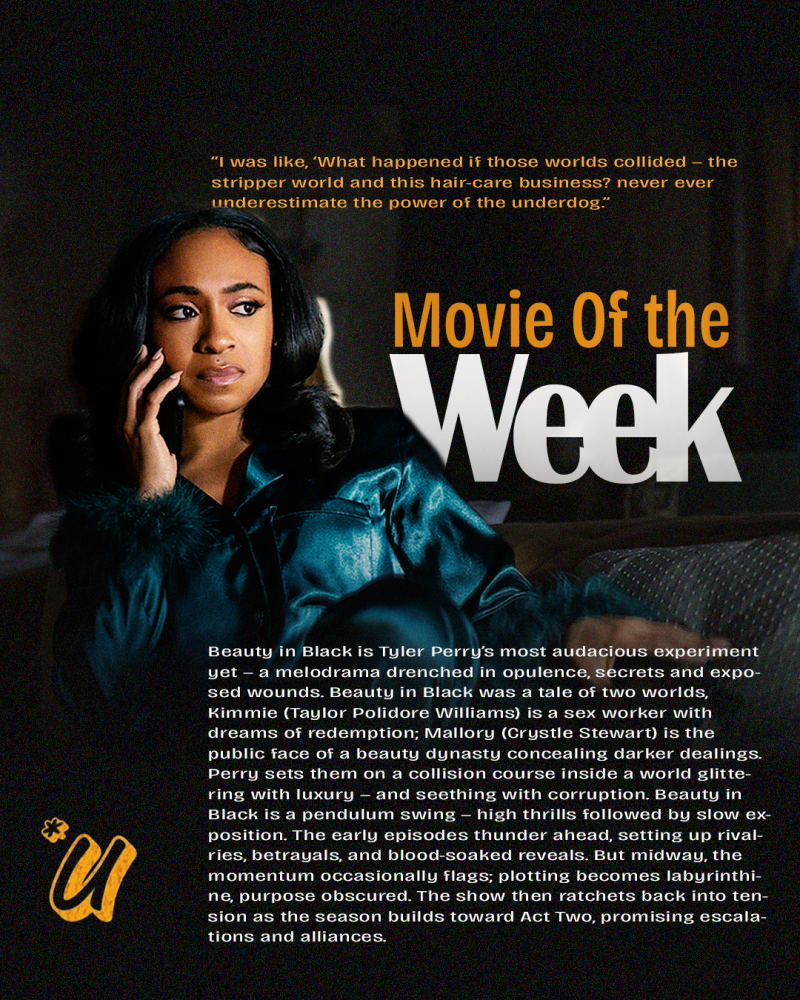
Beauty in Black is Tyler Perry’s most audacious experiment yet — a melodrama drenched in opulence, secrets, and exposed wounds. As Perry’s first major serialized drama for Netflix, it’s a bold pivot from his signature formula — but one that ignites both fascination and frustration in equal measure. At the heart of Beauty in Black lies a collision of two women and two destinies. Kimmie (Taylor Polidore Williams) is a sex worker with dreams of redemption; Mallory (Crystle Stewart) is the public face of a beauty dynasty concealing darker dealings. Perry sets them on a collision course inside a world glittering with luxury — and seething with corruption. From the pilot onward, Perry wastes no time. We are plunged into strip clubs, botched surgeries, illicit affairs, and a car crash that frames the show’s violent pulse. It’s a world unafraid to show its underbelly — sometimes to its detriment. As The Guardian’s reviewer put it, Beauty in Black is “proudly obscene and deliberately pornographic,” a series that tosses character nuance to the wind in favor of spectacle.
In reviews, critics and viewers are split. On Rotten Tomatoes, the show holds a middling score: praised by some for its energy, dismissed by others for a lack of depth. Rotten Tomatoes +1 Some see it as Perry’s best work yet; others see a descent into caricature. IMDb +1 Common Sense Media criticizes its “spotty pacing” and characters who “seem disoriented in their own actions.” Common Sense Media. One of Beauty in Black’s strongest cards is its visual ambition. The settings, costumes, and production value are slick — the kind of glossy veneer that makes the darkness underneath hit harder. The Guardian concedes: “The one thing Beauty in Black does have going for it is its high production values.”
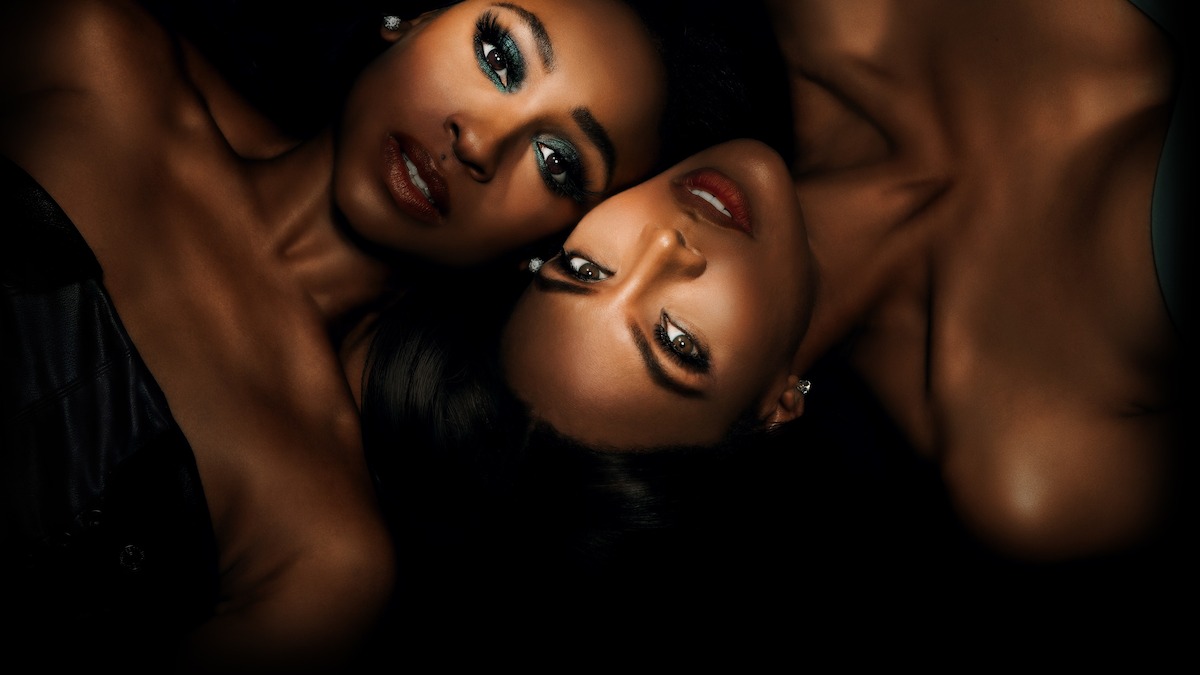
Tyler Perry’s Beauty in Black:
Related article - Uphorial Sweatshirt

Indeed, the world Perry builds is richly detailed — giving the show a cinematic sheen that pushes its soap-opera roots toward something more expansive. Equally bold is the show’s thematic ambition. Perry isn’t content to produce mere scandal — he aims to explore class, power, and identity. As People reports, though the show is set in Chicago, it was filmed largely in Atlanta. Perry told the outlet he envisioned a world where two distinct cultures — the strip club and the hair-care empire — collide. “I was like, ‘What happened if those worlds collided — the stripper world and this hair-care business?’” he said. People.com He adds that Beauty in Black is, at its heart, about underdogs: “never underestimate the power of the underdog.” People.com Perry also teases the next act: he promises a “mind-blowing” climb for Kimmie as the power balance tilts. People.com Netflix has since confirmed a second season, split into two parts, signaling faith in the story’s potential.
If the visuals seduce, the writing sometimes disappoints. Dialogue is frequently heavy-handed. Characters seem to explain motivations out loud rather than letting them emerge, as though Perry fears his audience might miss the point. The Guardian accuses the show of stretching setups that never pay off — scenes of smartphone-settings debate, illogical threats, dropped plot threads. The cast carries much of this weight, but the roles they inhabit strain under the script’s demands. Kimmie is burdened with redemption clichés; Mallory, ruthless to the point of caricature; nearly every character floats in extremes. Critics describe the characters as “one-dimensional” or “monsters,” lacking in empathy or complexity. Even with those flaws, some performances stand out — Stewart’s Mallory, for instance, earns nods for holding the center in a wildly shifting landscape. The show is also unflinching — sometimes gratuitously so — in its depictions of sex work, violence, and degradation. Common Sense Media warns of erotic content, threats, blood, and sexualized violence throughout.
For some, these elements underscore the world Perry wants to depict; for others, they eclipse any possible moral or emotional core. Perhaps most pointed is the critique from those who expected more from Perry. Some viewers accuse him of trading authenticity for exploitation. Stereotypes — of Black women, of power dynamics, of victimhood — surface periodically, triggering frustration among critics who hoped this would be Perry’s more mature era. Perry himself has long quarreled with being dismissed by what he calls “highbrow” critics. During a recent podcast appearance, he rebuked those who undermine his work, saying: “A large portion of my fans are disenfranchised … don’t discount these people and say their stories don’t matter.” That tension — between spectacle and substance, between mass appeal and critical respect — looms large in Beauty in Black. Watching Beauty in Black is a pendulum swing — high thrills followed by slow exposition. The early episodes thunder ahead, setting up rivalries, betrayals, and blood-soaked reveals. But midway, the momentum occasionally flags; plotting becomes labyrinthine, purpose obscured. The show then ratchets back into tension as the season builds toward Act Two, promising escalations and alliances. The trick Perry plays is in the contrast: he wants us dazzled, then unsettled; drawn in, then restless. Whether that rhythm works depends on how forgiving the viewer is of interim lulls or narrative inconsistency.
Beauty in Black is not a quietly confident piece of television. It is loud, overdone, overexposed — and often overreaching. But for better or worse, it's quintessential Tyler Perry in a new register: unapologetic, melodramatic, and craving conversation. Its greatest success is reminding us why we watch television to begin with: for worlds that thrill, characters whose secrets we yearn to decode, and stories that refuse to let us look away. Even when it missteps — or perhaps especially when it does — Beauty in Black stays visible, pulsating with ambition. Whether that ambition is fully realized is open to debate, but it’s a fascinating chapter in Perry’s evolution. In the end, Beauty in Black doesn’t always reward patience. But as an invitation — to shame, to struggle, to spectacle — it commands attention. And in the crowded streaming landscape, that may be enough.