The Baja people, renowned across the Philippines, Malaysia, and Indonesia for their ancestral connection to the sea, are legendary free divers, with some individuals rumored to hold their breath for over 13 minutes, a capability scientists speculate may be linked to evolved, larger spleens. However, their traditional world is facing severe pressure, forcing many families onto dry land where they struggle financially, often unable to afford basic necessities like food or medicine for sick children. Despite this widespread shift, the documentary maker Andrew Fraser journeyed deep into the south of Sulawesi to witness a Baja community still maintaining their ancient ways, sustained almost entirely by the octopus economy.
The community Fraser visited, located off Banggai Island, offers a stunning example of adaptation: a "floating village" where stilt houses are rendered more permanent by foundations of coral rock and stone. This construction allows the ocean to flow underneath, creating channels where residents maintain large travali ponds and even house wild turtles between their homes. The fishermen here rely on specialized, elaborate octopus lures, which Fraser described as "absolute works of art" and "crazy trippy" baits. The construction of these tools is an intricate process, beginning with grinding down a nail to serve as a makeshift hole punch. Beautiful tiger cowry shells form the base, which are then weighted by melting lead sheets over an open fire in a wok, pouring the molten metal directly into the shell cavity alongside collected bits of coral. Nylon line (thick mono) is threaded through holes punched in the shell, designed to imitate the legs of a lobster or crayfish. The lure is given "bling" by chopping up kitchen spoons to create makeshift metal flashers, which are rigged with wire and barrel swivels. Finally, hooks are secured to the mono legs with perfect knots tied with incredible speed. The resulting heavy lure is essential for punching through strong currents and bouncing along the productive reef bed.

Related article - Uphorial Radio
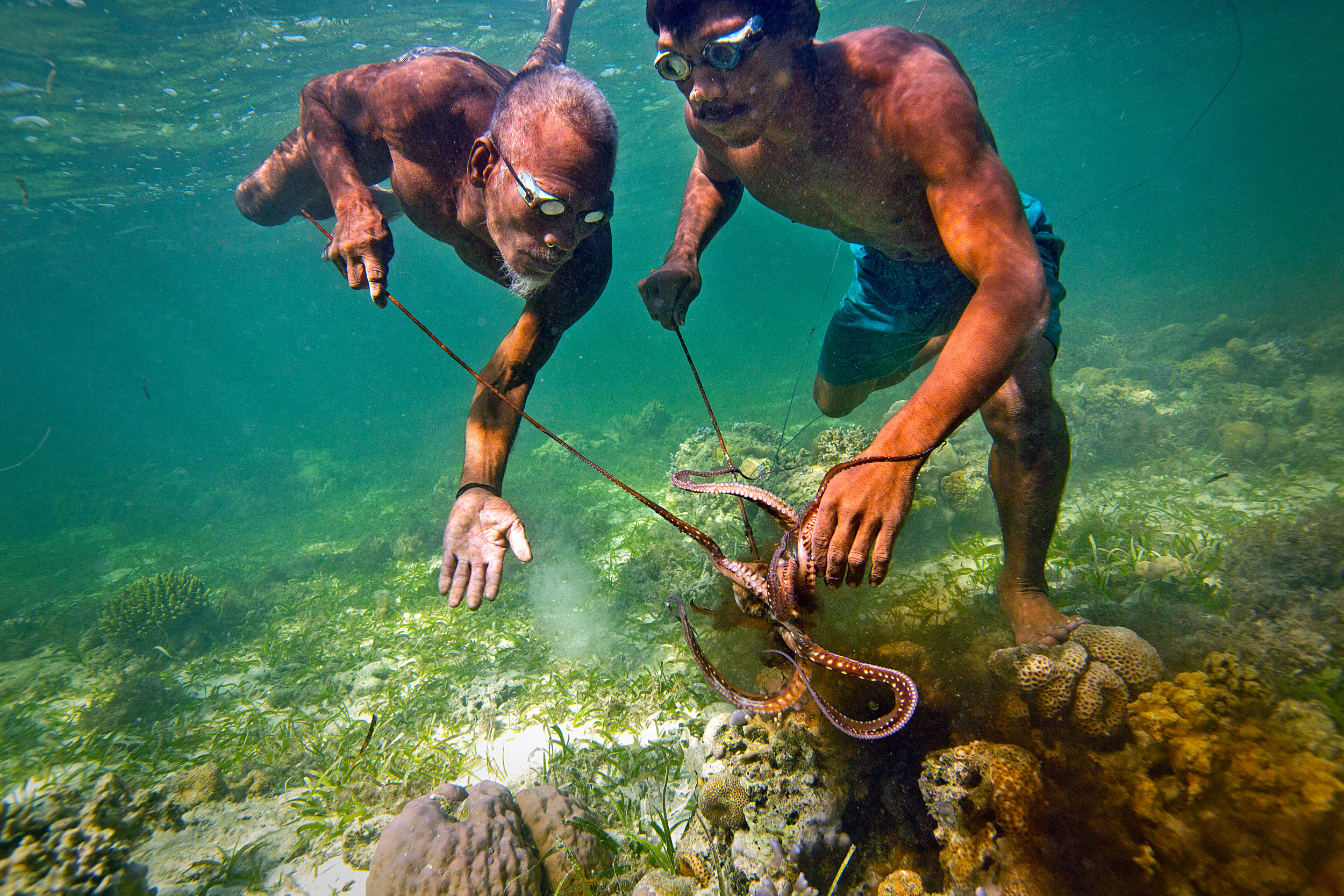
Fraser and his team set out on what was described as the village’s "finest boat". They quickly encountered other fishermen whose success underscored the vitality of the local ecosystem. Divers were reportedly catching two octopus in just an hour, with successful individuals sometimes hauling in more than 10 a day. The local market reflects this efficiency: catches are dropped off at a roadside stall, weighed, and cash is paid out immediately according to known market prices (which can reach 80,000 rupiah or more for larger specimens).
The fishing technique itself is a fascinating display of skill. Fraser observed one fisherman submerge his head, steering his canoe with one hand while carefully guiding the lure along the reef to prevent snagging. When currents were weak, the diver would even swim alongside his boat, jigging by hand while floating on the surface.
Later, an octopus was prepared using traditional Baja cooking methods. The process involves thoroughly cleaning the octopus (including the removal of the ink sacs), boiling it until it turns a deep reddish color, and then stir-frying the bite-sized pieces with a fragrant paste. This paste, crafted from chilies, garlic, shallots, ginger, and salt, is sizzled in oil along with MSG, pandan leaves, and local herbs. Fraser described the final deep-yellow dish, which included turmeric flour, as having "way more familiar flavors," resembling food cooked in Vietnam with a distinct lemon grassy and turmeric base. He called the dish "ridiculously good" and stated that if the texture were more suited to a Western palate, "this would not be out of place in any restaurant". The meal was finished with a powerful chili dip, or "ultimate bad sauce," made from chilies, salt, and a peculiar local ingredient described as a "ginger flour looking thing" containing small micro seeds.
Andrew Fraser concluded that this entire, surprisingly large community is running on the octopus' economy, proving the endurance of the "old school way" of life for these last remaining sea nomads.