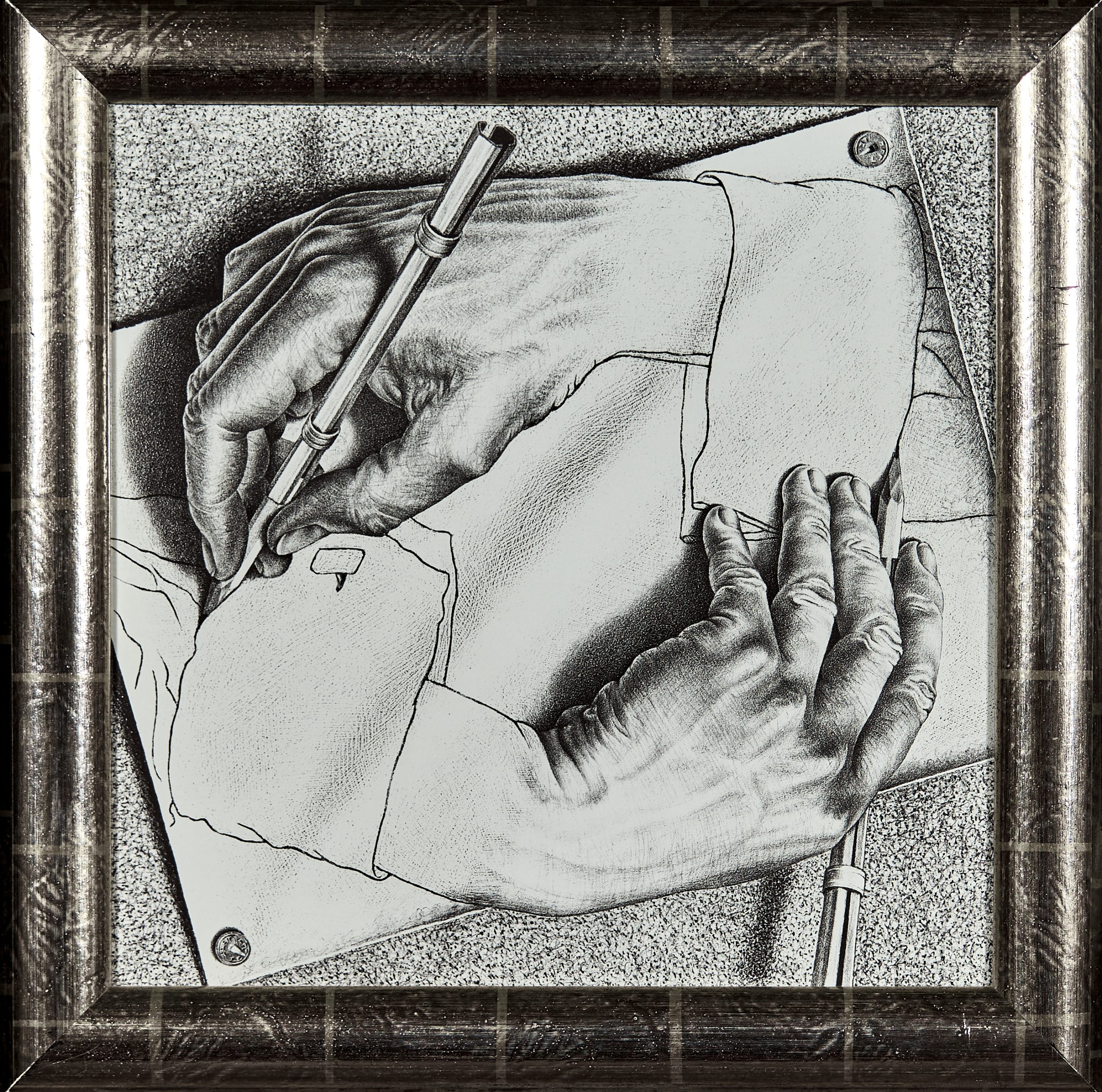
The intellectual pursuit of chirality—the intrinsic handedness of an object—is a rich vein of inquiry that bridges mathematics, physics, and biology, a subject recently explored by Professor Alain Goriely in a lecture series hosted by Gresham College. Professor Goriely, the Gresham Professor of Geometry, commenced his series on the geometry of nature by dissecting the core concept of chirality, derived from the Greek word cheir, meaning hands. He illustrates this fundamental asymmetry using the human hand, quoting Immanuel Kant: "What can more resemble my hand that its image in the mirror?". Yet, as anyone knows when attempting to wear a left glove on a right hand, the hand and its mirror image are non-superimposable.
This observation was formalized by Lord Kelvin in 1893, who defined a geometrical figure as "chiral" if its mirror image cannot be made to coincide with the original through any combination of translation and rotation. Objects that lack this property, such as spheres, are deemed achiral. Chirality is pervasive in the natural and engineered world, found in everything from left and right shoes and gloves to certain seashells, which can be defined as right-handed (dextral) or left-handed (sinistral) based on the side of their opening.
The challenge of defining left and right consistently preoccupied scientists for centuries. The ambiguity came to a head in the 1870s when James Clark Maxwell, recognizing that inconsistent left- or right-handed systems could invalidate formulas in electromagnetism, convened a meeting of the London Mathematical Society. The solution adopted was the right-handed system, symbolized by a corkscrew or the tendril of the vine. However, Professor Goriely notes that this convention was deeply problematic: corkscrews can be left-handed, and the botanical references were unreliable. Charles Darwin and other 19th-century botanists had observed that vine tendrils exhibit both left and right helices along their length—a structure resulting from an instability when a naturally curved elastic filament is put under tension—making them unsuitable for a universal definition. Even earlier systematic attempts by taxonomists like Linnaeus in 1751 to define handedness in plants suffered from published errata and subsequent confusion throughout the 19th century.
Related article - Uphorial Radio

A truly fundamental distinction between left and right in the universe was established not by geometry, but by physics in 1956. Chien-Shiung Wu’s pivotal experiment on the decay of cobalt-60 demonstrated that the weak nuclear force does not conserve parity (mirror symmetry). This groundbreaking result showed a fundamental physical difference between left and right, proving that particles emerging from weak decay carry spin mostly "to the left," a fact now incorporated into the Standard Model.
Chirality is integral to biological structure, dictating the spirals of DNA, which is overwhelmingly right-handed due to the chirality of its sugar building blocks, not its base pairs. Professor Goriely highlights the mystery of homochirality: why life utilizes only one specific mirror image of amino acids and sugars. The origin of this asymmetry remains a profound puzzle, potentially linked to the weak force or to polarized light emanating from galaxies. Chirality also governs the structure of materials like keratin, the protein in hair and nails, which forms a left-handed braid based on right-handed alpha helices, tracing the handedness all the way back to the constituent amino acids.
In chemistry, the crucial difference between mirror images, or enantiomers, was realized by Louis Pasteur in 1848, who separated tartaric acid crystals and found the two forms interacted differently with polarized light. The practical significance of this chemical handedness was tragically illuminated by the Thalidomide disaster, where one enantiomer of the drug treated morning sickness, while its mirror image caused severe birth defects.
For Goriely and his collaborators, modern geometry is not just about measuring static chirality but controlling it, a concept particularly relevant to robotics. Drawing inspiration from the elephant trunk, a muscular hydrostat composed of over 90,000 muscle fascicles (more than the entire human body), Goriely studied how the elephant achieves its preference for grasping objects (its "trunkless"). The trunk’s muscles are organized longitudinally and into left- and right-handed helical groups. Through a simplified mathematical model that uses three actuators (one longitudinal, two helical), researchers can precisely control the resulting curvature and torsion—a geometric measure essential for characterizing curves in 3D space. This work allows for the control and replication of the complex, specialized motions necessary for feeding and grasping, providing direct applications for soft robotic design.
Professor Goriely concludes his exploration by posing several fundamental questions for further reflection, including why most gastropod seashells are right-handed (90-95% of species), whereas ancient cephalopods like ammonites were typically achiral, underscoring that the geometry of nature retains many profound secrets.