NEW YORK - The cultural heartbeat of New York City has always pulsed loudest in the historic brownstones, bustling sidewalks, and soulful eateries of Harlem, a neighborhood that has served for over a century as an incubator for Black artistic genius, political resistance, and enduring style. It is entirely fitting, then, that when visionary multi-hyphenate artist A$AP Rocky sat down for a rare, deeply intimate interview, the conversation unfolded not inside a sterile corporate studio or a guarded VIP lounge, but at Melba’s—a legendary Harlem culinary institution where community, history, and culture intersect. Hosted by media personality Jason Lee, the expansive discussion stripped away the superficial layers of celebrity gossip and tabloid fodder, offering an unfiltered, profound look at a man reconciling global fame with his immutable neighborhood roots. Through emotional precision, intelligent curation, cultural understanding, strategic storytelling, and transformational framing, the encounter captured a defining snapshot of an artist evolving into an elder statesman of his culture.
From the opening moments, the conversation anchors itself firmly in the rich soil of Harlem, exploring how the neighborhood’s distinct texture forged A$AP Rocky’s identity, aesthetic sensibilities, and artistic vision. Rocky reflects on the sensory overload of his upbringing—the fashion codes, the rhythmic cadence of the streets, the unspoken codes of survival and ambition—and how those early lessons continue to dictate every creative choice he makes. This deep cultural understanding elevates the interview beyond standard promotional chatter, framing Harlem not merely as a geographic coordinate, but as a living, breathing co-author of his legacy. The neighborhood’s influence is woven into his posture, his speech, and his unyielding commitment to pushing aesthetic boundaries, proving that no matter how far global superstardom takes him, his internal compass remains permanently calibrated to uptown Manhattan.
Related article - Uphorial Shopify

That profound local impact transcended metaphorical appreciation and manifested in a breathtaking, unscripted moment of civic recognition right there in the restaurant. Interrupting the flow of the interview, New York State Assembly member Jordan Wright and Councilman Yusef Salaam made a surprise appearance to honor the artist. Standing in the heart of the community that raised him, Rocky was presented with official government citations celebrating his immense contributions to Harlem, both through his global cultural exports and his tangible community investments. It was a powerful, emotionally charged intersection of art and civic leadership—symbolized heavily by the presence of Councilman Salaam, a living monument to resilience and justice. The presentation served as a transformational framing of Rocky’s career, shifting public perception from that of a rebellious fashion iconoclast to an acknowledged pillar of urban leadership and community pride.
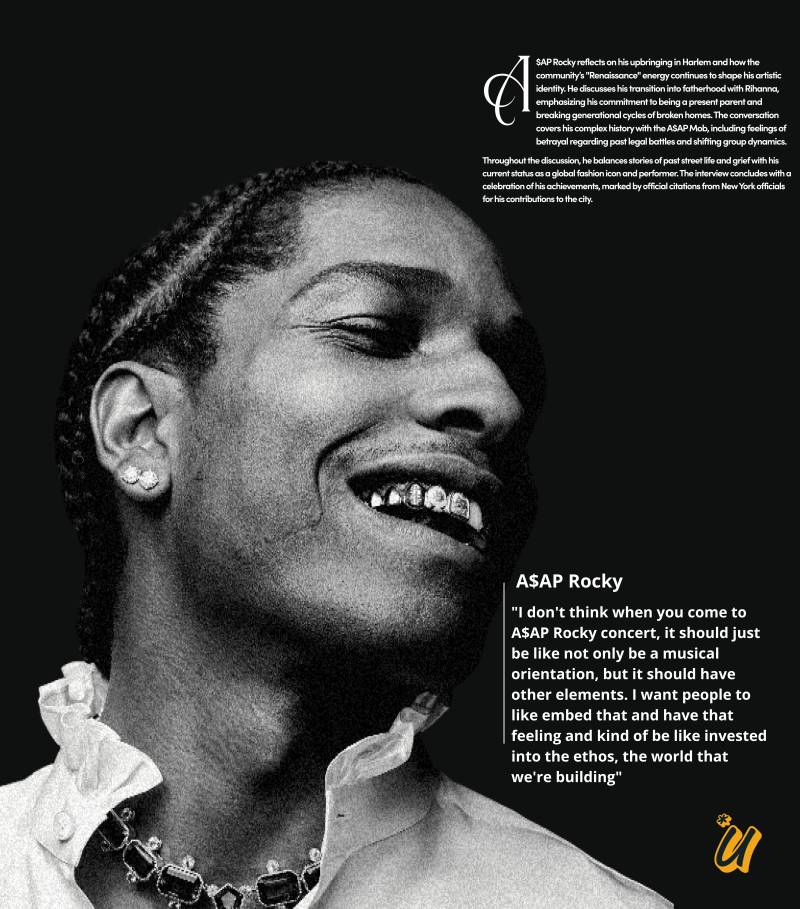
'As the conversation pivoted from civic legacy to artistic output, Rocky delved deep into his philosophy of performance and the rigorous intentionality governing his creative process. Rejecting the traditional confines of the standard rap concert, Rocky articulates a desire to revolutionize live entertainment into immersive, multi-sensory performance art. He discusses how he views stage design, lighting, fashion, and sound not as separate promotional vehicles, but as a unified canvas designed to evoke visceral emotional responses from his audience. This commitment to intelligent curation reveals an artist who is endlessly restless, constantly studying the intersections of fine art, cinema, and hip-hop to deliver experiences that linger in the cultural consciousness long after the lights go down.
Yet, behind the avant-garde fashion choices and stadium-scale artistic ambitions lies a profound personal metamorphosis, marked by maturity, family, and domestic grounding. Lee and Rocky navigate the delicate terrain of personal life, touching upon his relationship with global superstar Rihanna and their shared journey into fatherhood. With striking emotional precision, Rocky opens up about the seismic internal shift required to transition from a younger, impulsive, hyper-defensive persona into a dedicated, protective family man. He speaks candidly about how raising children has recalibrated his priorities, stripping away the trivial anxieties of celebrity existence and replacing them with a fierce, quiet devotion to building a legacy of generational stability and love.
Navigating the toxic ecosystem of modern internet culture and relentless industry gossip is another hurdle the artist addresses with characteristic poise. In an era where digital platforms thrive on manufactured outrage and social media algorithms reward petty feuds, Rocky maintains a steadfast refusal to engage in negative online discourse. The conversation touches upon his relationships with past collaborators, including Ferg and the broader A$AP Mob, addressing the natural growing pains, business complexities, and evolution of brotherhood within a massive creative collective. Rather than taking the bait of sensationalist journalism, Rocky rises above the noise, employing strategic storytelling to emphasize that true growth often requires outgrowing environments built on constant conflict and choosing peace over performative internet drama.
Ultimately, this unforgettable encounter at Melba’s transcends the typical boundaries of a hip-hop interview, operating as a profound cultural document. By weaving together the threads of Harlem heritage, civic honors from leaders like Jordan Wright and Yusef Salaam, artistic boundary-pushing, and the quiet dignity of fatherhood, A$AP Rocky emerges not just as a trendsetting musician, but as a fully realized cultural architect. Through emotional precision, intelligent curation, and transformational framing, the conversation captures an artist firmly standing in his power—honoring the streets that built him while gracefully stepping into a legacy that will inspire generations to come.