In the realm of physics, few concepts are as universally accepted as the conservation of energy. From the mechanics of a rolling ball to the vast dynamics of galaxies, energy conservation seems to be an unshakable pillar of our understanding. Yet, within the intricate fabric of general relativity, this foundational principle encounters profound challenges that not only question its applicability but also redefine our comprehension of the universe.
General relativity, Albert Einstein's monumental theory, revolutionized our understanding by describing gravity not as a force but as the curvature of spacetime caused by mass and energy. This paradigm shift led to predictions of phenomena such as black holes and gravitational waves, which have since been confirmed through observation. However, as the theory delves deeper into the cosmos, it confronts a significant dilemma: the conservation of energy.
In classical mechanics and special relativity, energy conservation is a straightforward concept. The total energy in a closed system remains constant over time. This principle is elegantly encapsulated by Noether's theorem, which links symmetries in physics to conservation laws. Time translation symmetry, for instance, implies that energy is conserved. Yet, general relativity introduces complexities that challenge this symmetry.
Related article - Uphorial Radio
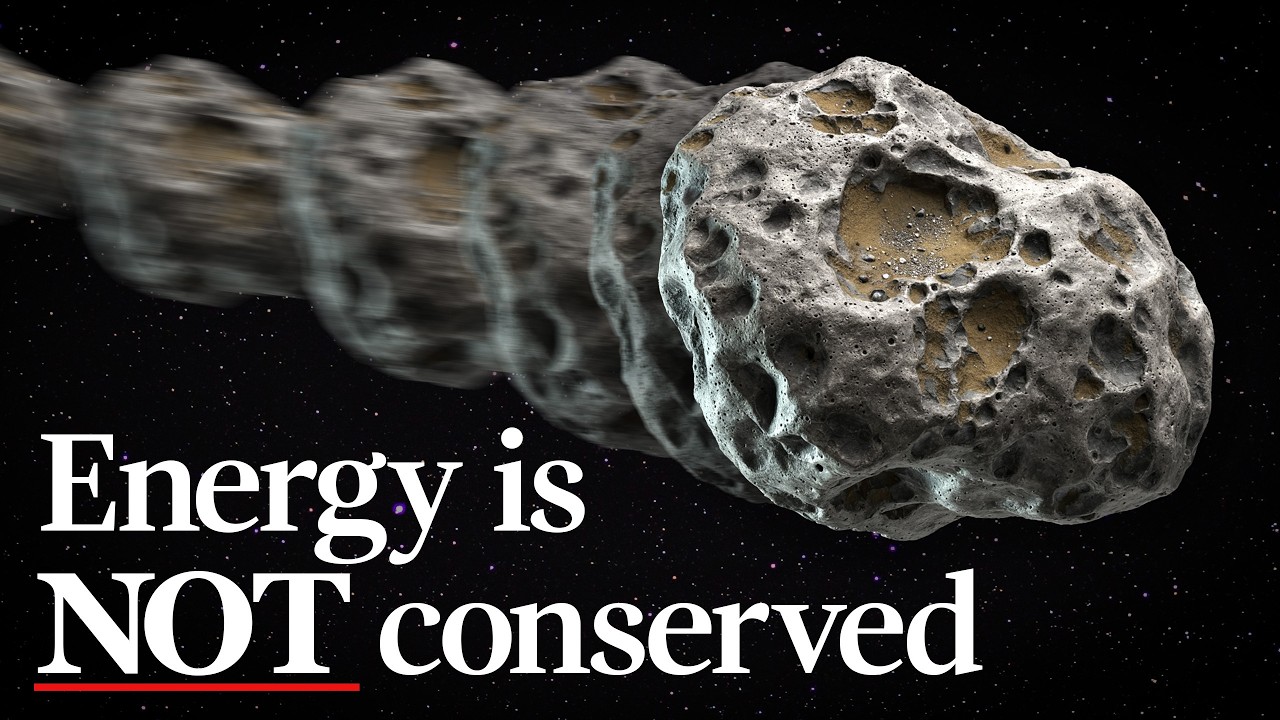
Veritasium
One of the primary reasons energy conservation becomes problematic in general relativity is the dynamic nature of spacetime itself. Unlike the static backdrop assumed in classical physics, spacetime in general relativity is malleable and can stretch and evolve. This fluidity means that defining a consistent energy measure across the entire universe becomes exceedingly difficult. As spacetime expands, especially in the context of cosmology, the concept of energy conservation becomes less meaningful.
The expansion of the universe serves as a poignant example. As space stretches, wavelengths of light traveling through it also elongate, leading to a redshift. This phenomenon suggests that energy is being lost, yet no energy is actually dissipated; it's merely redistributed due to the stretching of spacetime. This observation implies that energy conservation, as traditionally understood, doesn't hold in an expanding universe.
Moreover, the localization of energy poses another challenge. In general relativity, energy isn't confined to a specific location; instead, it's spread out across the curvature of spacetime. This non-localization makes it impossible to assign a precise energy value to a region of space, further complicating the application of conservation laws.
These revelations don't diminish the significance of general relativity; rather, they highlight the limitations of our classical intuitions when applied to the cosmos's grandest scales. They beckon physicists to refine existing theories and perhaps develop new frameworks that can reconcile these inconsistencies.
The implications of these challenges are profound. If energy isn't conserved in the traditional sense, it prompts a reevaluation of other fundamental principles in physics. Concepts such as causality, the arrow of time, and the very structure of physical laws may need to be reconsidered in light of these insights.
In conclusion, the exploration of energy conservation within the context of general relativity underscores the complexities and nuances of our universe. It serves as a reminder that our understanding of the cosmos is ever-evolving, and that embracing these challenges can lead to deeper insights and advancements in the field of physics.