BOSTON – The history of American art has long been a canvas upon which the Black body has been painted by others—subjected to the gaze of the observer, captured in states of subjugation, or reduced to the peripheral figures of a narrative not their own. Robert Pruitt, the Bronx-based visionary whose monumental, life-sized figurative drawings are currently redefining the boundaries of contemporary visual culture, represents a radical departure from this tradition. His work does not simply depict Blackness; it constructs a new world for it to inhabit, drawing from the deep wells of Black history, the speculative promise of science fiction, and the structural boldness of the comic book medium. Through a process that is as intellectually rigorous as it is emotionally precise, Pruitt is engaged in the work of Afrofuturism, creating a visual language that imagines Black existence beyond the historical constraints of trauma and the narrow stereotypes of contemporary representation.
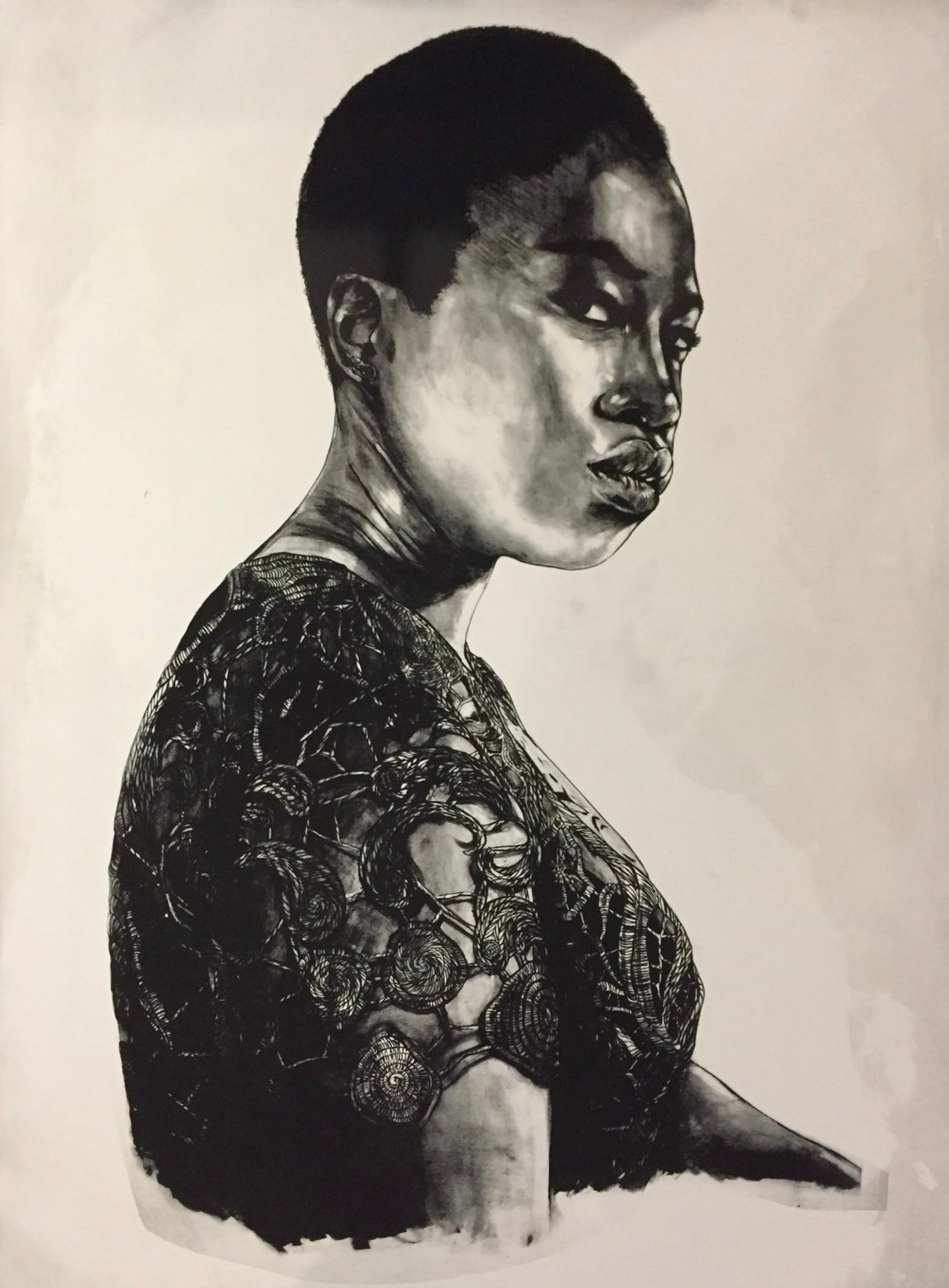
Pruitt’s artistic process begins long before the first line is drawn on the page, rooted in a deliberate, staged reality. He utilizes photography to build his symbolic worlds, working with models and self-constructed costumes to create a visual lexicon that is entirely his own. There is a profound act of resistance in his material choices; he dyes his drawing paper with coffee, creating a rich, organic, neutral base that stands in stark, intentional opposition to the "whiteness" of traditional art materials. This is an intelligent curation of the very tools of his trade, a reclamation of the substrate itself. By refusing to work on the sterile, historically loaded white paper of the Western canon, Pruitt asserts that his work is birthed from a different history—one that is warm, grounded, and undeniably of the earth.
The architecture of his imagination is built upon the twin pillars of mythology and personal memory. Growing up in Houston’s Fourth Ward—a neighborhood with a history etched into the soil by emancipated slaves—Pruitt developed an early and acute understanding of the relationship between place, ritual, and survival. He views his work not just as art, but as a practice of grounding, where the texture of the environment and the resonance of local history inform the figures he depicts. Simultaneously, he leans heavily into the influence of comic books, which he interprets not as mere entertainment, but as a contemporary, vital form of mythology. In these frames, he finds the tools to process the complexities of the self, the nature of transformation, and the psychological weight of trauma. For Pruitt, the comic book is a space where the impossible becomes plausible, allowing him to explore concepts of self-agency and resistance that feel both epic and profoundly intimate.
Related article - Uphorial Shopify
![Steeped [Robert A. Pruitt] | Sartle - Rogue Art History](https://www.sartle.com/sites/default/files/styles/as-is/public/images/artwork/steeped-robert-a.-pruitt-214221-5022556.jpg?itok=PXuPuabM)
Central to his work is a direct challenge to the subjective relationship we have with beauty. Cultural conditioning has historically influenced, and often corrupted, how the Black body is perceived, evaluated, and valued in the public sphere. Pruitt’s drawings disrupt this conditioning by presenting Black bodies that are unapologetic, powerful, and central. He forces the viewer to confront their own biases, demanding that they see the grace, the strength, and the inherent majesty of his subjects as they are, rather than as they have been reflected in the distorted mirrors of Western art history. This is transformational framing at its most potent: he takes the vessel of the human form and recontextualizes it within a narrative of potential, beauty, and autonomy.

The strategic storytelling within his drawings creates an atmosphere of "what if?" that is both compelling and urgent. He asks his audience to consider what freedom actually looks like for Black people when it is no longer defined by the struggle against oppression, but by the ability to thrive in the infinite spaces of the future. His figures are often caught in the liminal spaces between the past and the speculative, suggesting that Black identity is not a static point on a timeline, but a fluid, evolving force. By drawing on the visual tropes of science fiction, he places his subjects in a space of liberation, where they are no longer reacting to history but are actively driving the trajectory of the future.
Ultimately, Robert Pruitt’s drawings are a reclamation of the human imagination. He is not merely recording the present; he is archiving the future. In his work, the Bronx studio becomes a site of synthesis, where the dust of the Houston Fourth Ward meets the star-charts of a science-fiction odyssey. His drawings stand as monuments—monumental, indeed, in their scale and their ambition—that remind us that history is not a closed book, but a fluid process. Through his meticulous hand and his expansive vision, Pruitt proves that the most powerful form of resistance is the ability to envision a world that does not yet exist. In doing so, he ensures that the Black figure remains not a ghost of the past, but the architect of everything that is to come. His art is a profound testament to the power of the individual to reshape the cultural landscape, one coffee-stained sheet of paper at a time, inviting us all to look at the world, and at ourselves, with the precision of a historian and the hope of a futurist.