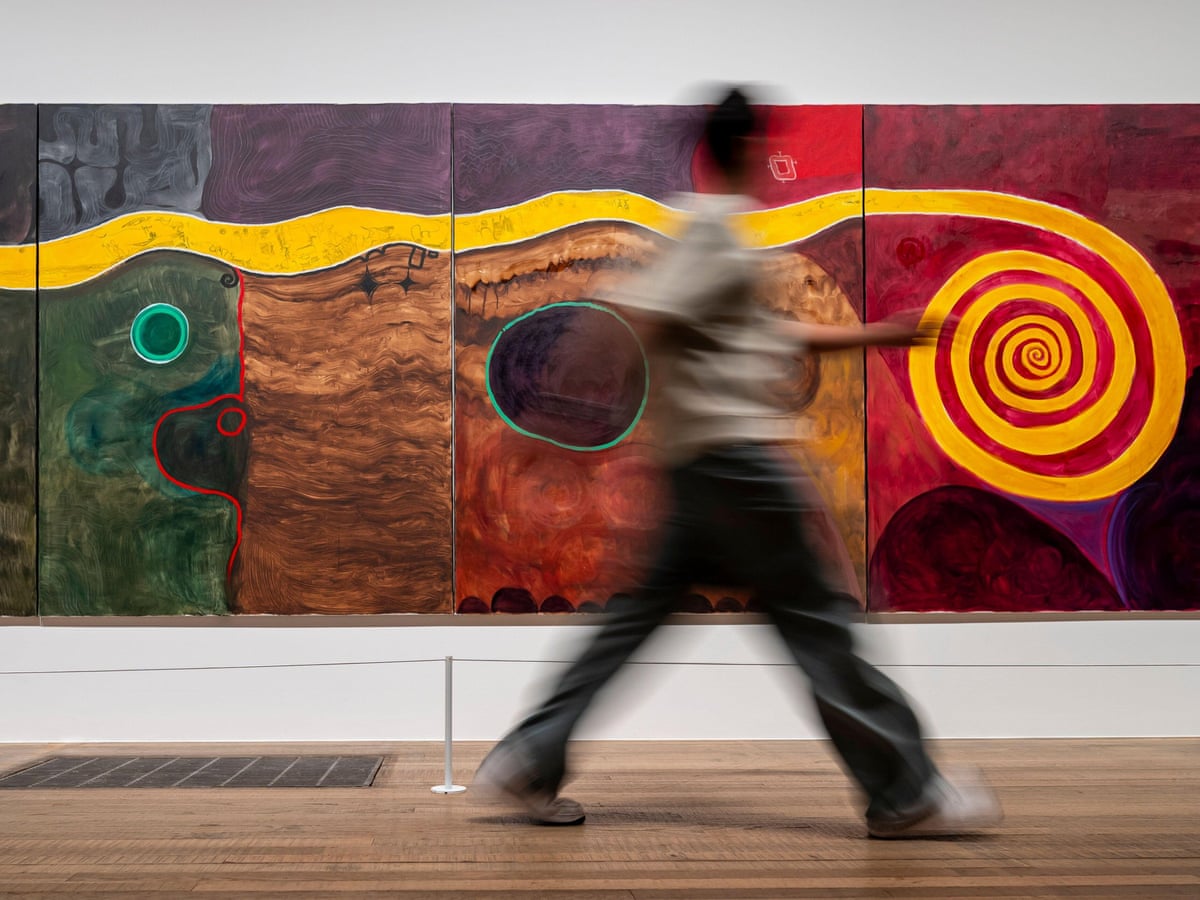
The exhibition traces the trajectory of Nigerian modernism from the 1940s to the 1990s—beginning in the late colonial period and continuing through independence, civil war, and into the diaspora years. It spotlights how Nigerian artists, educated both locally and abroad, balanced European formal training with deeply rooted indigenous traditions.A pivotal movement featured in the exhibition is the Zaria Arts Society, led by artists such as Uche Okeke, Bruce Onobrakpeya, and Demas Nwoko, who championed the philosophy of Natural Synthesis—a fusion of traditional African visual languages (like uli, adire, and carving) with modernist abstraction and techniques. This movement laid the groundwork for a distinctly Nigerian modernism that was both innovative and politically expressive.
The exhibition devotes focused spaces to iconic figures, many of whom helped define what modern art meant in a postcolonial African context. Ben Enwonwu’s sculptural works, especially his famous Anyanwu, are prominently featured. His synthesis of classical European form and Igbo spiritual aesthetics is a cornerstone of the exhibit. Uzo Egonu, whose work explored diasporic identity and dislocation, is showcased for his ability to convey both personal and national transitions in striking visual forms. Other major artists include Yusuf Grillo, known for his use of indigo hues and stained-glass inspiration; Ladi Kwali, the pioneering potter whose ceramics became emblematic of Nigerian craftsmanship; and Twins Seven-Seven, whose mythical, symbolic paintings captured the vibrancy of Yoruba cosmology. Works range across painting, sculpture, ceramics, textiles, photography, and mixed media, reflecting the broad scope of Nigeria’s modernist movement.
Beyond aesthetics, the exhibition confronts the realities of Nigeria’s political landscape. The Biafran War (1967–1970), the aftermath of independence, and decades of shifting identity are all reflected in the selected works. Art forms traditionally viewed as “craft”—like uli painting, pottery, and wood carving—are reframed as foundational modernist expressions. The curators highlight how these indigenous techniques were reclaimed, not only as markers of cultural pride but as tools of visual resistance against colonial and neocolonial ideologies.
Related article - Uphorial Sweatshirt
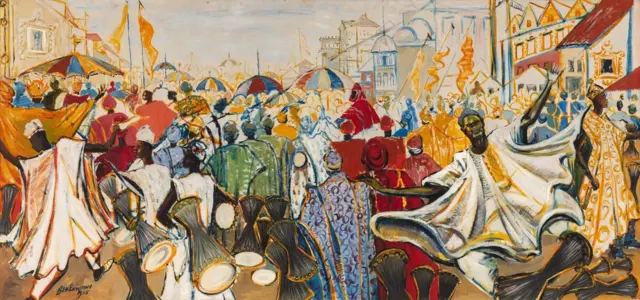
Nigerian Modernism gets recognition at London's Tate Modern

The exhibition was curated by Osei Bonsu and Bilal Akkouche, who emphasized the need to reposition Nigerian modernism within the broader canon of 20th-century art history. For too long, African artists were viewed as peripheral or imitative of European modernism. This exhibition rejects that narrative, placing Nigerian artists at the center of innovation, experimentation, and cultural commentary. By carefully constructing thematic and chronological arcs, the show invites visitors to understand Nigerian modernism not as an offshoot, but as an original and self-defined movement shaped by local experiences and global exchange.
The exhibition has been met with widespread acclaim from critics, scholars, and the public alike. It has been described as “transformative,” “timely,” and “a vital correction to art history.” For many Nigerians in the diaspora, it is a deeply emotional experience—seeing the art of their parents’ and grandparents’ generations finally recognized on a world stage. Artists like Bruce Onobrakpeya, now in his 90s, expressed profound satisfaction in seeing their life’s work embraced internationally, not just as national treasures, but as critical voices in global modernism. This exhibition is more than a collection of art—it is a cultural reclamation. It asserts that Nigeria’s artistic legacy is not just local but global, not just historical but urgent. It speaks to a new generation of African and diasporic creatives seeking to bridge past and present, tradition and innovation .By presenting Nigerian modernism in all its depth, complexity, and vibrancy, Tate Modern has taken a crucial step toward expanding the narrative of what modern art has been—and what it can be.
Exhibition Details
Exhibition Title: Nigerian Modernism: Art and Independence
Location: Tate Modern, London
Dates: October 2025 – May 10, 2026
Admission: Free with general entry; guided tours and talks available