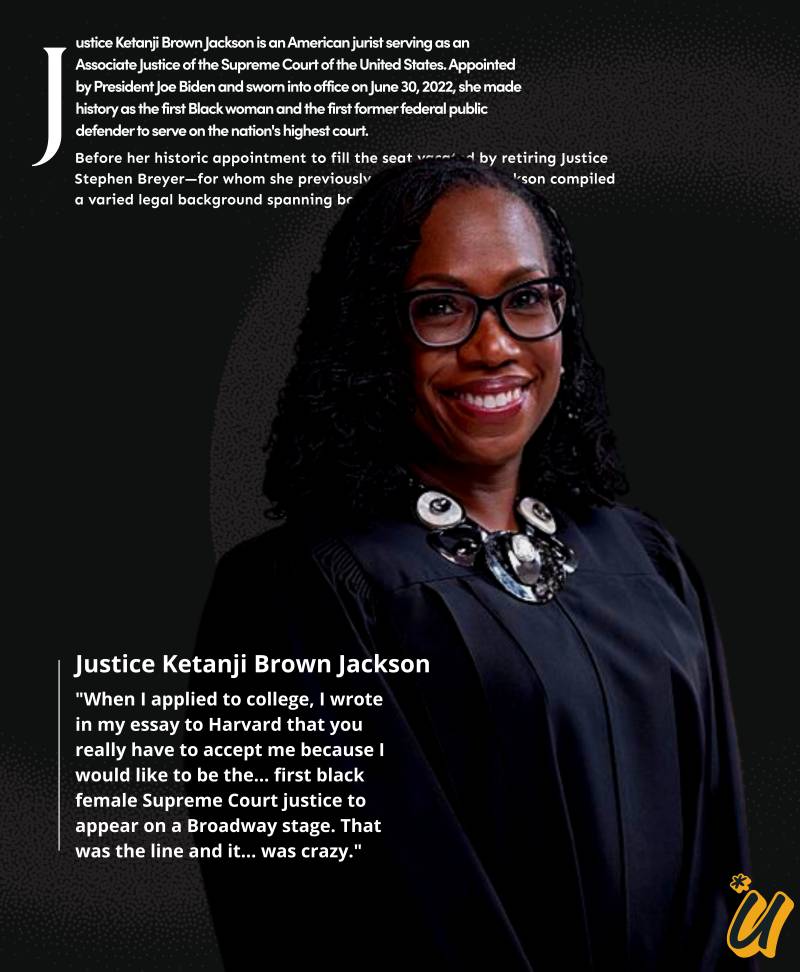
The grand tapestry of American jurisprudence has historically been woven by a narrow, homogenous strand of hands, leaving the nation’s highest court distant from the diverse reality of the citizens it sworn to protect. For generations, the marble steps of the United States Supreme Court felt like an impenetrable fortress to those standing outside the traditional corridors of power. Yet history is occasionally pierced by moments of profound, generational transformation—moments when the appointment of an extraordinary individual shatters centuries of precedent and redefines who belongs at the pinnacle of public service. In a deeply luminous, vulnerable, and intellectually rich episode of IMO, former First Lady Michelle Obama and Craig Robinson sit down in conversation with Supreme Court Justice Ketanji Brown Jackson to chronicle her historic, barrier-shattering path to becoming the first Black woman to ever sit on the highest court in the land, offering a masterclass in emotional precision, intelligent curation, and strategic storytelling that illuminates the true human cost of historic achievement.
The architectural foundation of Justice Jackson’s remarkable intellect and unyielding drive was poured long before she ever set foot in a courtroom, rooted deep within a family whose very lifeblood was public service. Reflecting on her formative years with striking emotional clarity, she shares early memories of witnessing her father pursue his law degree, recalling the quiet, disciplined rhythm of sitting side by side at the kitchen table as a young girl, studying while her father absorbed the vast texts of American jurisprudence. That shared domestic study hall was not merely an academic exercise; it was an early cultural transmission of resilience, intellectual curiosity, and the profound belief that education is the ultimate equalizer. Growing up surrounded by educators, civil servants, and champions of community uplift, Jackson absorbed an intrinsic sense of duty that would guide her through the most rigorous corridors of American law.
Related article - Uphorial Shopify

Yet, stepping out of that supportive familial cocoon into the wider, often exclusionary arenas of elite academia was a trial by fire. With searing honesty, Justice Jackson opens up about the profound, heavy isolation she experienced as a high-achieving student navigating predominantly white educational spaces, culminating in the daunting, disorienting experience of arriving at Harvard University as a first-year undergraduate. She describes the psychological weight of double consciousness—the unspoken pressure to perform flawlessly while feeling acutely conscious of being the cultural exception in rooms built without people who looked like her. That early loneliness, rather than breaking her spirit, forged an impenetrable internal armor, teaching her how to anchor her self-worth in her own capabilities rather than external validation.
As the conversation shifts from her academic crucible to the dizzying heights of her professional career, the dialogue turns toward one of the most universal and grinding challenges faced by modern working families: the agonizing tightrope walk of balancing high-powered careers with domestic life. Jackson and her hosts unpack the immense logistical and emotional juggling act required to manage two simultaneously demanding households—her own ascending career as a brilliant corporate litigator, federal defender, and judge, juxtaposed against her husband’s high-stress life as a practicing general surgeon—all while nurturing and raising their children. Stripping away the glossy veneer of judicial perfection, Jackson offers a deeply human portrait of late-night scheduling, emotional exhaustion, and the messy reality of partnership, reminding viewers that behind every historic resume lies a mountain of domestic compromise and mutual sacrifice.
Bridging her personal journey with civic education, Justice Jackson pauses to demystify the complex architecture of American law, providing a masterclass in intelligent curation of the federal court system. With lucid clarity, she breaks down the tiered structure of the judiciary, explaining the foundational fact-finding role of the District Court, the appellate review process of the Court of Appeals, and finally, the constitutional gravity of the Supreme Court. By translating dense legal mechanics into accessible, engaging dialogue, she underscores why the integrity of these institutions matters intimately to everyday Americans, framing the legal system not as an abstract mountain of dusty statutes, but as a living, breathing shield for civil rights and societal equity.
The discussion then expands into the vital mechanics of professional survival, tackling the universal art of navigating hostile workplaces and toxic leadership. Drawing from decades of navigating rooms where she was frequently the only woman—and almost always the only Black woman—Jackson, Obama, and Robinson share hard-earned wisdom on how to deal with difficult, micromanaging, or unsupportive bosses without losing one's professional dignity or creative spark. They emphasize that professional ascension is rarely a solitary march; it requires the strategic identification of genuine mentors, sponsors, and allies who are willing to pull open doors, offer unvarnished truth, and advocate for growth when the institutional currents push against you.
Ultimately, this unforgettable conversation serves as a transformational framing of what it means to rewrite history. Through cultural understanding, deep emotional resonance, and strategic narrative reflection, Justice Ketanji Brown Jackson’s story transcends the biographical milestones of her resume. It stands as an enduring testament to resilience, a blueprint for balancing ambition with humanity, and a brilliant reminder that when barriers are finally torn down, the entire nation expands its vision of what is truly possible.