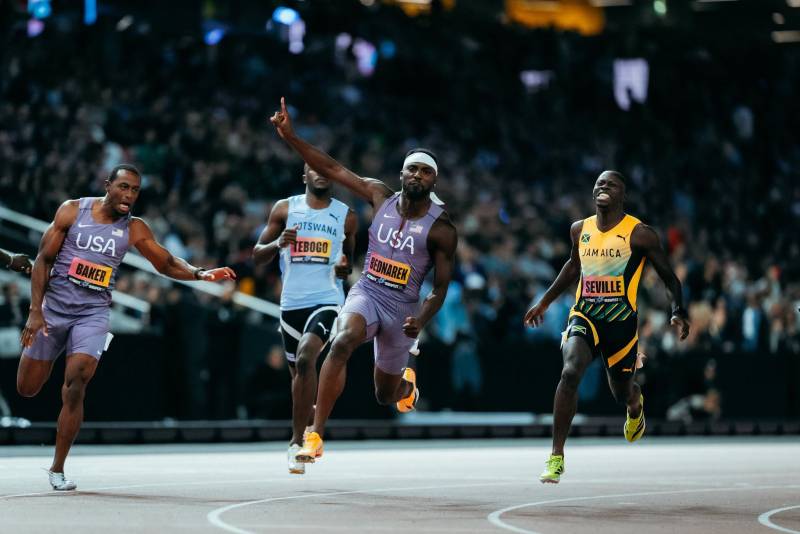
GABORONE — The global track and field community turned its collective gaze toward Botswana as Day 1 of the World Athletics Relays Gaborone 26 delivered a masterclass in speed, precision, and historical significance. Under the bright lights of the National Stadium, athletes from across the globe converged not only for the prestige of victory but for the high-stakes objective of securing qualification spots for the upcoming World Athletics Championships in Beijing. The atmosphere was a potent mix of electric local pride and the palpable tension that defines international relay racing, where the margin between a world record and a disqualification often rests on a fraction of a second or a single centimeter of a baton exchange.
The day’s most historic developments occurred in the Mixed 4x100m relay, a relatively new discipline that saw its competitive boundaries completely redefined within the span of a single evening. The session began with a stunning performance by the Canadian quartet, who established an inaugural world record for the event. However, the record proved to be ephemeral. In a later heat, the Jamaican team delivered a technical and physical powerhouse performance, reclaiming the record and etching their names in the history books by achieving the first-ever sub-40-second time in the mixed short-sprint relay. This rapid-fire exchange of records signaled a new era of tactical depth for the mixed events, as nations begin to master the specific pacing and gender-order strategies required for this high-speed discipline.
As the evening progressed, the local fans were rewarded with a moment of pure national euphoria during the Men’s 4x100m relay. The Botswana team, buoyed by the deafening roar of a home crowd, delivered a clean, aggressive race that culminated in a new national record. This performance not only solidified Botswana's standing as a growing powerhouse in global sprinting but also ensured their advancement in a field that featured some of the most storied programs in the sport. Among those competitors, the United States demonstrated why they remain a perennial threat, showcasing clinical baton exchanges and raw top-end speed to comfortably qualify for the final and set the stage for a heavyweight showdown.

Related article - Uphorial Shopify

The middle-distance drama continued with the Mixed 4x400m relay, where endurance and late-race positioning took center stage. Great Britain and Northern Ireland established themselves as the team to beat, putting in a world-leading performance that combined seasoned experience with a high-tempo finish. Not to be outdone, the Kenyan squad utilized the high-altitude conditions and their traditional strength in the 400m to secure their own qualification spot in spectacular fashion. By setting a new African record, Kenya sent a clear message to the rest of the world that their dominance is expanding beyond individual distance races and into the highly technical realm of elite relay competition.

However, the day was not without its share of heartbreak and technical failures, particularly during the Women’s 4x100m relay. The event was characterized by a series of chaotic baton exchanges that derailed several favorites. In a shocking turn of events, the defending champions from Great Britain were among those disqualified following a zone violation, a reminder of the unforgiving nature of the short relay. Amidst the chaos, Jamaica remained the picture of composure. Navigating the handovers with veteran precision, the Jamaican women emerged as comfortable winners of their heat, reaffirming their status as the gold standard for the discipline as they look toward the finals.
The final act of the day provided perhaps the most dramatic finish of the entire competition during the Men’s 4x400m relay. In a display of sheer grit that left the stadium in a state of suspense, the teams from Belgium and Qatar crossed the finish line in what was eventually ruled a dead heat. The photo finish underscored the immense pressure of the qualification race, with both nations ultimately earning their places in the finals. The result was a fitting end to a day that prioritized the pursuit of "Beijing berths" and showcased the relentless evolution of the sport.
As the sun set over Gaborone, the implications of Day 1 were clear. The World Athletics Relays have evolved into a critical tactical laboratory where world records are no longer safe and national pride is a powerful fuel for performance. With records falling and giants being humbled by technical errors, the road to Beijing has officially begun, and the standard for relay excellence has been raised to heights previously unimagined. The athletes depart the first day of competition having proven that in the world of relays, the only constant is change, and the only path to victory is through a perfect synchronization of human spirit and technical mastery.