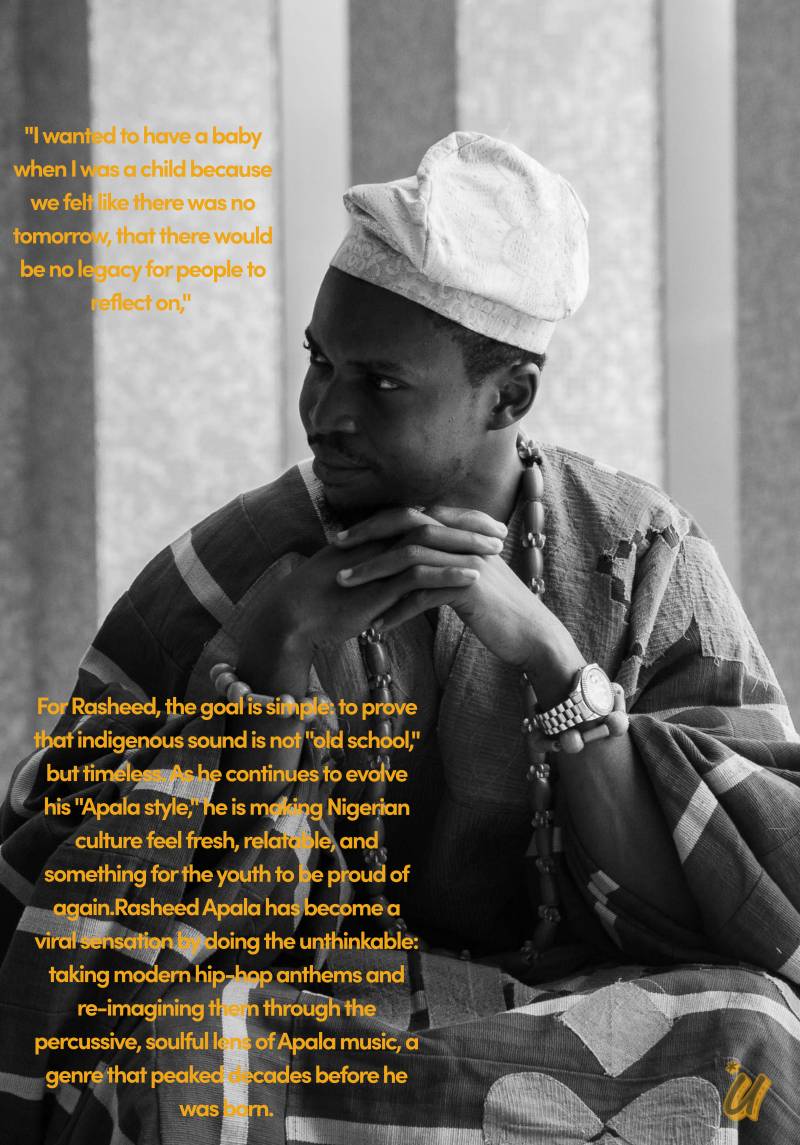
LAGOS – The vibrant pulse of Lagos’s contemporary music scene has found a powerful new champion in Rasheed Apala, whose recent appearance on the Echooroom Live Session is being hailed as a transformative moment for Nigerian indigenous music. In a high-energy performance that felt both like a historical tribute and a futuristic manifesto, the artist delivered a definitive rendition of his track "As How Na." The session, which has rapidly gained traction across digital platforms in early 2026, serves as a vivid reminder of the enduring power of raw, organic performance in an era increasingly dominated by synthesized production.
The Echooroom session distinguished itself by placing a premium on live instrumentation, stripping away the polished artifice of the recording studio to reveal the percussive skeleton of the Apala genre. From the opening moments of "As How Na," the air was thick with the rhythmic complexity that has defined Apala music for generations. The performance leaned heavily into the use of traditional talking drums and intricate percussive patterns, creating a dense, interlocking tapestry of sound. By prioritizing these raw acoustic elements, the session managed to capture the "heartbeat" of Nigerian street music, providing a visceral listening experience that resonates with both the traditionalist and the modern club-goer.
At the center of this rhythmic storm was Rasheed Apala himself, delivering a vocal performance that was as much an athletic feat as it was a musical one. His delivery on "As How Na" showcased a masterclass in rhythmic storytelling, a hallmark of the Apala tradition where the lyrics are woven into the percussion rather than merely sitting on top of it. Throughout the set, Rasheed maintained an intense level of energy, his passionate vocals punctuated by a command of the stage that suggested a deep, spiritual connection to the material. This was not a passive performance; it was an active dialogue between the artist, his band, and the cultural history he carries.
Related article - Uphorial Shopify

The true significance of the session, however, lies in its role as a bridge between two worlds. Rasheed Apala is at the forefront of a movement that celebrates Nigerian musical heritage while simultaneously pushing it into the contemporary "street-pop" conversation. By infusing the classical structures of Apala and Fuji-inspired music with the swagger and tempo of modern urban sounds, he is effectively ensuring the survival of these genres for a new generation. This cultural fusion highlights the evolution of Nigerian soundscapes, proving that indigenous rhythms are not static artifacts to be preserved in amber, but living, breathing foundations for modern innovation.
The Echooroom Live Session provided the perfect canvas for this evolution. The minimalist, focused environment of the studio allowed the nuances of the cultural fusion to take center stage. Listeners were invited to hear the direct lineage between the ancient drums of the Yoruba heartland and the high-octane energy of modern Lagos nightlife. It is this specific intersection—where the wisdom of the elders meets the restlessness of the youth—that gives Rasheed Apala’s work its unique potency. The performance of "As How Na" acted as a cultural declaration, asserting that the future of Nigerian music is inextricably linked to its past.
Ultimately, the video of the session stands as a celebration of authentic Nigerian culture and the undeniable power of live performance. In a globalized market where music can often feel sanitized and placeless, Rasheed Apala’s Echooroom session is a fiercely local and unapologetically loud statement of identity. It serves as a testament to the fact that when tradition is allowed to breathe and evolve, it can produce something that feels more modern than anything created solely with a computer. For those witnessing the rise of Rasheed Apala in 2026, the message is clear: the drums of heritage are still beating, and they have never sounded more relevant.