The world of technology and media is currently defined by disruptive shifts, with Artificial Intelligence (AI) propelling legacy hardware giant Cisco back to market heights unseen since the dot-com era, even as global media titan Disney struggles to satisfy Wall Street’s demands for growth. These contrasting narratives played out during a recent edition of Bloomberg Tech, hosted by Caroline Hyde and Ed Ludlow, alongside key executives and analysts.
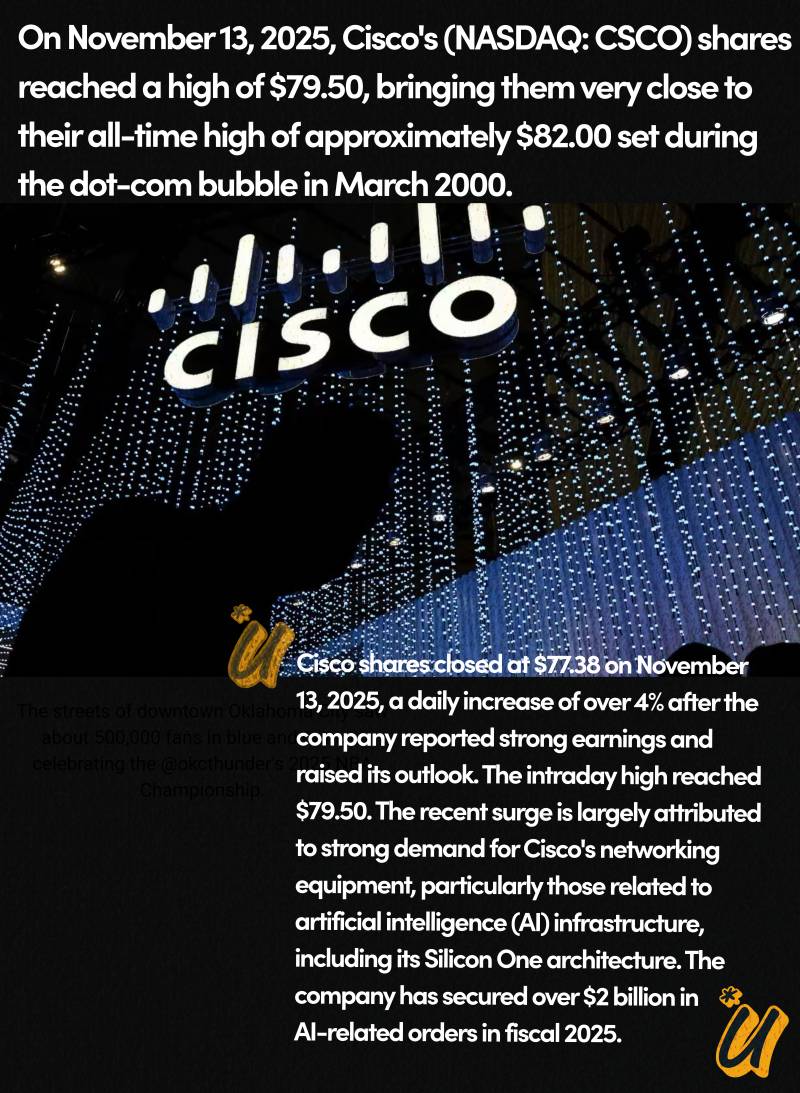
Cisco shares surged by around 4%, trading at their highest level since the year 2000, after the company raised its 2026 forecast and showed progress in capturing global AI spending. CEO Chuck Robbins expressed pride in his team, noting they had a record quarter and are set up for what is likely going to be the best year the company has ever had. Robbins emphasized that the decision of hyperscalers—some of the most advanced customers in the world—to continue spending more with Cisco "speaks volumes about the innovation and the technology" the teams are building.
Cisco’s success in AI is being driven by deals with the major hyperscalers primarily in the United States, as well as sovereign deals in the Middle East with G42 and the Emirates and Saudi. Robbins noted that the 1.3billionpipelinetheydiscussedisstrictlywiththetopfivehyperscalers$. The company has over $2 billion in its pipeline through the end of the fiscal year in neo-cloud and sovereign cloud. Robbins attributed much of this success to a crucial investment made in 2016 to develop its own silicon architecture.
On the crucial question of whether the industry is in an AI bubble, Robbins provided a nuanced view, stressing that the customers buying the predominant amount of this technology—the hyperscalers—have incredible balance sheets, cash flow, and profitability. They view AI as an "existential issue" for them, not merely a "nice to have". This fundamental difference between now and 2000 is that these buyers are massive companies with strong financial performance that "believe in this 100%". Philippe Bottari, a partner at Accel, concurred, pointing out that the NASDAQ's current valuation is "basically in line with historical trends" for platform shifts. Bottari noted that the productivity improvement potential of AI "goes well beyond what any of the previous platform shifts have generated".
This skepticism, however, is not unfounded. Investor Michael Burry's Scion Asset Management terminated its registration status with the SEC, suggesting he might be shuttering his hedge fund. This move comes shortly after he warned about market exuberance, particularly in AI. Analyst Tom Metcalf suggested this might signal that "even a Michael Burry start[s] to lose faith in trying to time this bubble". Burry recently put out shorts on Palantir and Nvidia. Breanne Dougherty, an analyst with Bloomberg Intelligence, acknowledged this tension but stated the firm is "not in the bubble camp".
Meanwhile, Disney shares fell by almost 10%, their worst day in years, after posting fourth-quarter earnings that missed estimates and projecting a forecast that underwhelmed Wall Street. Despite the company pointing to double-digit earnings per share (EPS) growth in 2026, analysts noted that the market was expecting "something much more specific and much more concrete" than just "double-digit EPS growth". CFO Hugh Johnson defended the results, noting 6% revenue growth and 13% growth in the experienced business (parks) was "terrific". Disney is confident that its streaming business will continue to be profitable through 2026, driven by a strong film slate including Avatar, Toy Story 5, and a new Avengers movie, alongside significant product investments like creating a unified app and improving recommendation engines. However, the projected streaming operating income of $375 million for Q1 2026 was "a lot less than the street was anticipating" due to investments in product and bundling. The stock is also potentially suffering from the "overhang" of the protracted CEO succession issue, which the board indicated will be resolved by the end of March 2026.
The conversation also touched on Tencent striking a deal with Apple, where Apple will handle payments and take a 15% cut of purchases in WeChat games and apps, about half of its usual 30% fee. This truce was necessary because Apple has less market power in China due to alternatives like Tencent. Separately, Tesla is developing support for Apple's CarPlay system in its vehicles. This marks a "stunning reversal" for CEO Elon Musk, driven by intense competition and the fact that Car Play is the "most in-demand feature" in EVs.
Ultimately, the market is defined by disruption: while AI is boosting companies like Cisco to historic highs, it is also raising existential questions for giants like Disney and leading veteran investors like Michael Burry to pause. As Accel's Bottari concluded, while "not all companies are going to be winners", the opportunity unlocked by AI is "much bigger than what we have seen in the past".