The architecture of cross-continental artistic heritage, royal court patronage, and textile mastery reaches a masterly, illuminating peak in a curated preview presented by Christie’s specialists Louise Broadhurst and Sara Plumbly ahead of the house’s landmark Art of the Islamic and Indian Worlds including Rugs and Carpets auction in London. Spanning centuries of creative exchange across Cairo, the Caucasus, Anatolia, Persia, and imperial India, the assemblage unites humble village looms with the highest echelons of royal ateliers and aristocratic treasuries. In an exceptionally detailed cultural feature report and fine-art chronicle, art historians and collectors examine a remarkable lineup defined by a rare Caucasian Dragon carpet dyed with Tyrian purple, a fourteenth-century Mamluk mosque lamp fragment commissioned by Sultan Hasan, an aristocratic Gördes prayer rug, ceremonial South Indian jewelry formerly owned by Adeline Pepper Gibson, an extraordinarily supple square silk Kashan carpet, and eleven imperial Mughal folios from the Zafarnama of Yazdi featuring a signed painting by court master Muhammad Dawlat.
At the textile forefront of the showcase stands a late seventeenth- or early eighteenth-century Caucasian Dragon carpet from the Karabagh region of Azerbaijan, a masterwork of village weaving tradition anchored by a bold geometric lattice enclosing stylized, inverted dragon motifs. What elevates this specimen into true rarity is its extraordinary dye palette, incorporating genuine Tyrian purple laboriously extracted from the mucus of predatory marine sea snails—an ancient, imperial pigment seldom encountered in classical Caucasian rugs. Through emotional precision, running one’s eyes across centuries-old wool saturated in rare maritime purple and woven by anonymous mountain artisans exposes the quiet devotion embedded inside surviving decorative arts, proving that objects built for everyday domestic warmth can outlast empires and rival royal commissions in sheer visual power.
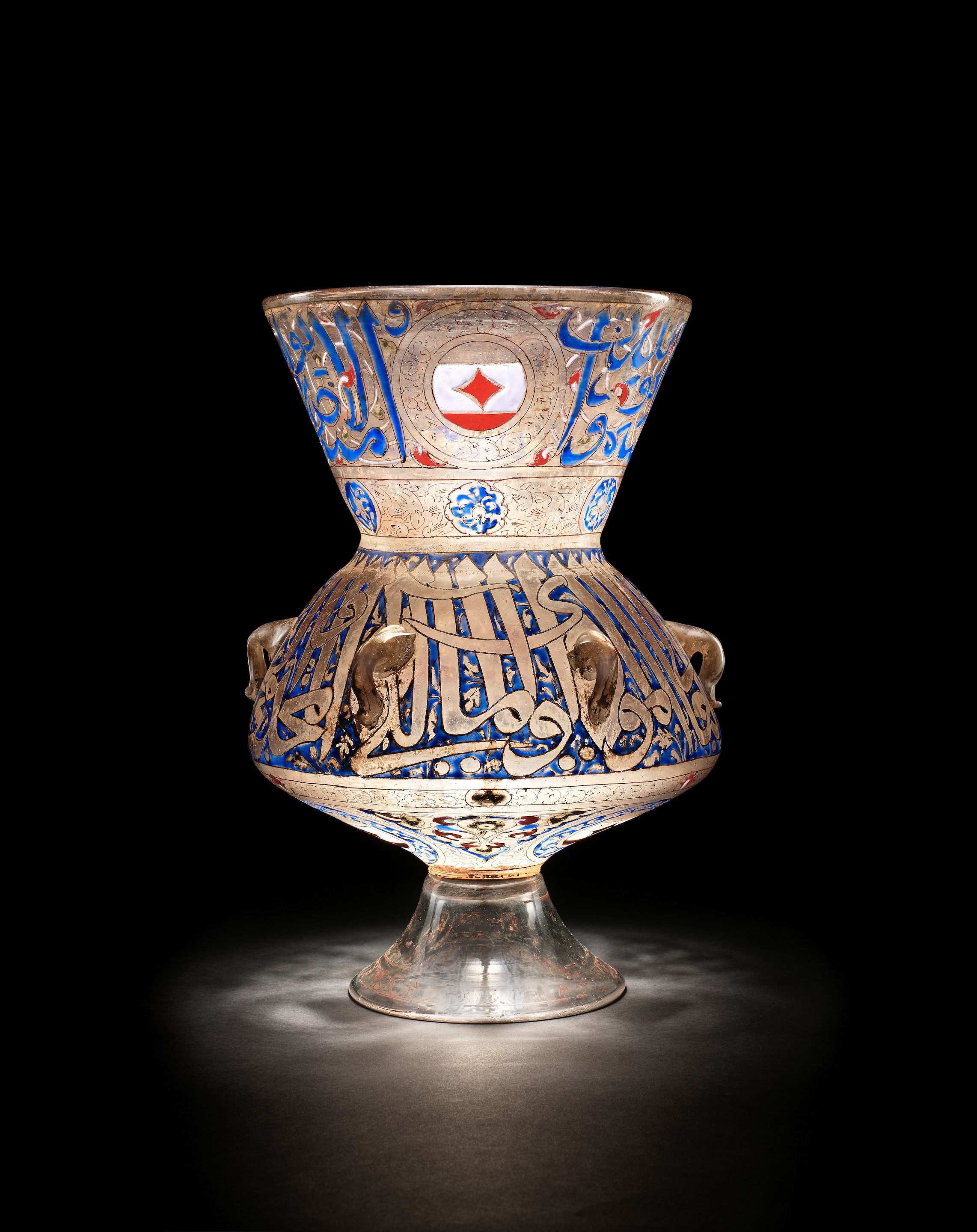
Central to the architectural and sacred grandeur of the collection is the upper section of a fourteenth-century enameled and gilded Mamluk mosque lamp from Egypt, commissioned during the reign of Sultan Hasan for his monumental religious complex in Cairo. Inscribed with monumental Quranic calligraphy alongside the Sultan’s own royal titulature, the vessel belongs to an ultra-scarce surviving group of roughly fifty examples tied to Sultan Hasan’s patronage. Designed to glow softly with suspended oil light inside one of medieval Islam’s greatest architectural sanctuaries, the fragment preserves the luminous interplay between glassmaking virtuosity and sacred text.
Related article - Uphorial Shopify

Through intelligent curation of European and Anatolian collecting history, the textile narrative shifts to a classical Gördes prayer rug distinguished by its crisp architectural prayer arch and deeply saturated red ground. Carrying distinguished aristocratic provenance tied to Count Wolfgang IV of Oettingen-Wallerstein, the rug exemplifies how Ottoman devotional weavings captivated European noble houses centuries ago—prized simultaneously for their geometric clarity, saturated natural dyes, and spiritual serenity.
Through a deep structural understanding of South Asian ceremonial adornment, the showcase turns to a captivating group of historic Indian jewelry formerly acquired by Gilded Age Philadelphia heiress Adeline Pepper Gibson. Highlighted by an opulent manga malai—a traditional South Indian mango-garland necklace—and a Navaratna armlet set with the nine auspicious planetary gems, the pieces bridge sacred temple iconography and royal courtly regalia, reflecting forms originally fashioned for Hindu deities and later worn during monumental bridal and ceremonial occasions.Equally arresting in its technical delicacy is a square-format, single-wefted silk Kashan carpet celebrated for an impossibly fluid, handkerchief-like drape. Executed using an intricate checkered silk weaving technique, the carpet demonstrates Persian workshop mastery pushed to its tactile extreme—transforming structural floor covering into something closer to shimmering, weightless haute couture.

Finally, the preview culminates at the zenith of imperial Mughal book arts with eleven illustrated folios from Sharaf al-Din Ali Yazdi’s Zafarnama—the celebrated chronicle of Timur’s victories—commissioned circa 1595–1600 by the Mughal Emperor Akbar. Among these pages sits an opening folio depicting Timur entertaining Amir Khizr Yasuri in Ulugh Maydan, bearing the signature of young imperial court painter Muhammad Dawlat. Linking Timurid ancestral memory with Akbar’s legendary royal atelier, the manuscript pages capture the precise moment when Persian literary tradition fused with vibrant Mughal naturalism.
Strategic storytelling frames Broadhurst and Plumbly’s walkthrough as far more than a pre-sale catalog tour; it stands as a vivid map of interconnected human ingenuity, tracing how snail-dyed Caucasian wool, Cairene glass, South Indian gold, Persian silk, and Mughal pigment once moved along shared arteries of trade, faith, and royal ambition.Through transformational framing, this chronicle of Christie’s Art of the Islamic and Indian Worlds including Rugs and Carpets highlights transcends routine auction previews. It stands as an enduring cultural and artistic chronicle, proving that when rare material chemistry, sacred architectural patronage, aristocratic provenance, and imperial atelier mastery align, historic objects rise beyond mere collectibles—becoming immortal witnesses to the beauty, devotion, and shared heritage of human civilization.