For New Yorkers, the East River is synonymous with filth, danger, and a centuries-old prohibition against swimming. Public Opinion Channel recently undertook an investigation to challenge this deep-seated urban myth, discovering that while the waters can sometimes be clean, the dangers posed by infrastructural failures and fierce currents remain significant.
The prevailing public opinion on swimming in the East River is overwhelmingly negative and categorical. When asked, New Yorkers responded with emphatic refusals, such as "hell no," "absolutely not," and "never," citing fears of "dead bodies and poop" and contracting serious diseases like hepatitis. This pervasive caution is essentially an "indoctrination" that stems from historical contamination, but many residents admitted this belief is based on anecdotal tradition rather than fact-checked data. This fear has persisted despite the fact that New York City has 520 miles of coastline, yet only 16 miles of beaches are designated as swimmable, and these all face the ocean.
:no_upscale()/cdn.vox-cdn.com/uploads/chorus_asset/file/19667300/GettyImages_1147952430.jpg)
Related article - Uphorial Radio
Historically, the river's reputation is well earned. Before colonization, the harbor was pristine, teeming with wildlife, fish, whales, and an estimated half of the world's oysters. However, as the city expanded, New Yorkers over-harvested the oyster beds and began dumping raw human waste and horse manure directly into the East River. Industrialization exacerbated the problem, with factories dumping waste along the shorelines, rendering the harbor practically lifeless and impossible for people to swim in by the mid-1900s. While the Clean Water Act in the 1970s improved pollution control by making industrial waste dumping illegal, a critical sewage problem persists.
The current contamination issue stems from the city's combined sewage system, which serves roughly 60% of New York City. This system processes household wastewater but also collects rainwater. On rainy days, the excess water that the treatment plants cannot handle is released directly into the harbor through approximately 450 Combined Sewage Overflows (CSOs) along the coastline. Experts estimate that between 21 and 27 billion gallons of raw sewage and untreated stormwater flow into the harbor annually via these CSOs. Fully eliminating CSOs would necessitate reconstructing the entire underground sewage system, a task deemed unlikely.
To assess current water quality, the investigation team partnered with the Billion Oyster Project, which tests water weekly for enterococcus, a bacteria found in sewage. Unlike the Department of Environmental Protection, which can take up to a month for results, the Billion Oyster Project provides data within 24 hours, allowing the public to make informed decisions about weekend recreation. Initial testing confirmed that the water can be clean enough for swimming under certain conditions; multiple East River sites sampled yielded single-day results that would be deemed safe for "primary contact". However, this safety is fragile. After heavy rainfall, many of the same East River sites registered single-day results that would mandate a total beach closure if they were formal public beaches, confirming the water quickly becomes "quite unsafe".
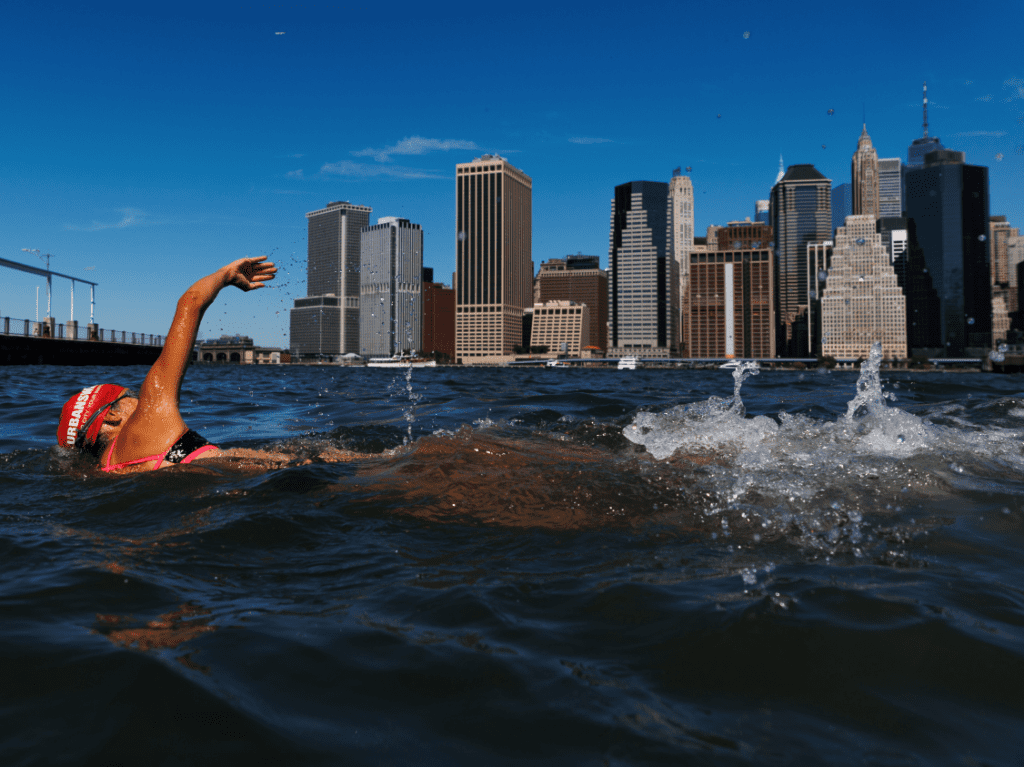
Beyond bacterial safety, the waterways present formidable logistical and physical dangers. The primary hazard is heavy boat traffic, including barges, cruise ships, and ferries, along with debris in the water. More critically, the currents in the Hudson and East Rivers are incredibly strong, reaching up to 3 or 4 miles per hour, capable of sweeping individuals away from boats. Arda, a 16-year-old who completed the 28.5-mile 20 Bridges Swim around Manhattan, confirmed the current was the hardest part of the challenge, emphasizing the need for a trained team. Despite these dangers, organizations like Urban Swim are dedicated to safely reintroducing people to the waterways. These organized events, such as the Rose Pitt Swim, require extensive safety measures, including multiple boats, jet skis, and a dedicated kayak for every swimmer. Participants at an urban swim event reflected that the waterways have become significantly cleaner over the past 50 years. The experience of swimming in the East River, surrounded by the Brooklyn Bridge and skyscrapers, was described as "amazing," transforming participants into "urban swimming evangelists". The hope is that the more people experience safe, clean water, the more they will advocate for the necessary infrastructural work to make the water safer and cleaner for everyone.