Bloomberg Technology, co-hosted by Caroline Hyde in New York, is dissecting the complex financial anxieties surrounding the massive Artificial Intelligence (AI) data center buildout, juxtaposed against a volatile crypto market. Caroline Hyde highlighted that while the NASDAQ is holding onto gains, trading more than 2% higher, Bitcoin is "not charging higher," sitting down 1.5%. Meanwhile, investors have pulled $3.5 billion from Bitcoin ETFs, reflecting the underlying asset’s worst performance since the 2022 collapse, leading to a potential "washout the fast money" in short-term traders.
The core concern raised by Caroline Hyde and her guests is the "AI data center debt debate". Amazon, for example, is demonstrating the tremendous scale of this buildout, owning, managing, leasing, or co-leasing 900 data centers. Caroline Hyde noted that they commonly think of cloud computing involving enormous data centers that companies own, particularly in places like Virginia. However, as revealed by Bloomberg, Amazon’s data center footprint is growing "tremendously," with one key strategy being the use of co-location facilities, which accounted for a fifth of its capacity last year. Matt Day explained to Caroline Hyde that the need for these third-party co-locations often stems from a lack of confidence in the ramp-up of demand, a desire for speed to market, or to achieve flexibility, particularly internationally, where most of these co-locations are understood to be situated.
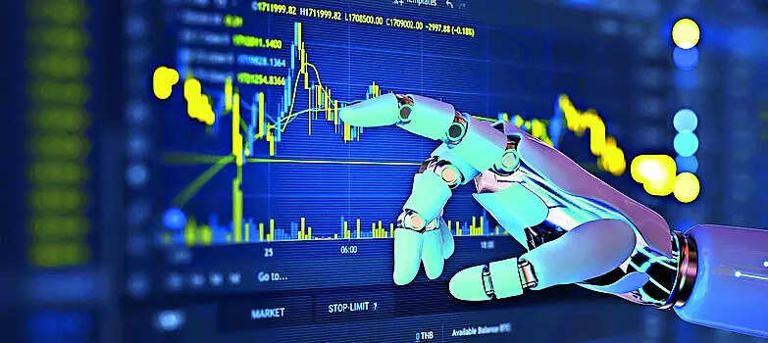
Caroline Hyde also pressed the issue of depreciation, noting that AI firms are taking on significant debt. Companies like Meta are spending tens of billions of dollars on physical assets like GPUs. Since NVIDIA releases new GPU models annually, designed to obsolete its own product, there is a real concern about the useful lifespan of these chips. Most companies are writing down GPUs over five or six years, but a shorter lifespan could mean they are "artificially boosting your profits". Caroline Hyde questioned who is "on the hook" when the "music stops," if the massive amount of debt financing these GPUs is based on an inflated useful life. Jay Hatfield, CEO and CIO of Infrastructure Capital, stated that while they are not "overall worried" about credit risk due to the "tremendous cash flow" of major companies, there is "anxiety" leaking into the market, particularly regarding high valuations like OpenAI trading at 25 times revenue.
Geopolitical issues, highlighted by Caroline Hyde, further complicate the AI landscape. President Trump is currently weighing the decision of whether to allow the sale of NVIDIA H200 chips to China. Howard Lutnick, U.S. Commerce Secretary, articulated the strategic dilemma: should the U.S. sell China some chips and "keep them using our tech," or hold back to "compete in the AI race ourselves". The H200 is considered a "very fast and powerful AI chip". Mike Shepard informed Caroline Hyde that NVIDIA CEO Jensen Huang argues that to compete globally for AI dominance, they must sell some technology in the Chinese market, which is currently the world’s largest market for semiconductors. However, more hawkish voices fear granting Beijing access to sophisticated AI technology, which could enable increased surveillance and use in advanced weaponry.
Amidst these financial and political tensions, Caroline Hyde discussed the continuing advancement of AI-enabled technology. IonQ, a quantum computing firm, has partnered with Heaven Arotech to develop quantum-enabled drones, which boosts them in the national security sector. Niccolo de Masi, IonQ CEO, told Caroline Hyde that drones were the "missing piece" in their strategy to bring quantum networking, computing, and sensing into every environment, including ships, satellites, and on the land. De Masi highlighted that their partnership with AstraZeneca demonstrated a "quantum advantage" with a 20x speed up in computation, turning what was previously a day-and-a-half of GPU data center computation into a fraction of the time. Caroline Hyde noted the importance of this development, as IonQ was the first public quantum company.