Eko Groove was a carefully stitched soundscape that rooted in memory, movement, and the magnetic pull of Nigeria’s cultural capital. Released at a time when Afrobeats dominates global airwaves, Eko Groove positions itself not just as a party soundtrack but as a cultural diary. Across 14 tracks, Spinall stitches together highlife guitar riffs, amapiano percussions, Fuji influences, and the ever-present Afro-fusion bounce. It feels like a sonic tour bus ride through Lagos Island to Ikoyi at sunset, Surulere on a humid afternoon, Lekki at midnight.
Released at a time when Afrobeats dominates global airwaves, Eko Groove positions itself not just as a party soundtrack but as a cultural diary. Across twelve tracks, Spinall stitches together highlife guitar riffs, amapiano percussions, Fuji influences, and the ever-present Afro-fusion bounce. It feels like a sonic tour bus ride through Lagos—Ikoyi at sunset, Surulere on a humid afternoon, Lekki at midnight. Critics have long credited Spinall for his adaptability—whether pairing Tiwa Savage’s silky vocals with minimalist beats or syncing perfectly with Wizkid’s understated swagger. On Eko Groove, he doubles down on collaboration. Guest features include both household names and rising stars, giving the project the duality of familiarity and discovery.
Related article - Uphorial Radio
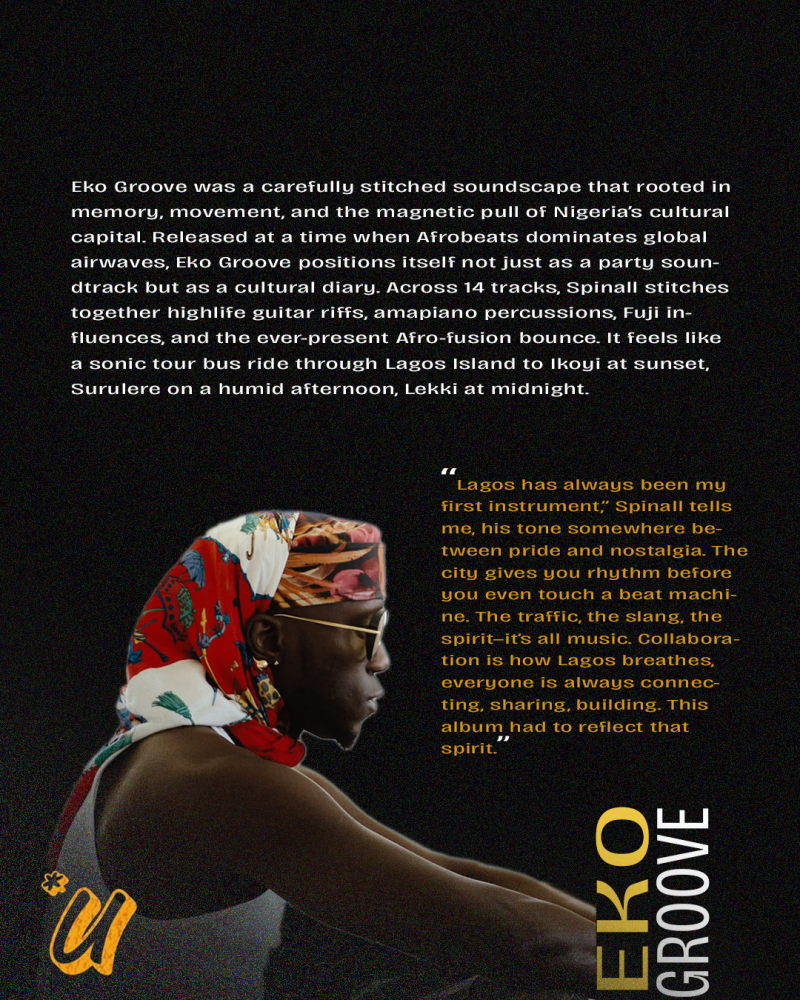
“Lagos has always been my first instrument,” Spinall tells me, his tone somewhere between pride and nostalgia. “The city gives you rhythm before you even touch a beat machine. The traffic, the slang, the spirit—it’s all music.” “Collaboration is how Lagos breathes,” Spinall explains. “Everyone is always connecting, sharing, building. This album had to reflect that spirit.”

Tracks like Island Vibes showcase his mastery of mood, fusing mellow saxophone runs with amapiano log drums. Meanwhile, Surulere Nights dives deep into storytelling, featuring verses that nod to resilience, street hustle, and dreams born under flickering streetlights. Yet, the project never strays too far from its party-ready core. Marina Sunrise and Owambe Forever are designed for dancefloors, with layered percussions and hooks engineered to make bodies move. Spinall insists that this balance was intentional: “You can’t talk about Lagos without talking about struggle and joy. The groove is in how we mix both—laughing even when the power goes out, dancing even when tomorrow is uncertain.” Beyond its Nigerian heart, Eko Groove also tilts toward international ears. Subtle EDM textures weave into Afro-house rhythms, and some tracks lean into Latin-inspired percussion, widening the album’s cross-cultural appeal.
It’s no surprise—Spinall has toured globally, from New York to Paris, and understands the universality of rhythm. Still, he resists the idea that he is making music for the global market. “I’m not chasing international approval,” he says firmly. “I’m exporting Lagos as it is. If the world vibes with it, then Lagos has already won.” Eko Groove is more than an album—it’s a cultural export wrapped in basslines and harmonies. Spinall uses sound to document the complexity of Lagos: the chaos, the beauty, the humor, and the grind. At its best, the project feels less like a playlist and more like a living map, each track a pin dropped on the city’s sprawling, restless energy. For listeners outside Nigeria, it’s a gateway to the Lagos spirit. For those within, it’s a mirror—reminding them that even in the noise and bustle, there is rhythm, groove, and pride. As Spinall puts it, “Eko is not just a place. It’s a frequency. With this album, I just wanted the world to tune in.”