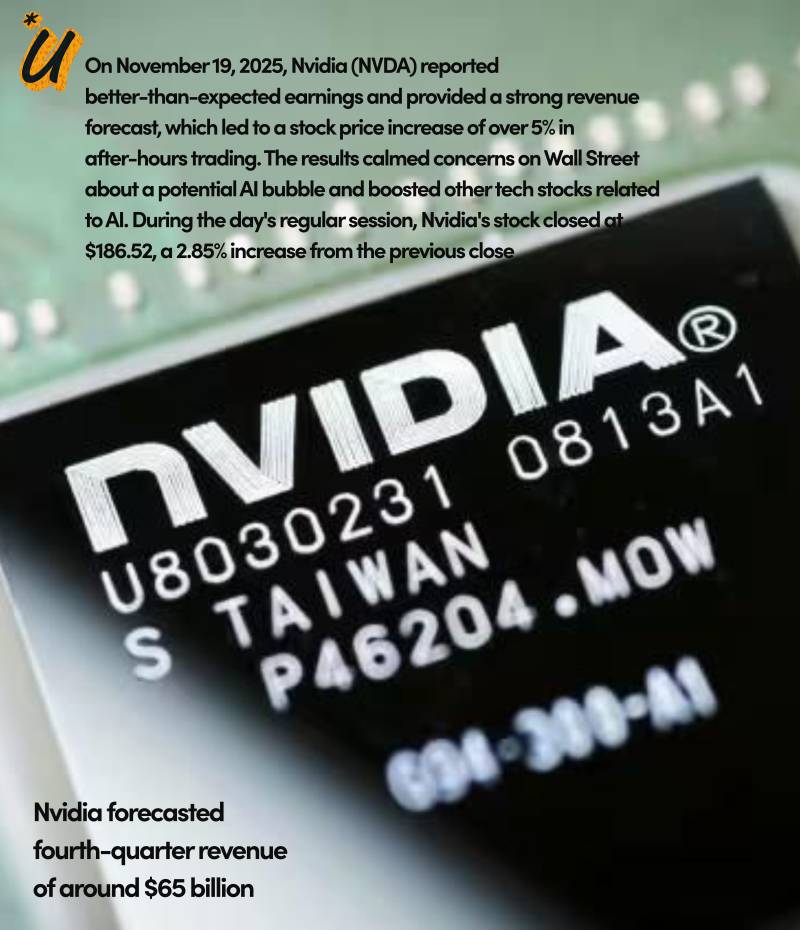
The financial world is treating Nvidia’s latest earnings report as the "Super Bowl moment" for the entire artificial intelligence trade, according to Bloomberg Technology. The hosts, Caroline Hyde and Ed Ludlow, emphasize that the results will dictate the "next direction of where the market -- entire market is going to go". With the stock up almost 40% year to date, Bloomberg Technology notes that this performance is double the performance of what has been seen in the Nasdaq and S&P 500. Nvidia holds the "largest weighting in the S&P" and is the "biggest name in A.I.".
The immense expectations are clear: analysts anticipate revenue and net income growth above 50%. Revenue predictions for the year are in the "60billionrange", a figure"10−X where we were three years ago". This trajectory suggests expected net income of "100 billion"—a sum greater than Intel and AMD’s combined revenue. Bloomberg Technology analysts stress that while the numbers are expected to be good, the crucial factor will be CEO Jensen Huang's forward guidance and whether the industry "really believe the basis for those numbers". The guidance is "probably even more important than the numbers that Nvidia actually reports".
Bloomberg Technology has actively probed the "real concerns and there are some real questions for Nvidia". The primary issues are depreciation and circular financing. This skepticism was heightened by the recent deal where Nvidia committed $5 billion to Anthropic, which in turn made a "big commitment to use a lot more of Nvidia’s chips". This arrangement is a concern that is "absolutely not going away" and will "accelerate until we get a clear outcome".
The depreciation question is crucial because, as Ed Ludlow noted, customers need to know how to "model for that impact on the balance sheet of those key customers of Nvidia". Investment perspective shared on Bloomberg Technology suggests these doubts—concerning depreciation and long-term demand—are "going to linger" and could lead to "more volatility" in the market. The question is whether Nvidia’s report will answer "all the A.I. doubts that are out there or whether it’s just going to arrest them for now".
The sheer scale of the AI infrastructure buildout was emphasized by a massive announcement covered by Bloomberg Technology: Brookfield Asset Management is partnering with Nvidia on a global AI infrastructure program targeting "150billionofcommitments". This financing arm plans to acquire up to "300 billions of data center energy and other assets".
This demand is driving a global push for compute power, highlighted by the appearance of Jensen Huang alongside Elon Musk at the U.S.-Saudi Investment Forum in Washington, D.C. Musk confirmed that X.AI will build a 500-megawatt data center in the Kingdom of Saudi Arabia. This reflects the urgency for regions to find "sovereign A.I." and secure access to the latest, greatest chips. The U.S. government, as Bloomberg Technology reported, is hopeful for reciprocity, seeking for Middle Eastern finance titans to invest "the equivalent number of dollars into the United States itself".
Musk and Huang even speculated on the "realms of imagination" regarding energy limitations. Musk argued that within four or five years, the "lowest cost way to do A.I. compute would be with solar-powered A.I. satellites" in space, where there is "continuous solar" and cooling can be achieved radiatively. Huang reinforced this, noting that of a two-ton supercomputer, "1.95 of it is probably for cooling".
When asked directly about an "A.I. bubble," Huang countered by justifying the investment with three fundamental shifts in computing, a segment also highlighted by Bloomberg Technology:
1. Transition to Accelerated Computing: Six years ago, CPUs were 90% of the world’s supercomputers; today, accelerated computing is at 90%.
2. Generative AI is the New Recommender System: The recommender system, the "engine of the Internet today," is "going Generative A.I.".
3. Agentic AI: This final opportunity, which includes Grok, OpenAI, and Gemini, is built on the prior two.
Huang asserted that the huge number of GPU supercomputers being built is justified by the needs of raw data processing (like SQL processing and data frames) alone, making the remaining investment for revolutionary Agentic AI "substantially less than you thought and all of it justified". Investment analysts featured on Bloomberg Technology largely concur, noting the belief that the "A.I. super cycle is real" and will have a "profound impact on the economy".
Bloomberg Technology also covered competitive shifts, noting that Alphabet/Google shares traded at a record high following the release of Gemini 3, which executives claimed shows a "big jump in the model’s ability for reasoning and coding". Analysts noted that if Gemini 3’s success is evidence of Google’s custom chip, the T.P.U., that might allow Google Cloud to offer more of its Nvidia allocation to external customers, boosting their cloud business.
Finally, Bloomberg Technology debated the impact of AI on the workforce, noting that executives are increasingly "laying the blame for job cuts at technology as feet". Executives have boasted that new AI agents "work hard 24/7," "don’t have to pay them," and "don’t need any healthcare benefits," making them "very affordable". Some experts suggest this may be a case of "A.I. washing," where technology is used as a convenient excuse for overhiring during COVID.