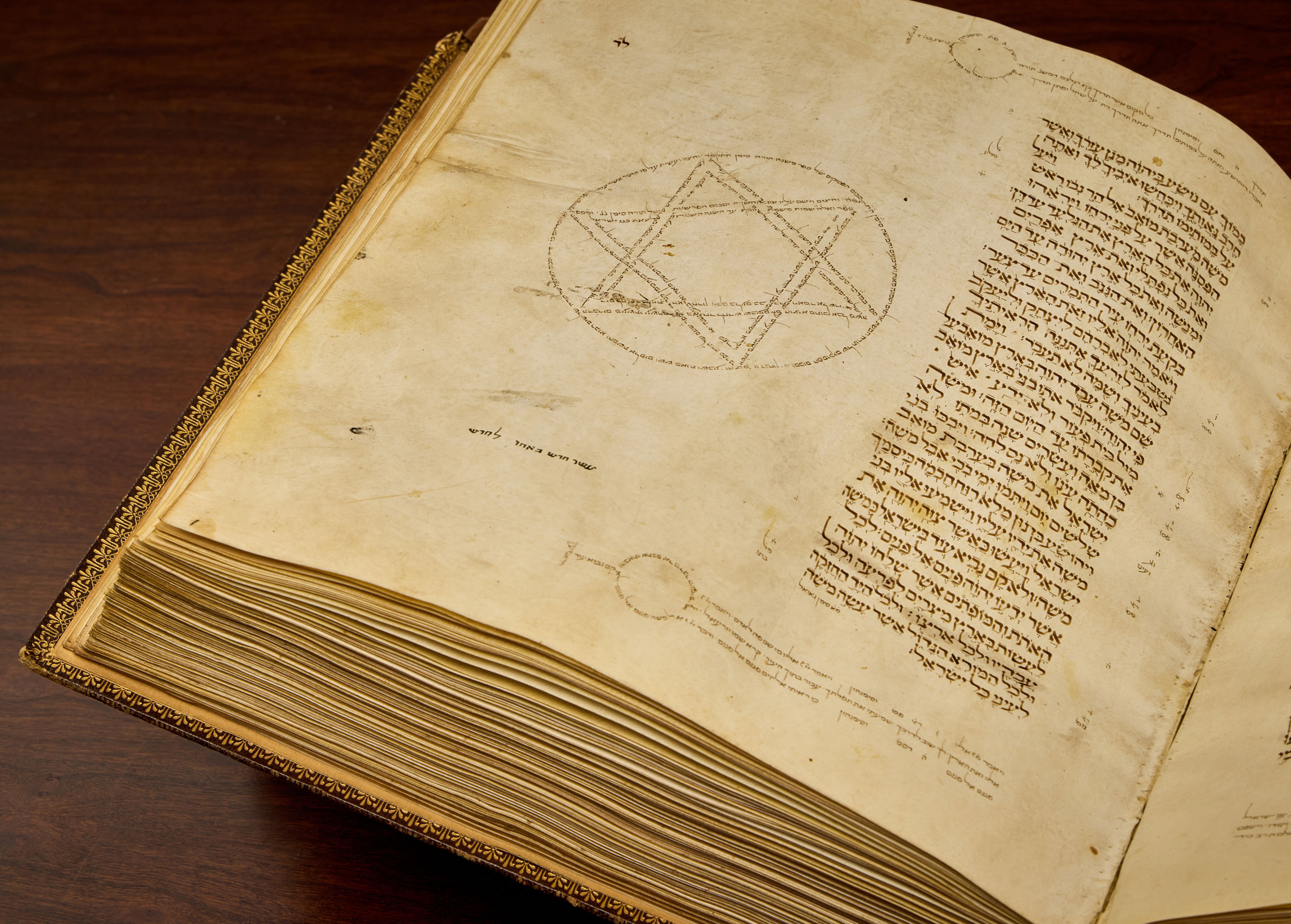
Global Jewish history has been defined for seven centuries by the constant movement of merchants, scholars, and families rebuilding after upheaval. Drawing on thirty years of expertise in Judaica, Sotheby’s identifies a selection of rare treasures that act as a map of this global diaspora, illustrating how ritual objects testify to both adaptation and continuity across the "four corners of the world". One of the most remarkable items is a Hebrew Bible from 1300, which Sotheby’s specialists identified through careful study of codicology and paleography as a masterpiece of the scribal culture in Toledo, Spain. This manuscript, created by the expert scribe Joseph Ben Judah Iben Marvas, features intricate micrography—miniature writing forming geometric shapes like the Star of David—and required approximately 150 sheep skins to produce its 400 pages. Remarkably, it survived the 1492 expulsion of Jews from Spain, carried into exile by a community that was permitted to take little else but their books.
Related article - Uphorial Shopify

The narrative of the diaspora continued in Italy, where Jewish families adopted local artistic styles into their traditions, as seen in a lavishly decorated 1732 marriage contract (Ketubot). This document incorporates zodiac signs as visual representations of wishes for good luck, alongside the Aramaic blessing for "congratulations," bimanava umalia. For those constantly on the move, a charming 18th-century miniature traveler’s prayer book offered protection and a sense of home; housed in its original gold-tooled leather case, it was a practical tool for merchants to carry on their journeys. Sotheby’s also highlights the aesthetic synthesis found in a 1752 Dutch Rococo silver Sabbath lamp, or Judenstern, and an extraordinary Chinese silver Torah case. The Torah case exemplifies a cross-continental cultural collision, following a structural model that originated with Iraqi Jews in Baghdad but decorated by Chinese craftsmen with traditional motifs like overblown peonies and scrolling leaves.
The collection's journey through memory concludes with the work of Ilya Schor, a silversmith who fled Ukraine and Paris for New York on the eve of World War II. His Sabbath candlesticks depict a "vanished world," featuring poignant vignettes of mothers holding challah and children playing with dreidels—scenes from a life he knew before it was destroyed by conflict.
As the experts at Sotheby’s observe, these objects refuse to be reduced to a single narrative; instead, they serve as enduring evidence of a people whose life has always been "both mobile and deeply rooted," carrying traces of craft, devotion, and reinvention across centuries. These artifacts are like ancient anchors that have been dragged across the ocean floor; though they have moved thousands of miles through turbulent waters, they still grip the heavy stones of their original tradition, keeping the identity of a wandering people firmly grounded regardless of where they land.