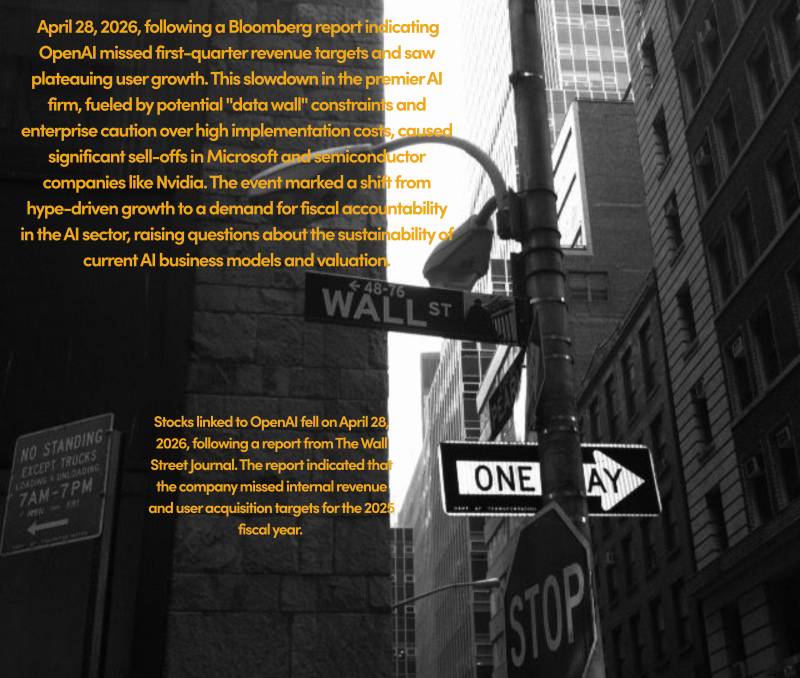
The high-flying world of artificial intelligence faced a stark reality check on Tuesday as stocks linked to OpenAI and the broader generative AI ecosystem experienced a significant sell-off. The downturn followed a leaked internal report suggesting that the San Francisco-based firm, widely considered the bellwether for the AI revolution, has missed critical performance targets and revenue milestones for the first quarter of 2026. This development has sent ripples through global markets, prompting investors to reassess the aggressive valuations that have defined the tech sector over the past three years.
For much of the morning trading session, the Nasdaq Composite and the S&P 500 tech sector struggled to find their footing as the news from Bloomberg Tech began to circulate. The report, which cites sources familiar with OpenAI’s internal financials, indicates that the company fell short of its projected growth in enterprise subscriptions and API usage. Perhaps more concerning for the market is the indication that the development of its next-generation foundational model has faced unforeseen technical hurdles, leading to a delay in its highly anticipated release schedule.
The immediate fallout was most visible in the share prices of OpenAI’s primary backers and hardware partners. Microsoft Corp., which has invested billions into the startup and integrated its technology across its software suite, saw its shares dip as analysts questioned whether the "AI dividend" was materializing as quickly as predicted. Similarly, semiconductor giants like Nvidia and AMD, whose GPUs power the massive data centers required for OpenAI’s operations, experienced a sharp pullback. The logic among traders appears to be that if the industry leader is seeing a deceleration in demand or execution, the entire supply chain will eventually feel the squeeze.
Market analysts suggest that this correction was perhaps inevitable given the astronomical expectations placed on AI firms. Since the launch of ChatGPT, the market has operated on the assumption of exponential, uninterrupted growth. Today’s report serves as a reminder that even the most innovative companies are not immune to the complexities of scaling infrastructure and the cyclical nature of enterprise spending. There is also the growing concern of "AI fatigue" among corporate clients, who are now scrutinizing the return on investment for expensive AI integrations more closely than they were twelve months ago.
The Bloomberg Tech report also highlighted a shift in the competitive landscape. As OpenAI navigates these internal headwinds, open-source alternatives and nimble competitors are gaining ground, offering comparable performance at lower price points. This has put downward pressure on OpenAI’s margins, a factor that appears to have contributed to the missed targets. While OpenAI remains the most recognizable name in the field, the aura of invincibility that once surrounded the company is being tested by the realities of a maturing market and increasing regulatory scrutiny.
Despite the immediate negative reaction, some institutional investors view the sell-off as a necessary recalibration rather than a fundamental collapse of the AI thesis. Proponents argue that missing a target does not equate to a failure of the technology itself, but rather a misalignment between market hype and the physical timeline of deployment. However, the sentiment on the floor of the New York Stock Exchange remained cautious as the closing bell approached. The "AI trade," which has been the primary engine of the bull market, is facing its most significant test of confidence to date.
Looking ahead, the focus will shift to OpenAI’s official response and its upcoming developer conference, where the company will need to provide a roadmap that restores investor faith. Until then, the volatility in AI-linked stocks is expected to persist as the market moves away from speculative enthusiasm toward a more disciplined, results-oriented evaluation of the sector. The era of "growth at any cost" in artificial intelligence may be giving way to an era of accountability, where missing a target is no longer overlooked by a captivated market. For now, the tech industry remains on edge, waiting to see if this is a temporary stumble or the beginning of a broader cooling period for the AI boom.