LOS ANGELES - The immigrant experience in America is often mapped through a complex, generational tug-of-war—a delicate tightrope walk suspended between the sacred, unyielding traditions of the homeland and the relentless, hyper-individualistic demands of the American dream. For the children of this remarkable diaspora, life is an ongoing exercise in cultural translation, where identity is forged not in a single fixed location, but in the vibrant, often humorous space between two worlds. In a profoundly heartfelt, side-splitting, and deeply introspective episode of One54, hosts Akbar Gbajabiamila and Godfrey Danchimah sit down with celebrated comedian and actor Chinedu Unaka—beloved by millions for his sharp-witted television work on hit shows like Abbott Elementary and Insecure—to explore the universal triumphs, absurdities, and emotional depths of growing up as a Nigerian-American in the United States.
At the very heart of the conversation is the shared cultural lexicon of the Nigerian-American childhood, a rite of passage rich with specific nuances that instantly resonate with anyone raised in a traditional West African household. Unaka opens up with disarming emotional precision about the universal immigrant struggle of having his name repeatedly mispronounced by schoolteachers, institutional bureaucrats, and neighborhood baristas alike—a micro-indignity that quietly forces young children to constantly negotiate the pronunciation of their own heritage. More pressing, however, was the immense psychological and cultural pressure of meeting his parents' towering, non-negotiable expectations. Like countless immigrant children whose parents sacrificed everything to cross oceans, Unaka was funneled toward the traditional "holy trinity" of immigrant career paths: medicine, law, or engineering. The quiet rebellion required to step away from these prescribed blueprints to pursue a life in the arts forms the foundational bedrock of his extraordinary journey.

Related article - Uphorial Shopify
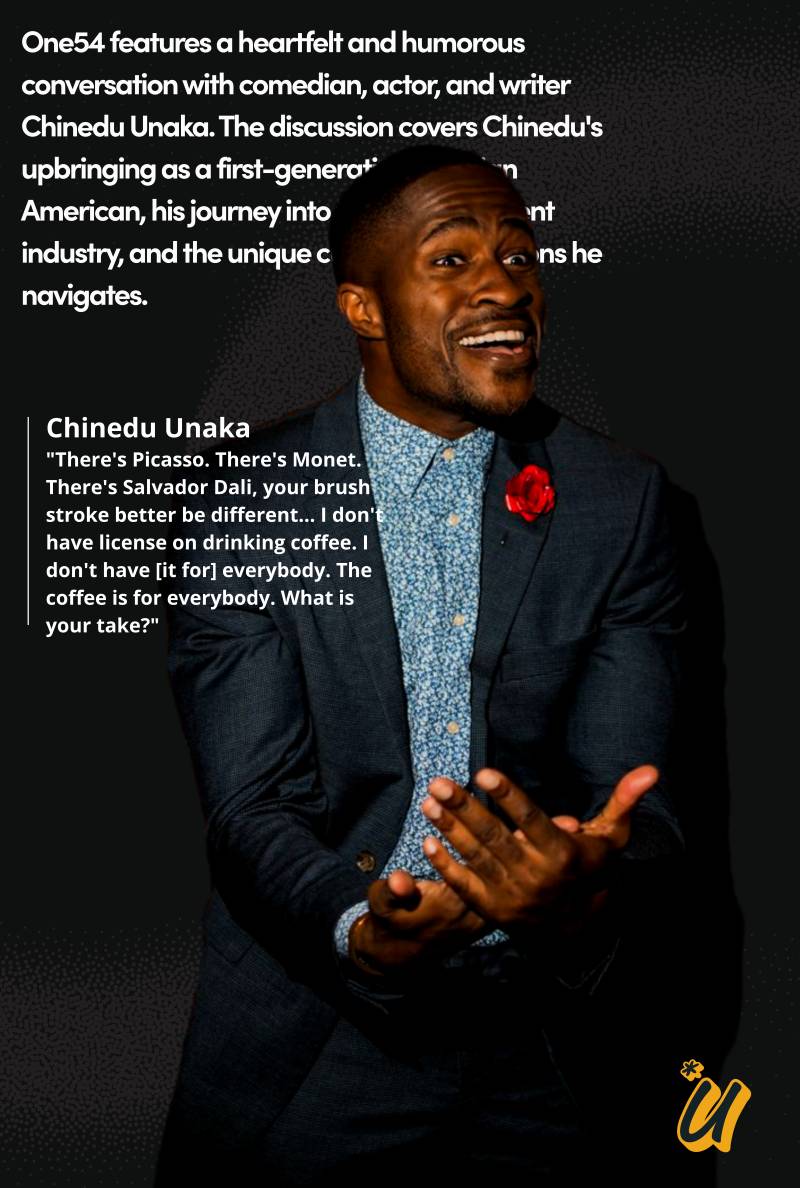
That rebellion crystallized into destiny during his college years, sparked by an unlikely catalyst: a simple dare that pushed him onto a campus comedy stage for the very first time. Unaka recounts his origin story in stand-up not as a premeditated career move, but as a sudden, electric collision between raw comedic instinct and a desperate need for authentic self-expression. He details the grueling, unglamorous grind of building a comedy career from the ground up, navigating open mics, late-night club sets, and the intricate, unforgiving science of reading a room. In a brilliant display of cultural understanding, the hosts and their guest explore the wildly distinct dynamics of performing for different types of audiences, noting the unique, high-stakes challenge of entertaining Nigerian crowds—where parental critique and unfiltered cultural honesty are delivered straight from the front row.
As the conversation pivots from the gritty underground comedy circuit to the glittering heights of Hollywood, Unaka reflects on his seamless yet hard-fought transition from the intimate stage to the television screen. He shares behind-the-scenes insights from his standout work on critically acclaimed series like Abbott Elementary, revealing the collaborative genius required to thrive in a writers' room and hold one's own alongside television royalty. Delving into the artistic DNA that fuels his performances, he credits comedy legends like Jim Carrey and Eddie Murphy as foundational influences who taught him that physical comedy and razor-sharp timing are merely vehicles for conveying deep human vulnerability. Every character he brings to life is underpinned by the intelligent curation of human observation, blending broad physical humor with subtle cultural truths.
Beyond professional milestones, the dialogue deepens into a moving, shared meditation on cultural reconnection. Gbajabiamila, Danchimah, and Unaka trade personal stories about returning to Nigeria as adults, unpacking the profound, emotional impact of stepping onto ancestral soil. For children of the diaspora, these return pilgrimages often serve as a mirror, dissolving the idealized myths of the homeland and replacing them with a complex, tactile understanding of identity, belonging, and familial roots. It is a transformational framing of displacement and return, illustrating how reclaiming one's heritage is not a static event, but a lifelong, evolving reconciliation of two distinct cultural pulses beating within a single chest.
As the episode draws toward its inspiring conclusion, the spotlight shifts to Unaka’s explosive current career momentum, highlighted by his celebrated stand-up special now streaming on Hulu. Yet, despite his blossoming television resume and mainstream success, Unaka makes it unequivocally clear that stand-up comedy remains his absolute favorite medium for creative expression—the one place where he retains total autonomy, direct communion with his audience, and the freedom to speak his absolute truth. Ultimately, his journey from the pressures of a traditional Nigerian household to the pinnacle of modern comedy stands as a masterclass in strategic storytelling, proving that when you honor your roots, embrace the absurdities of your upbringing, and trust your unique voice, the entire world cannot help but listen and laugh along.