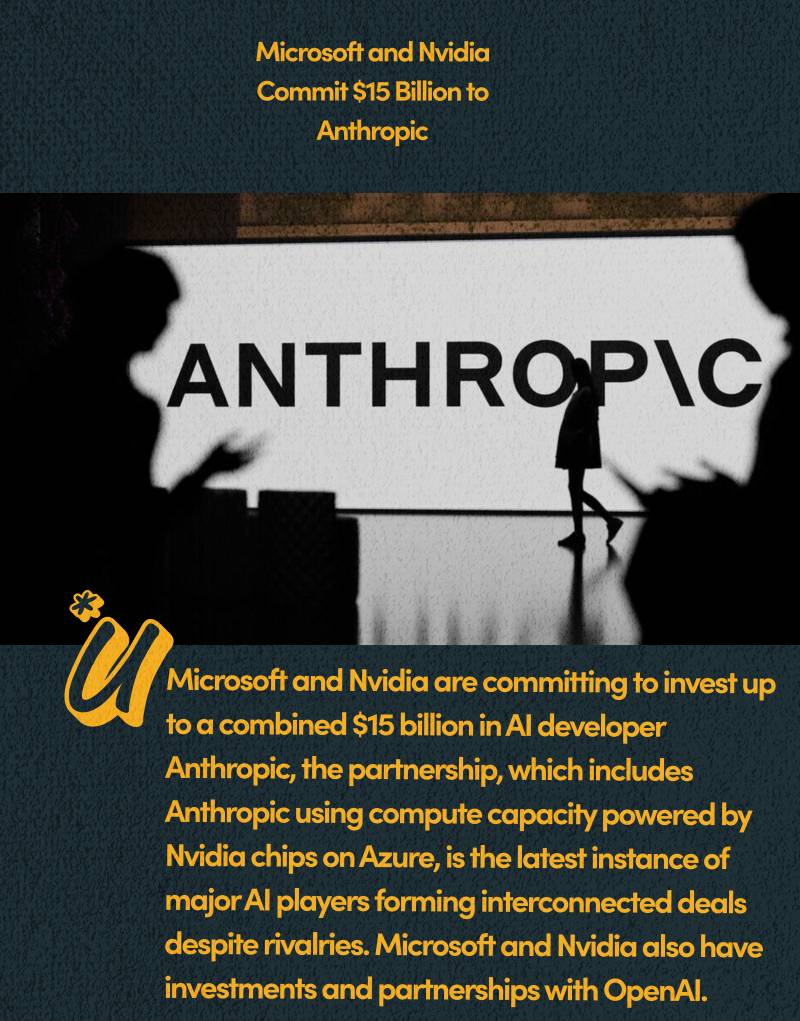
The latest episode of Bloomberg Technology, hosted by Caroline Hyde in New York and Ed Ludlow in San Francisco, delved into the escalating competitive landscape of artificial intelligence, highlighting a massive, combined commitment of up to $15 billion from Microsoft and Nvidia into Anthropic. This significant investment further tightens Anthropic's ties to the biggest backers of its main rival, OpenAI. As Ed Ludlow noted, this maneuver is "following the OpenAI playbook", where Anthropic accepts money from Microsoft and Nvidia, contingent upon spending on their platforms and utilizing their chips. This type of arrangement is described as the "new normal," driven by a "bottomless need" for compute, suggesting that companies "have to rise together or they fail". This financing is part of a larger, still-to-be-announced investment round for Anthropic.
The complex web of alliances in the AI sector was a key focus, with Caroline Hyde pointing out the anxious reaction from other players. Amazon felt compelled to clarify that they remain the "number one provider of cloud and training compute to Anthropic". Meanwhile, the rivalry with OpenAI continues, with that company seen turning to Anthropic's backers, namely Google and Amazon, creating "a lot of intrigue" on what that means for the Google-Ad relationship. While Google assists both Anthropic and OpenAI, it is simultaneously striving to be the dominant model peer with Gemini Three, touting gains in coding and mimicking processes that are "key aspects for Anthropic and OpenAI as well". Google's premium tier for Gemini Three, priced at $250, offers more intense reasoning and hypothesis testing.
The conversation then shifted to the global political dimensions of the chip competition, as the Saudi Arabian Crown Prince arrived at the White House to meet with President Trump. Caroline Hyde and Ed Ludlow framed the discussion around deepening U.S.-Saudi ties, with a particular focus on tech and innovation. A core issue is Saudi Arabia’s pursuit of greater access to U.S. intellectual property, specifically the latest chip innovations from companies like Nvidia. Saudi Arabia is offering hundreds of billions in investment into America in exchange. However, export licenses related to advanced semiconductors—promised six months prior following a visit by President Trump—have not yet been granted. The two sides are still negotiating security conditions for the shipments and reciprocal investments from Riyadh, which pledged $600 billion in U.S. investments over the next four years.
Later in the segment, Caroline Hyde and Ed Ludlow covered market stability and corporate innovation. Discussing Nvidia's stock performance, which was "just about flattish" for the fourth quarter, Senior Portfolio Manager Margaret Patel dismissed market anxieties, calling the pressure a "garden-variety correction". She asserted that the trend for artificial intelligence and data centers is "so strong" that a severe downward correction is unlikely, noting that companies are struggling to fill demand.
Finally, Caroline Hyde interviewed Roblox CEO David Baszucki regarding the platform’s decision to roll out age verification for all users and introduce age-based chat, aiming to increase protections. Baszucki told Bloomberg Technology that Roblox is the "first major gaming platform to use AI to estimate the age of everyone" using chat and communication, analyzing a quick image with AI to figure out who users might be chatting with to prevent minors from communicating with adults. The company expects the rollout to be complete by January.