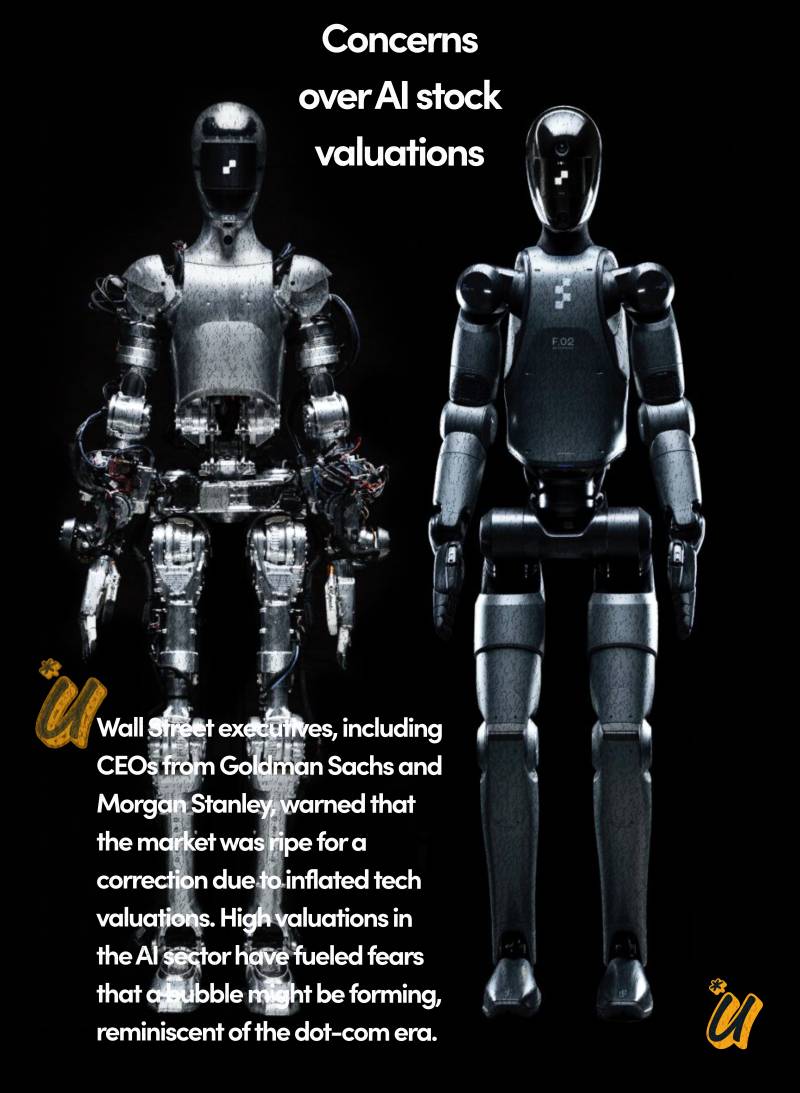
The AI rally is facing intense scrutiny regarding valuations, leading to pressure on the broader technology sector, as discussed on "Bloomberg Tech" with Caroline Hyde in New York and Ed Ludlow in San Francisco. The NASDAQ 100 has been under pressure, experiencing the worst selloff seen in the month. This market volatility coincides with warnings from Wall Street executives for investors to brace for a market correction exceeding 10% in the next 12 to 24 months, a situation Christine Hooper characterizes as a "Tale of Two Cities" where technology's success masks broader economic weaknesses.
A prime example of this tension is Palantir. Ed Ludlow highlights that Palantir's shares fell despite the company raising its annual revenue outlook, with sellers fixated on its valuation. Adding to the pressure, the bearish wagers disclosed by Michael Burry of "The Big Short" fame, particularly Palantir put options, underscore wider concerns about whether the market is in an "AI bubble".
However, aerospace analyst Marianna Perez Mora remains highly bullish, reiterating a Buy rating and upping the price target to $255, a conviction that Caroline Hyde explored. Mora contends that Palantir has "proven it has been the winner of this AI limitation" due to its peerless infrastructure, built over more than 20 years, focusing on ontology and data integration. This capability allows customers to extract real value, saving money and doing things “faster, cheaper, better, smarter”. Palantir’s deep experience with complex U.S. government operations translates directly to its commercial offerings. The analyst is convinced that “even if the AI bubble were to burst, Palantir would survive”. Ed Ludlow noted the strong commercial growth in the U.S., accelerating 121% year-on-year, though international commercial growth lags as Palantir focuses resources on domestic demand.
The risk factors threatening the sustained AI capital expenditure (CAPEX) boom are multifaceted, according to Christine Hooper. These include obstacles related to rare earth elements and concerns that productivity gains may be less significant than anticipated, leading companies to potentially slow down investment. Furthermore, the NIMBY movement (Not in My Back Yard) is emerging as a threat, with rapidly rising electricity costs driven by massive data center builds. Romaine Bostick offered concrete context, reporting on New Jersey where wholesale electricity prices jumped more than tenfold due to data center demand, which is currently 500 megawatts and is likely to double within a year.
In the mobility and delivery space, Ed Ludlow pointed out that while Grab raised its earnings forecast and increased its EBITDA guidance from $490 million to $500 million, leveraging affordability to achieve 40 million monthly transacting users, Uber reported disappointing income and EBITDA. Natalie Lam reported that Uber's results were linked to its strategy of investing heavily in new, non-profitable products, such as autonomous vehicles. Grab's CEO Peter Oey explained their approach of making products more affordable, like group food orders and less expensive shared rides, which drives cross selling and overall usage. Separately, Instacart is joining the AI fray, launching an AI chatbot service for groceries that can offer recommendations within retail apps like Kroger’s.
On the hardware front, Ed Ludlow covered AMD, which is set to report earnings amid the AI push. While AMD has secured major deals with OpenAI and Oracle for its latest AI chips, giving it a validated position, it significantly trails NVIDIA in annual revenue. Investors, Caroline Hyde noted, are demanding concrete numbers and strong forecasts to see how these deals translate into short-term revenue. Meanwhile, NVIDIA continues to expand its infrastructure, unveiling plans for a $3.2 billion data center in Germany.
Cloud platform Snowflake is addressing valuation concerns by focusing maniacally on delivering value. CEO Sridhar Ramaswamy detailed its strategy to become the data center of choice for enterprise AI, expanding partnerships to offer models like Google Cloud’s Gemini, alongside existing collaborations with AWS and Azure. Ramaswamy emphasized that Snowflake operates on a consumption model—it only recognizes revenue when customers use the products—forcing a focus on value creation. Caroline Hyde highlighted the importance of this value proposition in the context of an "AI bubble," to which Ramaswamy responded that their model prevents asking for investments ahead of the return, instead focusing on using agentic AI to replace expensive solutions for a fraction of the cost. He concluded that outside market distractions like valuations are secondary to the focus on creating value for customers.
Finally, the political landscape remains critical. The world’s largest sovereign wealth fund (Norway's), the ninth largest shareholder in Tesla, voted against CEO Elon Musk’s pay package due to concerns over its magnitude, dilution, and key man risk. As Caroline Hyde summarized, the Norwegian fund has historically opposed Musk’s pay packages, yet the board has often succeeded due to the substantial retail investor base. The current market sentiment, as summarized by Ed Ludlow, is defined by a dichotomy: strong fundamentals in key AI companies like Palantir, juxtaposed with acute anxiety about valuations and the sustainability of the boom. This creates a high-stakes environment where every earnings report and political decision is filtered through the lens of whether the AI ascent can maintain its breathtaking momentum.