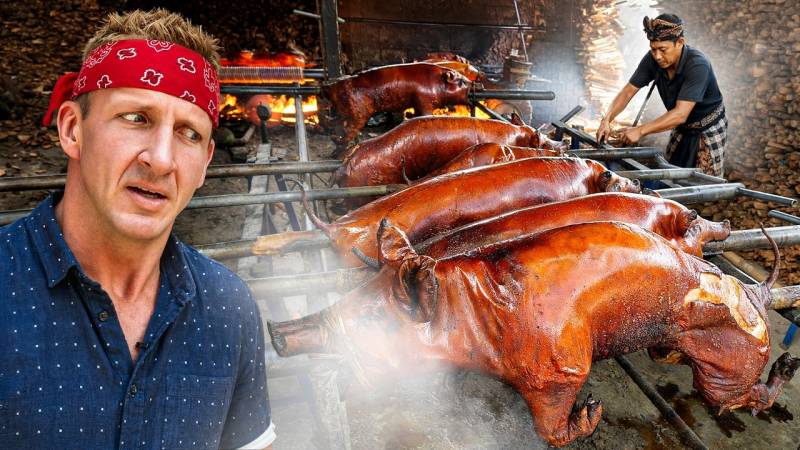
The markets of North Sulawesi, Indonesia, represent what has been dubbed "Asia's most extreme market" and the "final boss of extreme food culture," an environment characterized by sensory overload and fare that terrifies even many Indonesians. Andrew Fraser aimed to uncover whether these unusual foods are mainstream or marginal, test them himself, and trace their origins by traveling to the jungle to witness their hunting and preparation. Fraser noted that this unusual food culture is not driven by shock value, tourism novelty, or strange medical claims, but is simply "everyday Minahassen culture" and tradition, such as eating bat for Christmas dinner in Tomahan.
Fraser's journey began with a roadside vendor selling bats skewered on sticks "like some kind of popsicle from hell," an unusual sight that marked his entry point. He quickly arrived at Tomahan Market, which, despite being "beautiful" initially, soon revealed its reputation as one of the "craziest meat markets in Asia". The meat section was an "absolute sensory overload" where nearly every vendor was "stacked with jungle fair," including blackened, roasting dogs, pigs, pythons, and "endless numbers of bats". Fraser observed the pervasive smell of "burning air charred skins" and the constant sound of blow torches cleaning orders. Since North Sulawesi is a devoutly Christian region, wild boar, otherwise uncommon in Indonesia, is widely sold.
Related article - Uphorial Radio
The documentation of bat preparation was particularly comprehensive. Vendors display bats everywhere stacked on trays or hanging on hooks, often flapping them about to attract customers. When sold, the bats are slightly roasted. A vendor demonstrated how the bat is cleaned, noting that everything goes into the pot—organs, intestines, hairy ears, wings, and skin—as the guts are traditionally consumed as a remedy for asthma. Fraser's initial enthusiasm waned upon seeing the raw preparation, acknowledging that the process of cooking the whole bat was "pretty challenging". After boiling, the broth is saved and drunk as a traditional medicine to keep one strong or healthy. Fraser later tried the finished dish, finding the experience difficult due to the skin being "so tough" that it felt like leather, and the presence of "tiny micro hairs" and a very "gamy flavor". He noted that the wings are considered the best part and are often fought over by family members.
Fraser also dedicated significant effort to understanding the white-tailed forest rat, a species native to Sulawesi that is semi-arboreal. These rats are not cheap; three sells for 100,000 Rupiah, making them more expensive than staple meats like chicken or duck, and demand surges around Christmas and Easter. The hunting of these rats is essential for both protein and as a form of pest control, as they raid valuable cacao and coconut crops. Fraser joined a night hunt deep in the "pretty thick Sulawasian jungle," noting the immense effort required for such "tiny ass little rats". The rats were cooked over an open fire until "every last hair has kind of been singed off". After being chopped and rinsed, the meat was mixed with shallots, lemongrass, herbs, mushrooms, chilies, and garlic, then pushed into thin bamboo tubes for a final cooking stage. The final meal was intensely smoky and spicy, with the meat being dark red, chewy, and lean, which Fraser compared to duck or squirrel. Despite the challenges of hunting and preparation, Fraser ultimately concluded the flavor was "genuinely really, really good," recommending purchasing them at Tomahan Market as the easier option.