When Terry Gene “Hulk Hogan” Bollea collapsed in his Clearwater, Florida home on July 24, 2025, at 71, the world of sports entertainment lost more than a man—it lost a cultural seismic force that reshaped wrestling and pop culture alike. He wasn't born a superstar—Hogan began life as a musician, playing bass guitar for a local Tampa band called Ruckus. His physical stature and larger-than-life presence caught the attention of wrestling icons Jack and Jerry Brisco, and eventually Hiro Matsuda, who famously tested Hogan’s resolve by breaking his leg to see if he would return to training.
Hogan did return, electrified, stepping into the ring for his debut match on August 10, 1977, under the masked persona Super Destroyer in Championship Wrestling from Florida. In 1984, after wrestling stints in AWA and New Japan, he returned to Vince McMahon’s WWF and defeated The Iron Sheik to claim his first world heavyweight title. That victory, coupled with his flamboyant red-and-yellow gear and the catchphrase “Whatcha gonna do, brother?”, sparked “Hulkamania”—a cultural frenzy that sent wrestling from regional sport to global phenomenon.
Related article - Uphorial Podcast

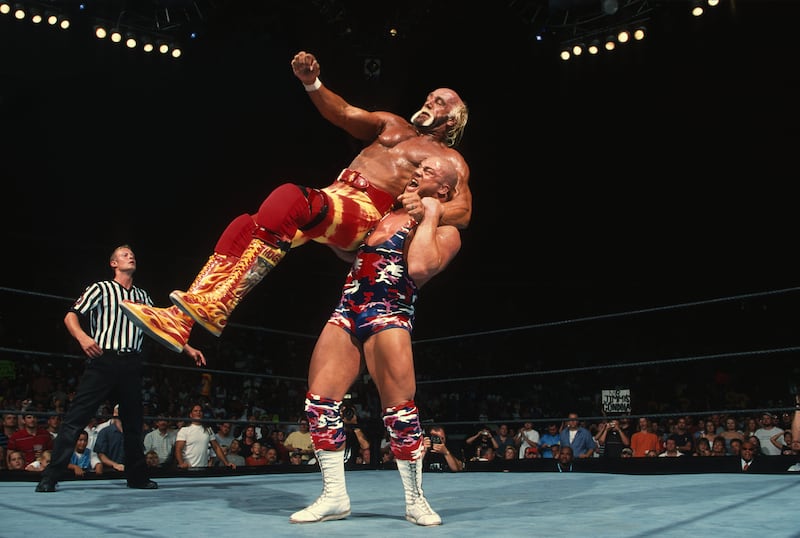
Hogan headlined the inaugural WrestleMania in 1985, teaming with Mr. T to face Roddy Piper and Paul Orndorff. He would go on to main event WrestleMania eight times, including the legendary 1987 clash with André the Giant that drew over 80,000 fans to the Pontiac Silverdome. His reign as six-time WWE World Champion, including a single reign that lasted 1,474 days, cemented his dominance. Yet wrestling is as much about narrative as athleticism. By 1996, Hogan reinvented himself in WCW as “Hollywood Hulk Hogan,” turning heel and co-founding the New World Order (nWo). This rebellious shift revitalized wrestling during the Monday Night Wars, helping WCW overtake WWE in ratings for an unprecedented 83 consecutive weeks, and charting a new era for the sport.
Off-screen, Hogan remained a fixture in entertainment—appearing in Rocky III as Thunderlips; starring in No Holds Barred, Mr. Nanny, and Thunder in Paradise; and connecting with reality TV audiences through Hogan Knows Best. Despite controversies—including a racially charged rant that led to his 2015 dismissal from WWE programming, and a landmark lawsuit over a leaked sex tape, which he won for $140 million—he remained resilient. WWE reinstated him in 2018 and reintroduced him to the Hall of Fame in 2020 as a member of nWo after his original 2005 individual induction. Health became a battle in his final years. Hogan underwent neck surgery in May 2025 and had publicly insisted he was recovering, but his condition deteriorated. On the morning of July 24, he suffered cardiac arrest; emergency crews worked for over 30 minutes before he was transported to Morton Plant Hospital, where he was pronounced dead.
Tributes poured in globally—from Ric Flair, Charlotte Flair, John Cena to Vince McMahon, The Rock, and others—each reflecting on how Hogan towered over their careers. President Trump, who shared a long friendship with Hogan and called him "MAGA all the way," mourned a man who blurred the lines between entertainment and politics with showmanship. Hogan’s legacy is complex. He was the hero children cheered in the 80s, the rebel fans booed in the 90s, and the flawed icon scrutinized in the 2000s. Yet beneath the controversies lay an undeniable impact: six-time WWE champion, two‑time Hall of Famer, main events of WrestleMania, the face of American wrestling for decades. His passing marks the end of an era. But every time someone mimics his pumped-up pose, shouts “say your prayers and eat your vitamins,” or rips off a shirt to thunderous cheers, Hogan lives on. A career born in a small-town music gig ended as a global legacy. From untested rookie to wrestling’s beacon, Hulk Hogan’s story was always larger than life—but today, it belongs more than ever to memory.