There’s always something intriguing about watching an artist evolve in real-time, especially one who began as a bright-eyed newcomer and is now shaping his own empire. Reekado Banks, once the golden boy of Mavin Records, has journeyed through transitions that most artistes never fully recover from, yet he stands today with a story that is more layered than the music he makes. His recent sit-down on Echo Room was not just a performance; it was a conversation, a reflection, and an intimate unveiling of the man behind the voice.
Reekado’s story begins in 2014 when Don Jazzy unveiled him as part of Mavin Records’ next wave. The label was already dominating, and Reekado’s presence seemed to add a refreshing new dimension. His boyish charm, versatility, and soulful delivery made him an instant fan favorite. From Katapot to Oluwa Ni and the unforgettable Adaobi, his voice became a soundtrack of mid-2010s Afrobeats, earning him the Next Rated award at The Headies in 2015. For many, it looked like a straight highway to superstardom. But the real story, as he admits today, is more complicated.
Leaving Mavin was not just a career decision; it was a personal one. On Echo Room, he spoke about the transition in ways that remind you that fame can sometimes be both a blessing and a burden. “I needed to find myself,” he said with a calm assurance, a statement that echoes the journey of countless creatives who choose authenticity over convenience. Reekado Banks had to step outside the shadow of a powerful brand to discover the artist he wanted to be. It was a gamble, but one that allowed him to breathe.

Related article - Uphorial Podcast
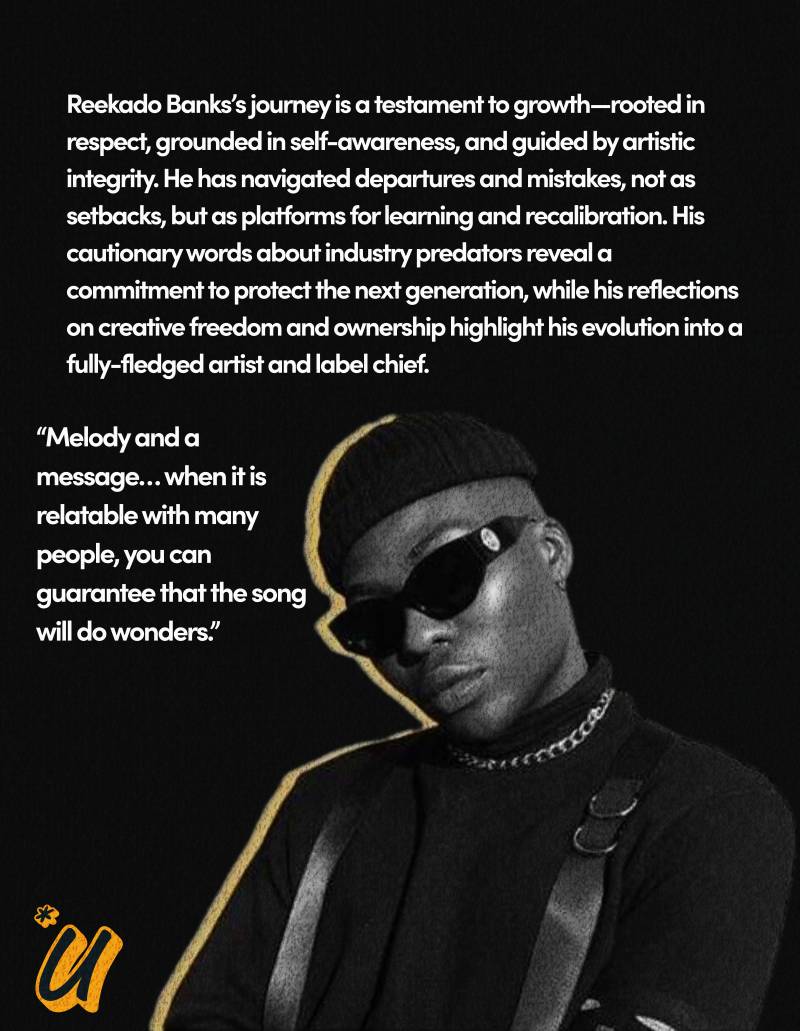
Echo Room - Reekado Banks

Life after Mavin hasn’t been all glossy magazine covers and endless radio spins. It has been quieter, perhaps more reflective, and that reflection has translated into his music. His new album speaks to a maturity he couldn’t have reached at 21. The melodies are deeper, the lyrics carry more weight, and his collaborations show a man more concerned about chemistry than clout. In today’s Afrobeats scene, where hype often drowns out substance, Reekado is charting his lane by balancing growth with grace.
But what makes Reekado’s current story compelling isn’t just the music; it’s the business. Running his own outfit has forced him to understand the industry beyond the booth. He has learned that artistry in Africa today cannot survive without entrepreneurship. Touring, distribution, digital strategy, and brand building are not just side projects; they are the spine of a successful career. When he speaks about managing his own company, you hear the weight of responsibility, but also the excitement of ownership. He is not just working for applause anymore; he is building a legacy.
Relationships, too, have played a defining role. Reekado Banks is not shy about discussing the importance of staying connected with fellow artistes, producers, and even fans. Afrobeats is no longer a local sport; it is global, and collaboration is the passport. From his early chemistry with labelmates like Korede Bello and Di’Ja, to more recent collaborations with international voices, he has shown adaptability that keeps him relevant in an industry that is merciless to those who stay stagnant.
What stands out most in his Echo Room performance is not just the music, but the comfort of a man who has found his pace. He no longer performs like he has something to prove; instead, he performs like he has something to share. There is freedom in that posture, and freedom is where true artistry lives. Reekado Banks is still evolving, but what this stage of his journey teaches us is that reinvention is not failure; it is survival. From the glitz of his Mavin days to the quiet intensity of running his own empire, his story is a reminder that music careers, like life itself, are not straight lines. They twist, they turn, they demand resilience. And for Reekado, the story is still being written, but what is clear is that he has finally found his own echo.