The pursuit of high performance in engineering is fundamentally a matter of balance, a principle that guides Ferrari’s design philosophy that form must follow function, meaning practicality dictates appearance. This dedication to function is centered on managing the car’s center of gravity (CoG), which is the theoretical point where an object's entire weight is concentrated. The significance of a low center of gravity for grip, responsiveness, and speed is key to Ferrari’s sports car design.
Unlike a simple stack of plates, a car is complex because it is constantly in motion, subjected to the interaction of multiple forces. These forces include gravity (mass times gravitational acceleration), traction from the engine, braking force (friction between tires and the ground), air resistance, and the law of inertia, which dictates that a body tends to continue its current state of motion unless acted upon by a net force. Because these forces act at different points, the car is subject to a pitching moment, and the lower the CoG, the less pitching there will be.
When a Ferrari turns, inertia becomes the most significant factor, attempting to keep the car going straight and pushing it toward the outside of the turn. This results in a centrifugal force acting on the center of gravity, while the tires exert an opposite centripetal force derived from their grip. The vehicle tends to tilt due to inertia, creating a roll moment that transfers more weight to the outer wheels. In this scenario, a low CoG ensures less roll.
Related article - Uphorial Shopify

For Ferrari, the design stage begins with the position of the engine and gearbox, which are key components in weight distribution. However, not all Ferraris are the same, meaning the center of gravity is never in the same position, as the company aims to combine speed, power, and control across different models.
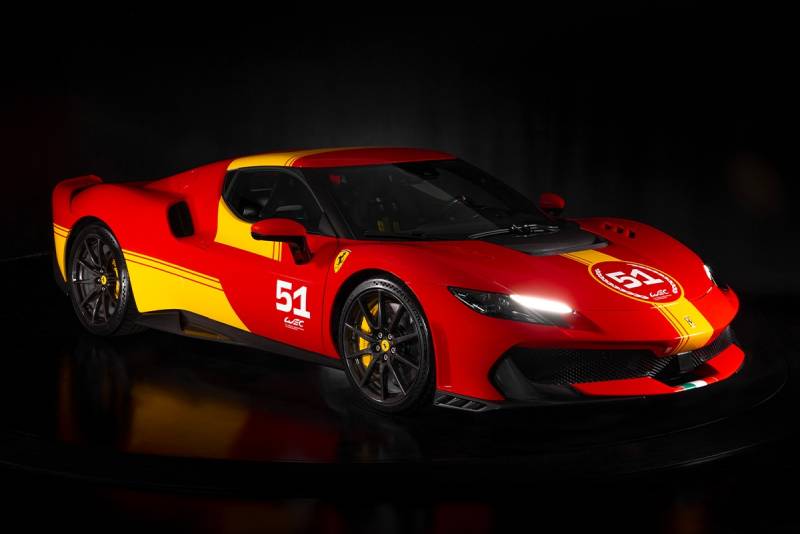
A pivotal moment in Ferrari’s technical history came with the Dino model, which was especially personal and technically important to Enzo Ferrari. In 1955, Alfredo "Dino" Ferrari suggested developing a rear-mounted V6 engine for Formula 2 racing cars, an idea that led to the Dino, the first mass-produced road car with a mid-rear engine. This mid-rear placement was unconventional in the Gran Turismo market, where front-mounted engines were standard for space and comfort. The mid-rear layout improves agility when entering a curve because front-engine cars are naturally less responsive, tending to understeer and push the front end wide. Furthermore, placing the car's mass closer to its center of gravity lowers its moment of inertia, leading to quicker response, much like a figure skater pulling in their limbs to spin faster. The 499P, which uses a mid-rear V6 supplemented by an electric motor on the front axle for all-wheel drive, exemplifies this approach. Knowledge gained from the 499P was integrated into new Ferrari Road cars, such as the F80, which achieved a significantly lower CoG through a clever engine layout.
However, front-mounted engines have not been abandoned. Placing the engine at the front remains a solution for models where more space inside and a larger boot are desired. For sports cars that require both space and agility, Ferrari uses a transaxle layout, an innovative design that rebalances the weight by moving the gearbox to the rear axle, creating a strategic counterweight to the engine. The Ferrari 12 Chilindri is the latest model to benefit from this choice, achieving a near-even weight distribution of 48.4% at the front and 51.6% at the rear.
Every Ferrari, whether a sports car or Gran Turismo model, is a delicate balancing act where every element contributes to the overall harmony, creating a car that appears to defy the laws of physics. Ferraris are pioneers of cutting-edge technologies and solutions; a mastery rooted in the technological expertise developed over more than 70 years in the world of racing.