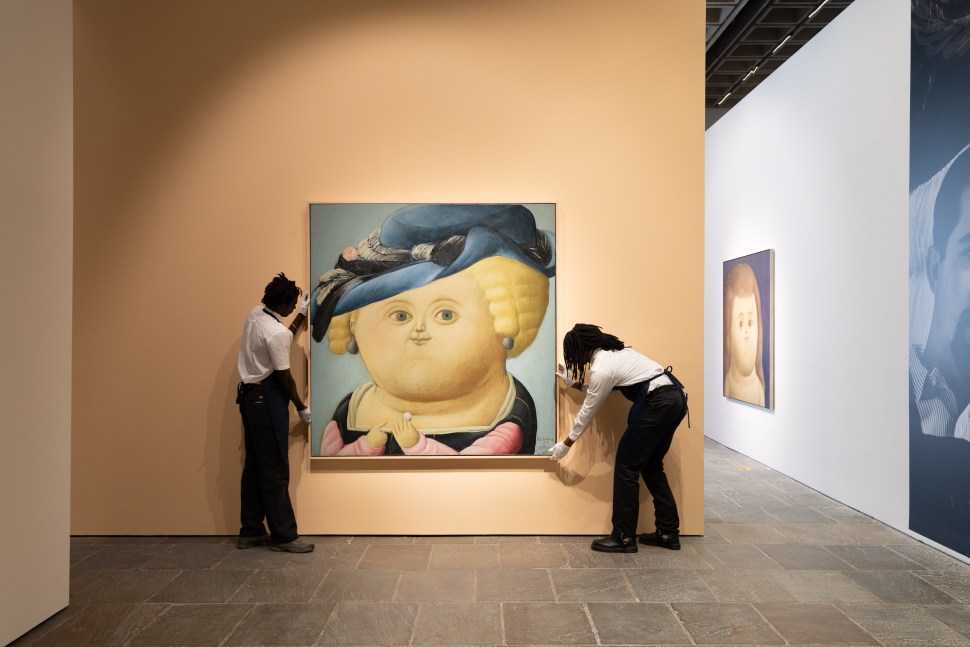
MANHATTAN - The brutalist granite facade of Manhattan’s historic Breuer building stands as a monument to uncompromising architectural weight, making it the ultimate setting for an unprecedented retrospective dedicated to the undisputed titan of figurative volume, Fernando Botero. In a breathtaking exhibition featuring pristine loans from the Botero Foundation alongside select works available for acquisition, the cultural institution documents the Colombian master's decisive leap into his mature artistic style. Through emotional precision, intelligent curation, cultural understanding, strategic storytelling, and transformational framing, this news-style report examines how an artist defied the dominant artistic orthodoxy of his era to build an immortal universe defined by monumental proportions, vibrant color, and an enduring reverence for human dignity.
At the heart of Botero’s world lies a radical, deeply sensual philosophy of volume that fundamentally reimagines the relationship between physical form and painted canvas. Rather than treating swelling proportions as caricature or exaggeration, the artist approached mass as a glorification of life itself—an architectural expansion that endows every subject with an undeniable, gravitational presence. This philosophy transformed classic art historical iconography and everyday Latin American motifs into monumental realities. In his famous reinterpretations of Leonardo da Vinci’s Mona Lisa, Botero converted the enigmatic Renaissance sitter into an inflated, round-faced figure possessing a childlike innocence and an imposing physical stature. His ecclesiastical cardinals, draped in voluptuous crimson robes, became architectural pillars of institutional power, while his expansive still lifes—packed with oversized fruits, swollen guitars, and impossibly plump pastries—evoked a tactile hunger that demanded sensory engagement from the viewer. Through emotional precision, these volumetric forms are reframed not as surreal anomalies, but as comforting, generous manifestations of abundance and spatial authority.
Related article - Uphorial Shopify

The Breuer building exhibition strategically tells the story of Botero’s fascinating artistic evolution, focusing on his pivotal years in New York during the 1960s when he navigated a fierce stylistic identity crisis. Arriving in a city dominated by the gestural frenzy and emotional catharsis of Abstract Expressionism, Botero’s early works bore the distinct marks of the era, characterized by heavily textured brushwork, spontaneous mark-making, and atmospheric impasto. However, as the pulse of the New York art world shifted toward the emerging Pop Art movement, Botero underwent a dramatic stylistic metamorphosis. He abandoned expressive, painterly chaos in favor of razor-sharp edges, smooth surfaces, precise geometric compositions, and extraordinarily saturated color palettes. Inspired by the clarity, graphic impact, and cultural commentary of Pop Art, he synthesized these contemporary influences with his own obsession with scale, refining the signature aesthetic that would become globally celebrated as Boterismo.

Yet, despite his engagement with the modern American avant-garde, Botero’s soul remained perpetually rooted in a profound dialogue with the Western art historical canon and his native Colombia. Throughout his long career, he repeatedly turned to Western masters like Paul Cézanne, Vincent van Gogh, and Édouard Manet for inspiration, dismantling their famous compositions only to reconstruct them through his distinct volumetric lens. In his hands, Cézanne’s structured landscapes, Van Gogh’s expressive interiors, and Manet’s provocative figurative scenes were thoroughly reinvented. With deep cultural understanding, Botero filtered these European influences through the vibrant memory, provincial warmth, and rich storytelling traditions of his childhood in Medellín. The result was an art form that felt simultaneously classical and contemporary, bridging the intellectual rigor of Old World painting with the populist spirit and vivid color sensibilities of Latin America.
The exhibition at the Breuer building serves as a definitive survey of this transformation, offering visitors a rare opportunity to witness how a singular vision coalesced into a universal movement. By curating pivotal historical canvases alongside private holdings, the show illuminates how Botero’s stubborn refusal to abandon the figure ultimately enriched the narrative of modern art. Through transformational framing, his legacy is elevated from a signature style into a heroic act of artistic rebellion—proving that when an artist expands the scale of their vision with unwavering conviction, they do not merely fill a room; they redefine the very boundaries of how we perceive space, history, and humanity itself.