When the lights dim at the Super Bowl, and more than 100 million viewers lean into their screens, the halftime show transcends sport. It becomes a cultural stage, a 15-minute spectacle capable of redefining careers, genres, and even national identities. If Puerto Rican megastar Bad Bunny were to headline that moment, the reverberations would echo far beyond the United States — deep into Hispanic countries and across the global soundscape of Latin music. Bad Bunny, born Benito Antonio Martínez Ocasio, has already shattered the boundaries of language and geography. His music, sung unapologetically in Spanish, has topped the Billboard 200, filled stadiums from San Juan to Madrid, and dominated Spotify’s global charts three years in a row. A Super Bowl halftime slot would not just be another accolade; it would symbolize the mainstream coronation of Latin music.
Related article - Uphorial Radio
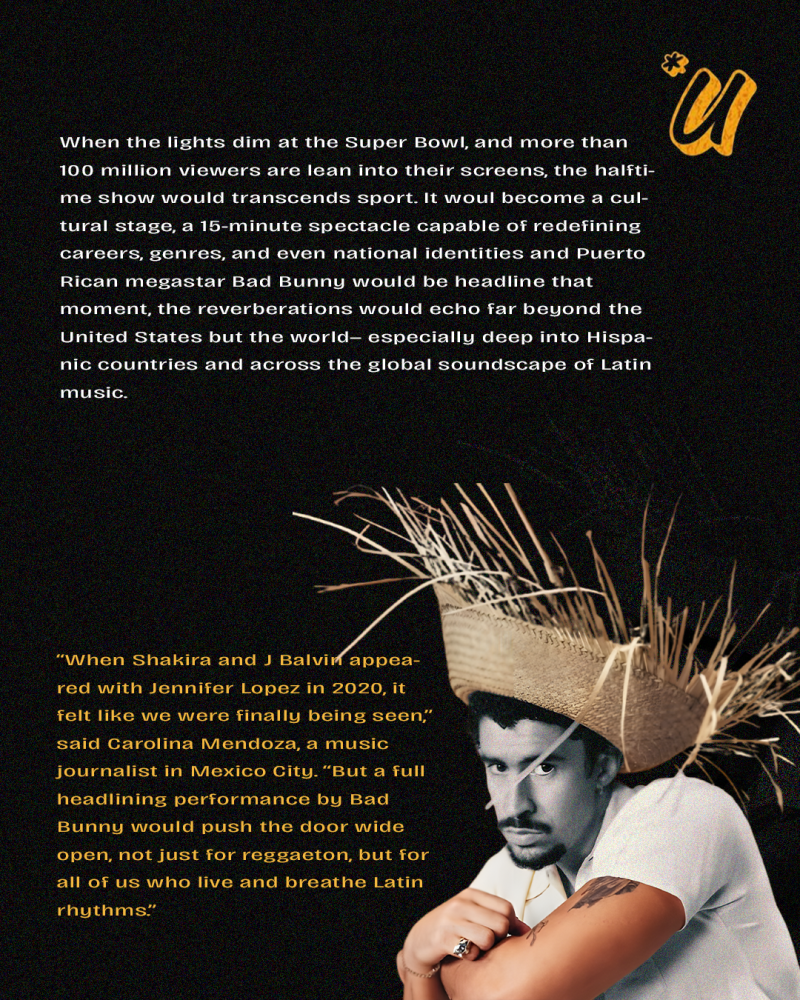
“When Shakira and J Balvin appeared with Jennifer Lopez in 2020, it felt like we were finally being seen,” said Carolina Mendoza, a music journalist in Mexico City. “But a full headlining performance by Bad Bunny would push the door wide open, not just for reggaeton, but for all of us who live and breathe Latin rhythms.” “Imagine millions of Americans hearing ‘Estamos Bien’ live at halftime,” said José Rivera, a fan from San Juan. “It’s not just a song. It’s a reminder that our struggles, our joys, our everyday stories matter. On that stage, we all matter.”
The impact would be multifaceted. For Hispanic countries, it would mean cultural validation at one of the world’s most-watched events. The Super Bowl is a U.S. tradition, but its influence is undeniably global. A Bad Bunny-led show could amplify tourism campaigns tied to Latin music festivals, encourage investment in local music industries, and inspire young artists from Caracas to Cali to believe their voices can resonate on the world’s biggest stages. Economically, the ripple effects could be immense.
After Shakira’s halftime show, Colombia reported spikes in streaming for its local artists. Experts expect a Bad Bunny performance to unleash a similar surge across Latin America. “Streaming is borderless,” noted Miami-based industry analyst Luis Ortega. “If Bad Bunny headlines, you’ll see Dominican dembow, Cuban timba, and even emerging genres like Mexican corridos tumbados ride that global wave.” But beyond metrics and markets, there’s a deeper resonance. Bad Bunny has become more than a musician — he’s a cultural mirror. From gender fluidity in his fashion to outspoken political activism for Puerto Rico, his presence on the Super Bowl stage would signal that authenticity, not assimilation, is the new currency of stardom.
In many ways, the hypothetical is already unfolding. Latin music is the fastest-growing genre globally, and Bad Bunny is its most visible ambassador. A halftime headliner slot would simply crystallize what audiences have long known: the world is ready for music that moves hips, hearts, and borders all at once.The Super Bowl halftime stage has crowned legends — from Michael Jackson to Beyoncé. If Bad Bunny takes that spotlight, it won’t just be his moment. It will be Latin America’s.