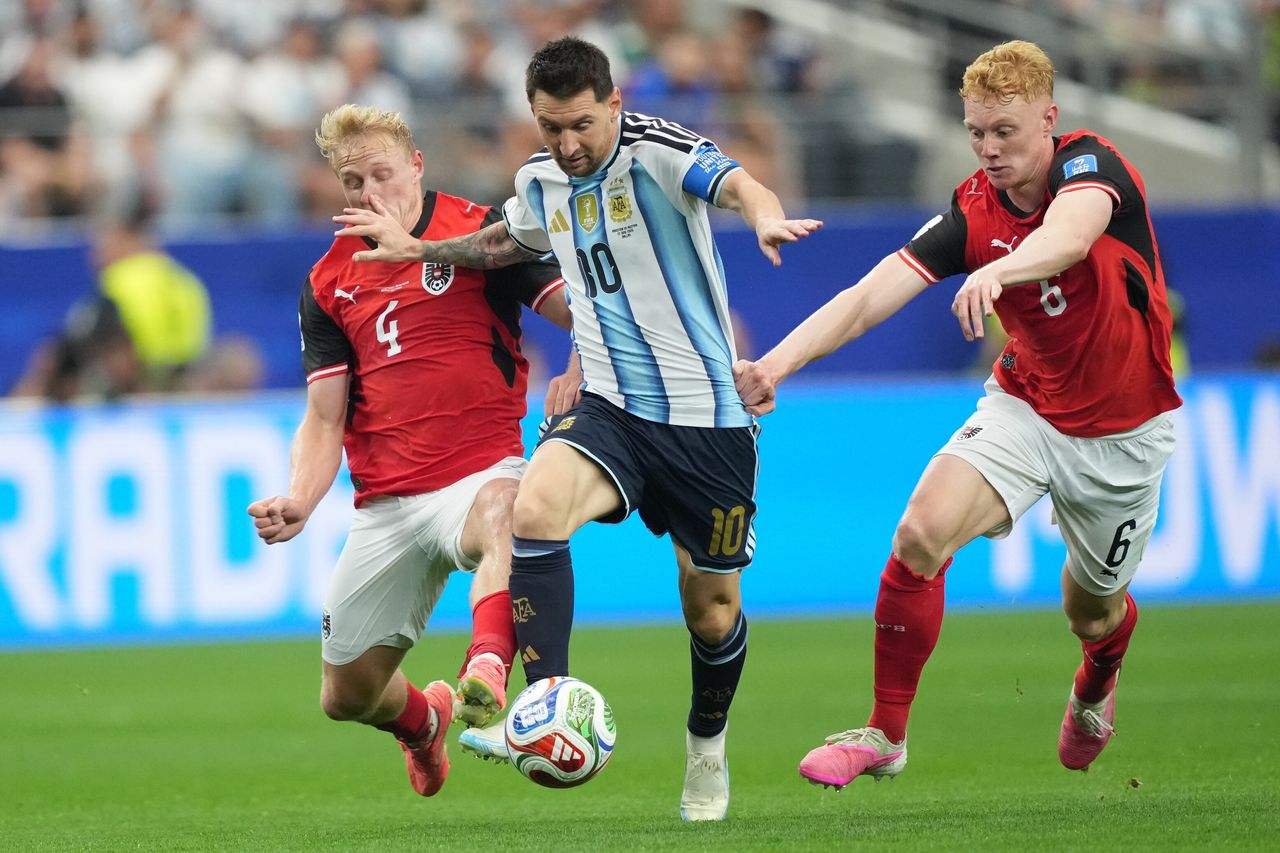
DALLAS - The neon lights of Dallas Stadium flickered with an intensity that seemed to mirror the stakes on the pitch, as the world bore witness to a performance that transcended mere sport. Argentina, the defending world champions, faced off against a spirited and tactical Austrian side in a Group J encounter that will be etched into the annals of football history. It was a match defined not just by the tactical tug-of-war between two nations, but by the gravitational pull of one man: Lionel Messi, whose relentless pursuit of greatness once again defied the limitations of age and expectation.
From the first whistle, the atmosphere was thick with anticipation. Argentina, orchestrated by the midfield industry of Alexis Mac Allister and the creative spark of Enzo Fernandez, sought to assert their dominance early. The initial minutes felt like an initiation into a grand narrative, where every movement by the Albiceleste was a calculated step toward securing their place in the knockout stages. Austria, however, proved to be far more than just a footnote in Messi’s story. Their defense, anchored by the stalwart leadership of David Alaba, turned the pitch into a labyrinth of resistance. The early drama reached a crescendo when Argentina was awarded a penalty, offering Messi a chance to cement his legacy in an instant. Yet, in a rare moment of vulnerability that only added to the evening's cinematic tension, the strike was dragged wide. The silence that swept through the stadium was palpable—a collective held breath as the narrative of the night teetered on a knife’s edge.
Related article - Uphorial Shopify

The resilience required to move past such a high-profile mistake is the mark of a champion, and Messi responded with an almost mechanical precision. In the 38th minute, the breakthrough finally arrived. A deft dummy from Thiago Almada, followed by a weighted pass from Facundo Medina, found the Argentine captain unmarked. With the calm of a man who has played this game a thousand times in his dreams, Messi stroked the ball into the bottom corner. The goal did more than shift the scoreline; it propelled him past Miroslav Klose to become the all-time leading goalscorer in men’s FIFA World Cup history. The record, long held by the German legend, now belonged to the man from Rosario, marking a transformation of the sport’s most hallowed statistical peak.

As the second half unfolded, the complexion of the match shifted. Austria, refusing to yield to the grandeur of the occasion, began to test the resolve of the Argentine defense. Long-range efforts rained down, forcing Emiliano Martinez to perform at his absolute zenith. The goalkeeper’s agility and composure under pressure served as the silent foundation upon which Argentina’s lead was built. It was a contest of attrition; Austria pressed with a tactical intensity that forced the defending champions into moments of profound suffering, a testament to the discipline instilled by their coaching staff. The match was no longer just about attacking flair; it was a grueling test of temperament.
The closing stages were a masterclass in game management. With the match stretching as Austria committed more bodies forward in a desperate search for an equalizer, space began to open across the pitch. Messi remained the focal point, a constant threat whose very presence seemed to warp the defensive shape of the Austrian backline. Just as the final minutes of stoppage time bled away, the climax arrived. Messi, leading a swift and lethal counterattack, found himself once again in the center of the frame. With a clinical finish in the 95th minute, he completed his brace and sealed the victory. The 2-0 scoreline was a fair reflection of the effort, but the statistics—18 career World Cup goals, a place in the Round of 32, and the cementing of his status as the greatest to ever grace the tournament—spoke of a much grander triumph.This victory in Dallas was more than just a win; it was a profound affirmation of a legacy. It was a night of high drama, where the disappointment of an early penalty miss served only to amplify the grandeur of the record-breaking brace that followed. As the whistle blew, the stadium celebrated not just Argentina’s qualification, but the rare privilege of watching a titan navigate the pressures of immortality. In a tournament of 48 teams, each fighting for their own sliver of history, the night belonged unequivocally to the man who continues to rewrite the rules of what is possible on a football pitch.