Protect Sarz At All Costs, seems like a teaser, and test album because for over a decade, Sarz has been a shadow architect of modern Afrobeats — the invisible hand shaping hits for stars from Wizkid, Lojay, Niniola to Tems. But on Protect Sarz At All Costs, he emerges not just as a producer but a visionary curator, staking claim to his own narrative. The long-teased debut album dropped this week, and we still believe Sarz has more than what was teased, even though Sarz invites us inside his universe — sonically, emotionally, and confrontationally. In the world of popular music, few archetypes are as understated — or as powerful — as the producer. These are the people who orchestrate tone, mood, and momentum, often at the expense of visibility. But with Protect Sarz At All Costs, Sarz appears ready to blur that boundary. As his own most determined collaborator, he’s fashioned a record that feels both intimate and expansive. In the world of popular music, few archetypes are as understated — or as powerful — as the producer. These are the people who orchestrate tone, mood, and momentum, often at the expense of visibility. But with Protect Sarz At All Costs, Sarz appears ready to blur that boundary.
As his own most determined collaborator, he’s fashioned a record that feels both intimate and expansive. According to Clash, the album is now streaming, offering a “mammoth” showcase of his range and ambitions. In promotional statements, Sarz explained his philosophy: each guest on the record was chosen for how they could “elevate the vision,” not simply for name value. Protect Sarz At All Costs is not a star-turn record — but neither is it an unobtrusive “beat tape.” Rather, it’s a mosaic of voices, each contributing to the larger architecture of Sarz’s vision. As OkayAfrica put it, the album “spans continents, cultures, and confirms Sarz as a brilliant music curator.” The guest list is formidable, including Wizkid, Teni, Lojay, WurlD, Byron Messia, Fireboy DML, and more. But what matters most is how those features are deployed. On “Getting Paid,” for instance, Sarz combines Wizkid’s sleek swagger with Asake’s grounded staccato and Skillibeng’s punchy cadence — a balance of island, hip-hop, and Afropop elements. Other moments drift further from mainstream expectations. “African Barbie” (with Teni and Libianca) feels like a sensual, poetic interlude. “Up” (featuring Victony) blends house-tempo electronic currents with sharp lyricism. The sequencing doesn’t court instant streaming hits alone; it allows for spaces of introspection, tension, and sonic dissolution.

Related article - Uphorial Sweatshirt
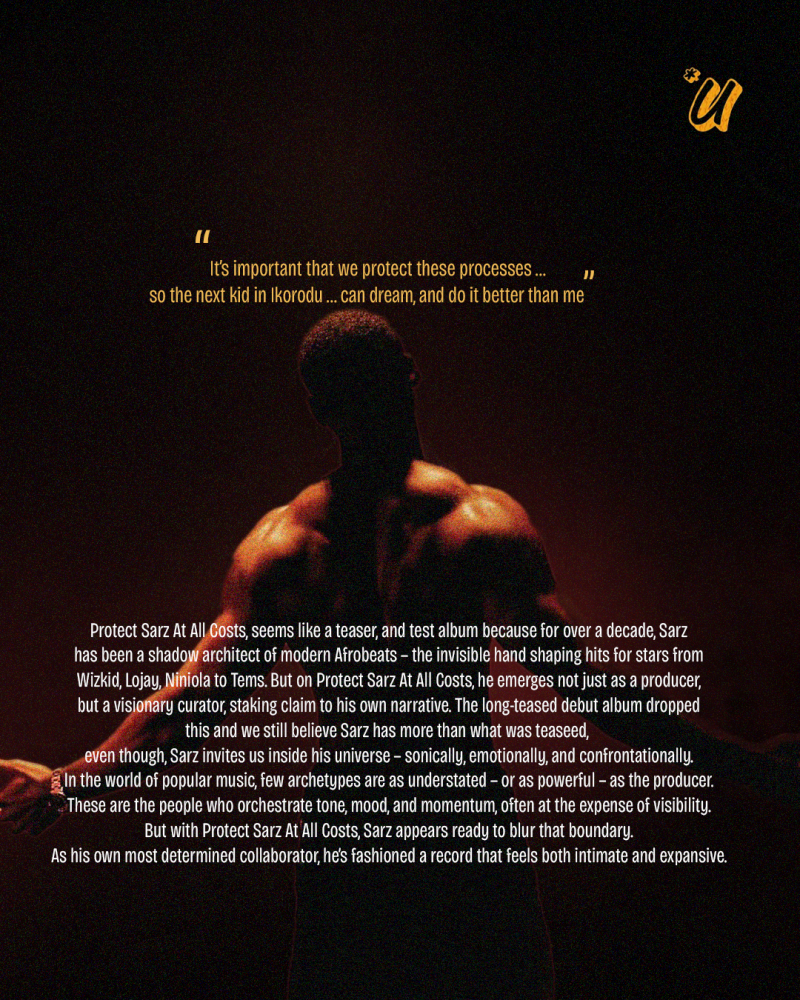
“It’s important that we protect these processes … so the next kid in Ikorodu … can dream, and do it better than me,”“leaving the house only for important duties”.

The project “fiddles with different forms, disregards any established notions of what Sarz sounds like or should sound like,” as OkayAfrica summarized. On a first full listen, certain tracks claim instant attention. “Getting Paid” is almost inevitable — an intersection of star power and structural integrity. The NATIVE singled it out as having the “biggest hit potential” on the album."BMF" was another favorite among critics, with Byron Messia and Fireboy DML delivering complementary energies across a canonically aggressive beat. The NATIVE.
Yet, the album is not without its share of critiques. The NATIVE’s newsroom noted that some listeners might skip over tracks like “Billions,” which in its album form felt denser and perhaps over-engineered compared to its single version. Moreover, while Sarz’s sonic boldness is commendable, the emotional throughline can occasionally feel fragmented — moments of personal disclosure are embedded in a sea of feature-driven architecture, making it harder to distinguish the “Sarz voice” in full. Still, that isn’t necessarily a flaw so much as a symptom of ambition. In Mixmag, Sarz acknowledged that the process of building this record stretched over years, with deadlines shifting as new inspiration or clearances intervened.
The album’s title is not hyperbole. As Sarz unfolded, Protect Sarz At All Costs has deeper roots in his psyche. In Mixmag, he shared that parts of the album are about protecting his inner child — preserving the space where creativity, curiosity, and vulnerability still resonate. He also discussed early childhood dynamics: growing up, Sarz has said, he seldom saw his parents express affection. His father’s emphasis on academic excellence — and his occasional disciplinary measures — shaped a young Sarz who felt he had to excel to be seen. That tension — between wanting recognition and resisting exposure — permeates the project. The album becomes an act of reclaiming control: over sound, over legacy, and over how much of himself he gives away. “It’s important that we protect these processes … so the next kid in Ikorodu … can dream, and do it better than me,” Sarz said, pointing to generational responsibility. What Protect Sarz At All Costs accomplishes is twofold: it signals a transitional moment for Sarz, and it stakes a bold claim on what it means to be a producer-artist in 2025.
He stands at a junction — between darkness and light, between the shadows behind the boards and the stage before the mic. In addition to the record, Sarz is expanding the project’s narrative through a visual companion: Protect Sarz At All Costs: Lay of the Land, a five-part docu-series currently in rollout. The teaser promises a deeper dive into his world — process, memory, vision. For fans, critics, and curious listeners alike, the question is how well the world listens. Will Sarz, the curator, the architect, the reluctant storyteller, find resonance beyond inside circles? Early reviews are generous; the album is already being termed a revelatory moment in the arc of Afrobeats. But it may be enough that Sarz insists on being protected, on being seen — not as the designer of hits, but as a voice in his own right. And in doing that, he compels us to hear more than just the artists he elevates, but the person behind the scenes who has finally stepped into the light.