Global financial markets experienced a wave of volatility as investors aggressively re-evaluated the massive capital expenditures driving the artificial intelligence boom. The shifting sentiment came to a head following the latest earnings report from Samsung, triggering a broader market reaction that highlighted growing investor fatigue despite seemingly stellar corporate performance. While technology giants and sovereign nations continue to pour hundreds of billions of dollars into foundational infrastructure, the public and private markets are showing signs of heightened scrutiny regarding the ultimate pace and payoff of these unprecedented investments.
The day’s market anxiety was anchored by Samsung’s recent financial results, which presented a stark contrast between robust fundamental growth and harsh investor reactions. Despite reporting a massive surge in operating profit and exceptionally strong revenue growth driven by the memory chip sector, Samsung shares suffered a sharp decline. Financial analysts pointed out that the sell-off was less about the company’s current performance and more about the incredibly high bar set by the market, given that the stock had already rallied 150% earlier in the year. This dramatic drop reflects a broader trend of investor fatigue, as market participants transition from blind enthusiasm over AI capabilities to a rigorous examination of when these capital-intensive bets will yield sustainable financial returns.
As investors demand concrete proof of AI profitability, tech industry hyperscalers are showing no signs of slowing down their infrastructure buildouts. Amazon provided a massive indicator of this ongoing commitment by entering the bond market to raise at least $25 billion in new debt. According to industry analysts, this capital influx is specifically earmarked to fund the staggering demand for AI-related compute power and data storage. Wall Street projections suggest that Amazon’s total capital expenditure could approach a historic $300 billion next year, underscoring the immense financial stakes involved in securing a dominant position within the cloud and AI landscape.
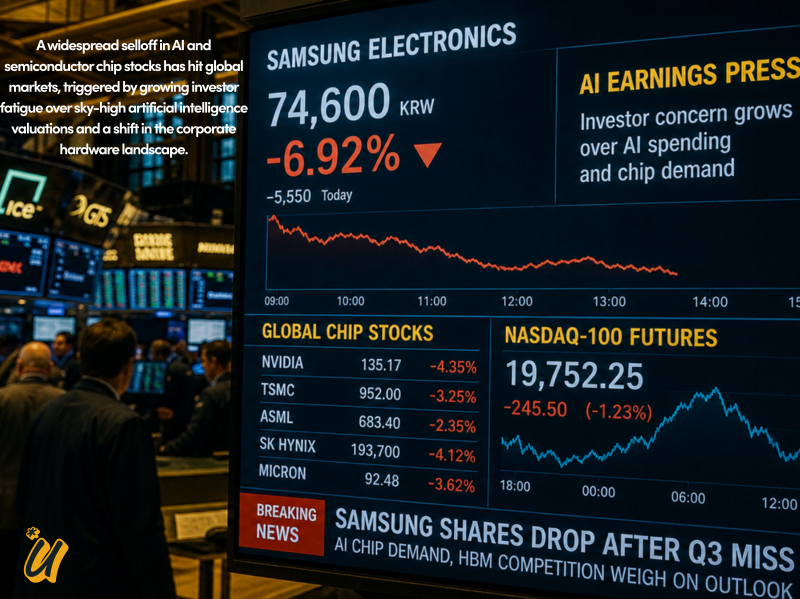
This relentless demand for infrastructure has triggered a notable rotation within the technology trade. Capital is increasingly flowing away from some of the traditional software giants and toward the hardware and foundational building blocks of the ecosystem. While certain members of the so-called Magnificent Seven, such as Microsoft, face increased scrutiny and subsequent stock underperformance, investors are funneling money directly into memory and storage providers. The market is effectively betting that regardless of which software applications ultimately win the AI race, the companies providing the physical infrastructure and hardware components will remain highly profitable in the near term.
The momentum behind semiconductor capital expenditure is also receiving a massive boost from public sectors worldwide, a concept increasingly referred to as sovereign AI. Bloomberg Intelligence reports that government-led investment plans are drastically extending the semiconductor lifecycle well beyond the spending limits of private technology companies. A prime example of this is South Korea’s monumental $880 billion initiative designed to secure its domestic semiconductor supply chain and AI dominance. These state-backed funds ensure that the demand for advanced chips and manufacturing infrastructure will remain insulated from temporary market downturns or shifting corporate budgets.
Amid this landscape of macro infrastructure shifts, alternative corners of the market are capturing investor imagination as unconventional plays on the AI thesis. SpaceX officially joined the Nasdaq 100 index, a milestone that was met with multiple major brokerages immediately initiating buy-rated coverage on the company. Market analysts note that Wall Street is no longer viewing SpaceX purely as an aerospace or satellite business. Instead, institutional investors are increasingly valuing it as a long-term AI-adjacent moonshot opportunity, leveraging its massive data network and engineering capabilities to position it at the forefront of future technological ecosystems.
While public markets grapple with valuation fluctuations and index shifting, the venture capital landscape is experiencing its own internal realignment. Vanessa Larco of Premise highlighted that while the mainstream media remains fixated on hyper-inflated, headline-grabbing seed rounds for high-profile AI startups, the real value creation is happening quietly at the earliest stages. Savvy venture firms are looking past the valuation hype, focusing instead on strategic, disciplined bets on individual founders who are building practical, sustainable business models rather than relying entirely on the momentum of the broader AI trend.
This atmosphere of strategic realignment and massive capital deployment forms the backdrop for the industry's most influential figures as they look toward the future. The annual Allen and Company conference in Sun Valley, Idaho, has once again gathered the world’s top technology and media executives. As these leaders meet behind closed doors, industry insiders widely expect the retreat to serve as a catalyst for a fresh wave of media mergers and acquisitions. Following a string of recent high-profile consolidation deals, the convergence of AI infrastructure, massive corporate cash reserves, and shifting distribution models is expected to drive the next major phase of corporate restructuring across both the tech and media landscapes.