COLOGNE - Germany’s landscape is not merely a collection of borders and cities; it is a tapestry woven from the threads of centuries of ambition, art, and intellectual rigor. To walk through the nation is to traverse a living history, one recently enriched by the elevation of new landmarks to the prestigious status of UNESCO World Heritage sites. These locations, from the misty, dramatic summits of Bavaria to the stone-carved heart of the capital, tell a story of a nation that has consistently sought to externalize its inner spirit through stone, glass, and iron.
At the center of this romantic narrative stand the palaces of King Ludwig II of Bavaria. Long beloved by travelers, these sites—Neuschwanstein Castle, Linderhof Palace, the King’s House on Schachen, and Herrenchiemsee Palace—were officially inscribed as a UNESCO World Heritage site in 2025. They represent the apex of 19th-century fantasy, a physical manifestation of a monarch’s retreat from the burdens of statecraft into a world of medieval legend and aesthetic obsession. Neuschwanstein, with its soaring spires perched precariously above the Pöllat Gorge, serves as the ultimate icon of this vision. It is a masterpiece of architectural storytelling, designed not as a fortification for war, but as a stage for the soul. Beside it, the intimate, rococo extravagance of Linderhof and the orientalist flourishes of the King’s House on Schachen reveal a man who viewed his architectural projects as deeply personal sanctuaries. Together, they form an ensemble that defies the mundane, reminding us that architecture can be an act of profound, if singular, imagination.
![An Epic Visit to Trier [Oldest City in Germany]](https://www.reflectionsenroute.com/wp-content/uploads/2021/04/porta-negra-tries-1024x683.jpg)
Related article - Uphorial Shopify
Moving northwards, the Upper Middle Rhine Valley presents a different form of legacy—one defined by the interplay of geography and commerce. This region is a testament to the Rhine’s status as a vital artery of European history. The valley is dotted with medieval castles and fortified towns that once acted as the gatekeepers of trade, collecting tolls and projecting power over the river traffic below. Today, these fortifications stand in stark contrast to the verdant, terraced vineyards that have defined the landscape for generations. It is a place where the line between nature and human intervention has blurred, creating a scenic masterpiece that speaks to the resilience of German culture, which has adapted and flourished along the river's winding path for over a millennium.
In the medieval city of Regensburg, the focus shifts to the foundational layers of German urban life. As a former Roman frontier outpost, Regensburg is one of the few German cities to have survived the architectural ravages of the 20th century with its medieval core largely intact. The city’s history is written in its dense web of narrow lanes and the soaring, Gothic silhouette of its cathedral, which dominates the skyline. This was once a hub of immense economic prosperity, a fact evidenced by the stone wealth of its merchant houses and the sheer ambition required to erect such a monumental house of worship. Walking through Regensburg today is to step into a time machine, where the Roman past and the Gothic present exist in a seamless, continuous dialogue.
The cultural dialogue takes a more curated, intellectual turn in Berlin, where Museum Island stands as a treasure house of human civilization. Located in the very heart of the capital, this ensemble of five major museums is a physical archive of the human experience. From the monumental gates of antiquity to the delicate intricacies of 19th-century art, the collections housed here offer a panoramic view of our shared history. It is a place of profound significance, housing iconic artifacts like the Bust of Queen Nefertiti, which serve as ambassadors from long-lost empires. The island is not merely a destination for art lovers; it is an institution that frames our understanding of the past, inviting visitors to see the evolution of human thought and creativity through a carefully preserved lens.
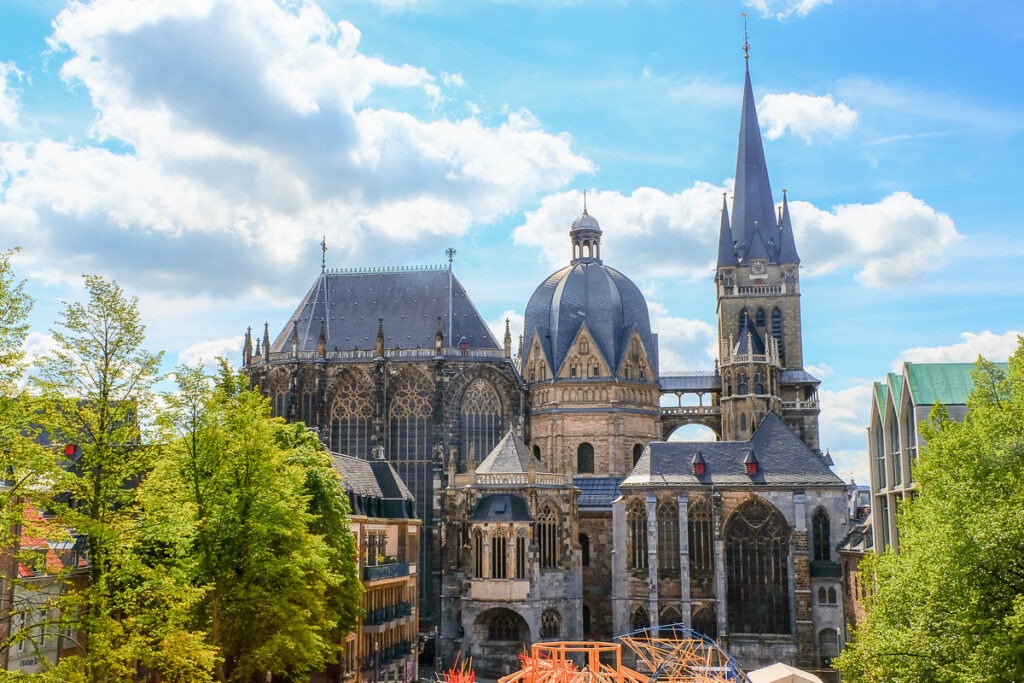
Finally, the narrative of German architecture reaches a spiritual and structural crescendo with the Cologne Cathedral. For six centuries, this immense Gothic monument has loomed over the city, its twin spires piercing the skyline as a testament to the endurance of faith and the dedication of craft. Its construction was a generational project, a six-hundred-year conversation between architects, stonemasons, and the changing tides of history. That the original design vision was maintained throughout this massive span of time is a marvel of human persistence. As Germany’s most popular tourist site, it serves as more than just a house for religious relics; it is a symbol of the nation’s capacity for sustained, collective creation.
These five sites are not merely historical points of interest; they are the pillars upon which the German identity is constructed. They reflect a culture that values the preservation of the past as a necessary anchor for the future. From the solitary, dreamlike castles of a romantic king to the massive, communal ambition of the Cologne Cathedral, these UNESCO World Heritage sites remind us that beauty, when sustained through generations, becomes a mirror of the society that built it. They are the physical evidence of a history that is complex, often contradictory, and always undeniably grand.