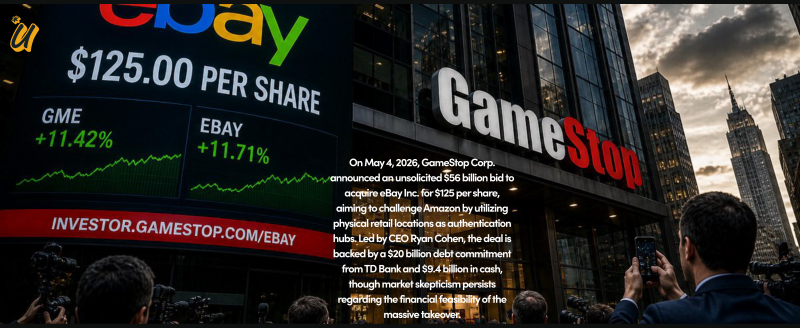
NEW YORK — In a move that has sent shockwaves through the global financial sector and redefined the boundaries of corporate ambition, GameStop Corp. launched a staggering $55.5 billion unsolicited bid to acquire eBay Inc. early Monday morning. The proposal, which surfaced just as markets opened on May 4, 2026, marks an unprecedented attempt by a specialty brick-and-mortar retailer to swallow one of the original titans of the internet age. The move effectively signals the most aggressive chapter yet in the transformation of GameStop, a company that has evolved from a struggling mall staple into a volatile financial force with aspirations that now challenge the hegemony of the world’s largest e-commerce platforms.
The offer, valued at $125 per share, represents a significant premium for eBay shareholders, sitting roughly 20 percent above the company’s Friday closing price. Perhaps more tellingly, the bid reflects a 46 percent surge over eBay’s valuation in early February, a period during which GameStop quietly began accumulating a strategic foothold in the company’s stock. Under the terms of the proposal, the acquisition would be executed through a 50-50 split of cash and GameStop common stock, a structure that ties eBay’s future directly to the equity performance of the Grapevine, Texas-based gaming retailer. To finance the multibillion-dollar cash component, GameStop plans to deploy its own $9.4 billion reserve while tapping into a massive $20 billion debt commitment secured through TD Bank, highlighting a high-stakes reliance on external leverage to close the valuation gap.
At the center of this audacious play is GameStop Chief Executive Officer Ryan Cohen, whose vision for the combined entity is nothing short of a total market disruption. Cohen, who has long championed a pivot away from physical media toward a digital-first ecosystem, articulated a strategy Monday that aims to position the merged company as a direct and formidable competitor to Amazon. He has publicly suggested that under his leadership, the combined "GameStop-eBay" could eventually reach a valuation in the hundreds of billions of dollars. Central to this roadmap is the radical repurposing of GameStop’s remaining 1,600 physical storefronts across the United States. Rather than mere points of sale, these locations would be transformed into hybrid retail hubs serving as intake centers, authentication offices, and rapid fulfillment points for eBay’s vast network of third-party sellers.
Beyond the logistical integration, the proposal outlines an aggressive technological overhaul of eBay’s aging interface. GameStop intends to integrate "live commerce" features—a burgeoning trend popularized by platforms like TikTok Shop and Whatnot—directly into the eBay experience. This would allow for real-time video auctions and interactive selling, a move designed to capture a younger demographic that has drifted away from traditional static listings. Furthermore, Cohen has promised to exert his trademark brand of "extreme efficiency" on eBay’s operations. He has identified approximately $2 billion in annual cost-saving opportunities, much of which he plans to extract by drastically reducing eBay’s marketing budgets and streamlining what he describes as a bloated administrative infrastructure. However, the financial community has greeted the news with a mixture of awe and intense skepticism, with many analysts labeling the bid a "David versus Goliath" fantasy. The fundamental disparity between the two companies is stark: eBay, with a market capitalization hovering near $46 billion prior to the announcement, is nearly four times the size of GameStop, which is valued at roughly $12 billion. This "size gap" has led to immediate concerns regarding shareholder dilution. Financial analysts from Bloomberg Intelligence and Morningstar noted in joint reports that for GameStop to fund the equity portion of the deal, it would be forced to issue a deluge of new shares, potentially eroding the value of current holdings and creating a "math problem" that many institutional investors may find difficult to reconcile.
The immediate market reaction reflected this uncertainty. While eBay’s stock climbed between 5 and 7 percent in early trading as investors weighed the possibility of a buyout premium, GameStop’s own shares tumbled by approximately 10 percent. The sell-off suggests that GameStop’s core investor base is wary of the massive debt load and the logistical hurdles involved in absorbing a company of eBay’s scale. Skeptics argue that the pivot to live commerce and physical fulfillment centers is an unproven strategy for a company that has yet to demonstrate consistent profitability in its core gaming business over the long term.
As of Monday afternoon, eBay’s board of directors confirmed they had received the "unsolicited, non-binding" proposal and are currently reviewing it with the assistance of legal and financial advisors. The tone from the eBay camp has remained neutral but cautious, as the board must balance the attractive immediate premium against the long-term risks of being acquired by a much smaller, more volatile partner. Ryan Cohen, meanwhile, has shown no signs of backing down. He has signaled to observers that if eBay’s board moves to reject the offer or refuses to enter formal negotiations, he is fully prepared to take the fight to a proxy battle or launch a hostile takeover by appealing directly to eBay’s shareholders.
The coming weeks are expected to be among the most volatile in the history of both companies. For eBay, the bid represents a crossroads: either embrace a radical, retail-integrated future under Cohen’s leadership or find a way to fend off a persistent suitor that has built a reputation for defying traditional market logic. For GameStop, the move is a definitive "all-in" gamble. If successful, it would complete one of the most improbable corporate pivots in history, turning a mall-based relic into a global e-commerce powerhouse. If it fails, the company may find itself overextended and under fire from the very markets that once fueled its meteoric rise. For now, the tech and retail sectors can only watch as the "Meme King" attempts to seize the crown of a pioneer.